
 E-Paper



AQI tops 400-mark, Delhi sees 1st ‘severe’ air day of the season
Experts blamed calm winds and dipping temperatures for trapping pollutants close to the surface, causing Delhi’s worst air of the season.

 Prefer HTon Google


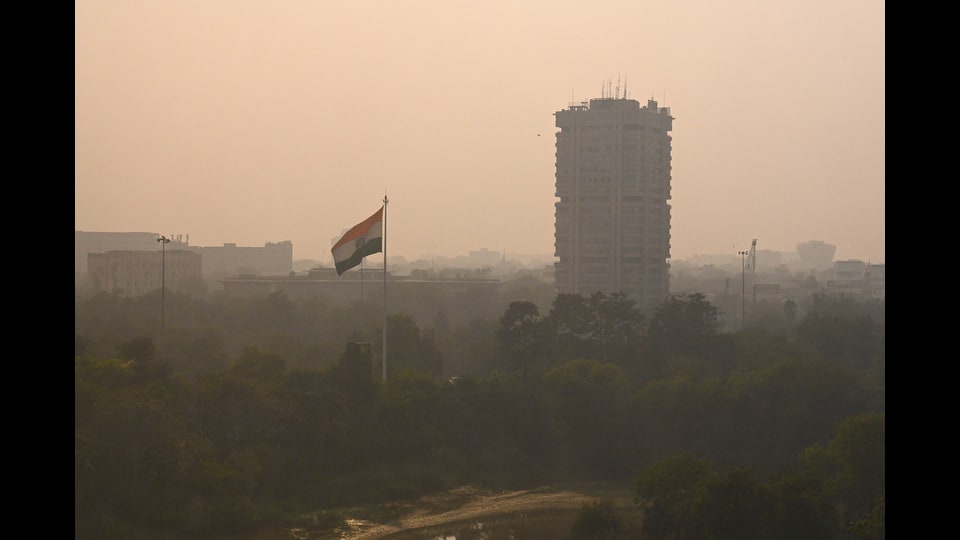
Residents woke up to another day of burning eyes and respiratory difficulties as the air quality index (AQI) in the national capital, which has been shrouded in a haze of toxic pollutants for days now, officially crossed the 400-mark, dipping into the ‘severe’ category for the first time this season.
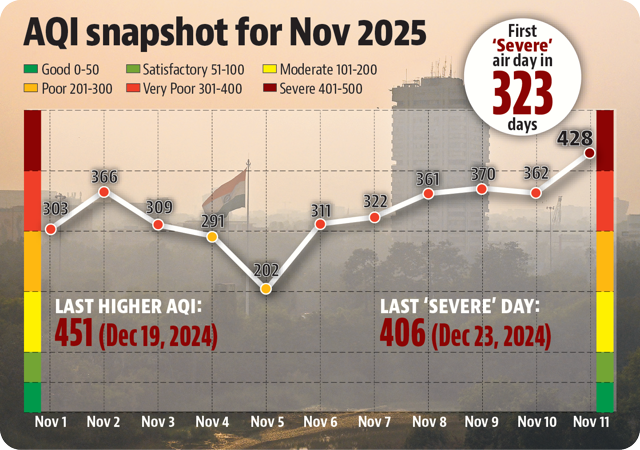
Delhi’s 24-hour rolling average AQI stood at 428 at 4 pm, when the Central Pollution Control Board (CPCB) releases its daily national bulletin — the highest AQI since December 19 last year, when it was 451. This prompted the Commission for Air Quality Management (CAQM) to invoke measures under the next stage of the Graded Response Action Plan (GRAP) in NCR and adjoining areas, with immediate effect.
Experts attributed Tuesday’s spell of extremely polluted air to dipping temperatures and a drop in wind speed. This together leads to inversion, where a layer of warm air sits on top of cooler air, trapping it. The warm layer tends to lock in the pollutants close to the surface, creating a visible haze as they are not able to disperse.
According to forecasts for Delhi by the Centre’s Air Quality Early Warning System (EWS) , a marginal winds pick up in wind speeds on Wednesday could lead the AQI to go back into ‘very poor’.
“Winds started to drop on Monday and were almost calm through the night. We also have dipping temperatures, which led to significant accumulation of pollutants,” said Mahesh Palawat, vice president at Skymet, adding that the winds only picked up post noon on Tuesday, touching up to 12 km/hr.
“As per forecasts, we can expect winds to stay consistent on Wednesday, so there are chances of marginal improvement,” he added.
The Air Quality EWS further said the AQI will stay in the ‘very poor’ category till Friday. “The outlook for the subsequent six days from Friday shows the air quality is likely to be in the ‘very poor’ category,” it said.
On Monday, Delhi’s average AQI was in the ‘very poor’ category for the fifth day, recorded at 362 at 4 pm. The sharp deterioration on Tuesday comes a day after air quality data was unavailable for around 10 hours — between noon and 10 pm — due to, what officials said was, a server issue. The day’s national bulletin, typically released around 4 pm, was eventually released after 11 pm on Monday.
Till noon on Monday, among the most polluted days this season, the AQI stayed at 345 at noon with no updates from the CPCB till 10 pm, when the AQI read at 391. By midnight, it was 398, crossing 400 at 1 am on Tuesday.
At 9 am, when GRAP stage-3 was invoked, CPCB showed that 33 out of the city’s 39 active ambient air quality monitoring stations were in ‘severe’, with Bawana (463) the worst impacted, followed by Wazirpur (460).
The city’s 24-hour running average for particulate matter (PM)2.5 showed concentrations fluctuating between 302 µg/m³ at 8am and 315 µg/m³ at 3pm, while hourly averages stayed well above 400 µg/m³ through much of the day before dipping from 249 µg/m³ at 1pm to 135 µg/m³ by 5pm. The safe standard for PM is 60µg/m³.
Among the worst-affected areas were Alipur, Bawana, Burari, Chandni Chowk, ITO, and Jahangirpuri, where hourly PM2.5 levels touched 600 µg/m³ in the morning hours.
The toxic haze also affected visibility, with the lowest visibility at Safdarjung recorded at 600m (6:30 am), while it was 700 metres at Palam – at around 8am.
While it improved soon after sunshine came out, it remained below 2,000 metres. The IMD has forecast a shallow fog in the early hours, with winds of up to 20 km/hr on Wednesday.
Sunil Dahiya, founder and lead analyst at EnviroCatalysts, said, “High emissions from local sources, combined with regional contributions from power plants, industries, and stubble burning – under the current meteorological conditions – have created this health emergency,” calling for coordination between agencies for emergency-based action under GRAP.
Meanwhile, Delhi’s minimum temperature stood at 10.2°C, a season low and four degrees below normal. It was 10.4°C a day earlier. The minimum is forecast to hover between 10-12°C on Wednesday. The maximum was meanwhile recorded at 27.7°C, two degrees below normal. It is forecast to be between 26-28°C on Wednesday.


Stay updated with all top Cities including, Bengaluru, Delhi, Mumbai and more across India. Stay informed on the latest happenings in World News along with Delhi Election 2025 and Delhi Election Result 2025 Live, New Delhi Election Result Live, Kalkaji Election Result Live at Hindustan Times.


