E-Paper



As Delhi swelters, city’s power demand hits record 8,000MW
The previous high, recorded on Tuesday, was 7,717MW, preceded by a demand of 7,695MW in June 2022.

 Prefer HTon Google


Rising mercury levels in the Capital continued to exacerbate the need for cooling devices, leading to a record power demand of 8,000MW on Wednesday, breaking the all-time demand record for the second consecutive day, according to data from the State Load Despatch Centre (SLDC).

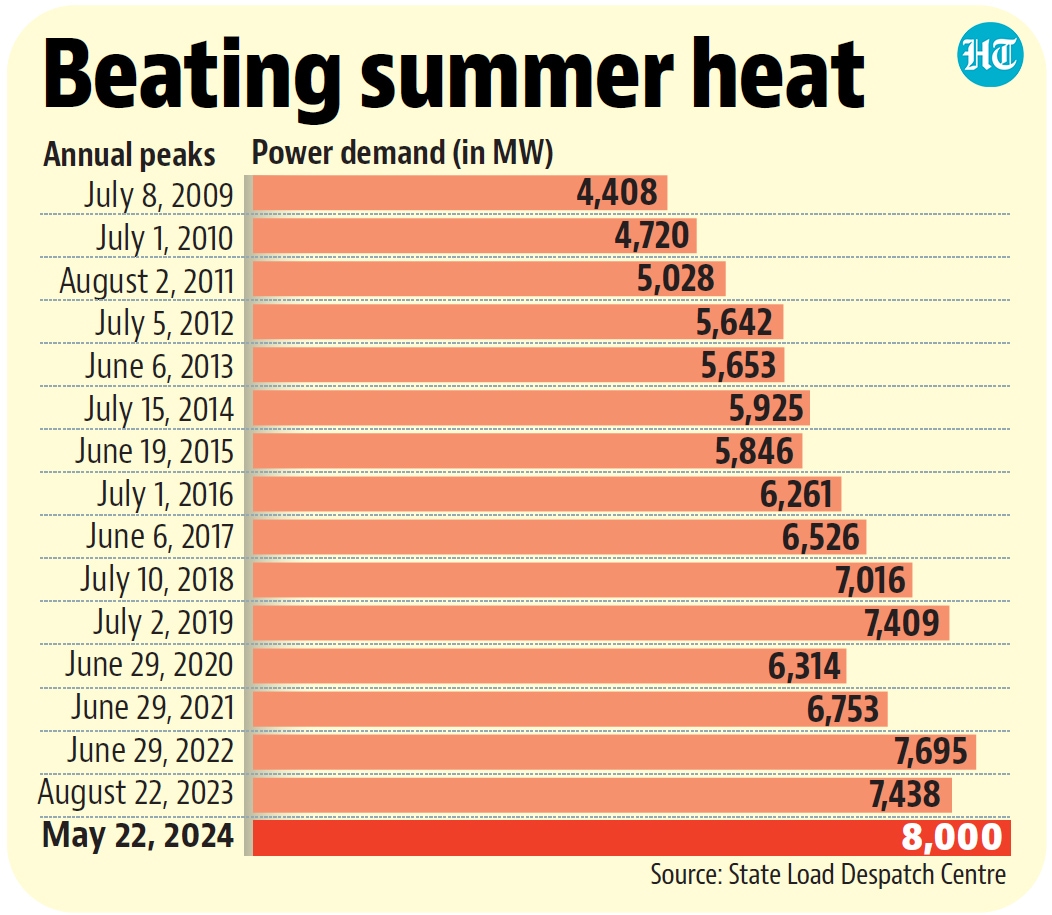
The previous high, recorded on Tuesday, was 7,717MW, preceded by a demand of 7,695MW in June 2022.
Distribution companies (discoms) said a combination of artificial intelligence (AI) and machine learning (ML) models were used to forecast the expected demand, coupled with long-term power purchase agreements (PPAs) — which allow discoms to source power — helped them handle the all-time high load without any power cut.
A PPA is a long-term electricity supply agreement between two parties, commonly between an electricity producer and a distributor. Delhi’s discoms have PPAs with over 40 power plants across the country.
BSES, which supplies electricity to south, west, east and central Delhi through its subsidiaries BRPL and BYPL, said they successfully met peak power demands of 3,511MW and 1,812MW in their respective jurisdictions.
A spokesperson for BSES said: “To meet the present challenges and to get a grip on the many varied and dynamic variables, BSES uses a mix of advanced statistical forecasting models, combined with state-of-the-art weather forecasting solutions, including AI and ML. These analytics help us build models, which lead to high accuracy planning and huge saving of man-hours.”
While a chunk of BSES’s power comes from PPAs, it also has significant green power flowing into the grid. It receives around 840MW of solar power from the Solar Energy Corporation of India (SECI), and around 500MW of wind power, 546MW of hydropower and 40MW from Delhi’s waste-to-energy plants. In addition, 160 MW is generated through rooftop solar panels installed under its jurisdiction.
A spokesperson for Tata Power DDL, which supplies power to north Delhi, said it handled its all-time high demand of 2,268MW without an outage or network constraint.
Delhi chief minister Arvind Kejriwal said there was no power outage or disruption across the city, lauding the government’s efforts to provide a reliable power supply.
In a post on X, Kejriwal said: “Today at 3:42 pm, the peak power demand in Delhi reached 8000 MW. The Delhi government met this peak demand without a power cut. This is a great achievement for the people of Delhi, because till 2014, there used to be long power cuts even at the peak demand of 5925 MW in summers.”
He said that in the past few days, power cuts were lasting 10-12 hours in the BJP-ruled states of Uttar Pradesh, Haryana, Rajasthan and Madhya Pradesh.
“This is the reason why the BJP wants to destroy the Aam Aadmi Party. Because our work shows the truth of their failure to the entire country,” he said on X.
Power minister Atishi also hit out at BJP-ruled states, claiming there were several power cuts to societies in Greater Noida, Noida, Ghaziabad and Gurugram in the past few days.
The Delhi BJP hit back at Kejriwal and Atishi, saying the Delhi government played no role. “The Arvind Kejriwal government has no role... Power purchase, its supply and the distribution network are all maintained by private discoms,” Delhi BJP spokesperson Praveen Shankar Kapoor said.