
 E-Paper



Boats, water sprinkling, bamboo barriers to clear foam in Yamuna on Chhath
Massive foam built up on the surface of the Yamuna due to pollution levels touching unprecedented levels at Kalindi Kunj. On Wednesday, a government official, it was decide to deploy boats, bamboo barricades and water mixed with anti-phosphates to clear the froth


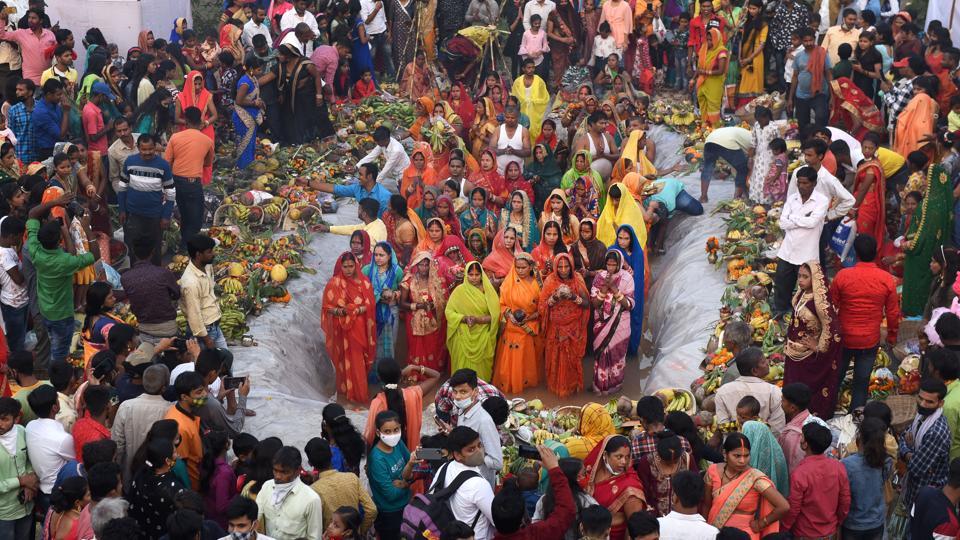
Hundreds of people gathered on the banks of the Yamuna on Wednesday to perform prayers on the occasion of Chhath, defying the Delhi Disaster Management Authority (DDMA) ban on celebrating the festival along the river, with authorities implementing some intriguing measures to remove the highly toxic foam that was floating on the surface of the river such as installing bamboo barricades, sprinkling water and running a boat through the froth at high speed.
Experts, however, dismissed these measures as “merely optics”, and added that they will do nothing to address the basic problem of high pollution content in the river water.
The 800 Chhath Puja venues set up by the Delhi government also witnessed large crowds, with MLAs of the party participating in the celebrations.
Delhi chief minister Arvind Kejriwal also participated in the celebrations. “This year, we faced lot of hurdles because of the Covid-19 pandemic. However, we overcame all and now we are celebrating Chhath Puja. I pray for everyone’s well-being,” said Kejriwal, at a puja venue in East Kidwai Nagar.
When asked about large number of people, including many led by two MPs of the Bharatiya Janata Party (BJP) -- Manoj Tiwari and Parvesh Verma-- celebrating the festival on the Yamuna banks in defiance of the DDMA order, Kejriwal said, “It is a pious occasion. It should not be politicised in any manner.”
Massive foam built up on the surface of the Yamuna due to pollution levels touching unprecedented levels at Kalindi Kunj. On Wednesday, a government official said the revenue department, flood control department and the Delhi Pollution Control Committee decided to deploy two boats with a large cloth tied to them to remove foam from the river as an emergency measure. He added that at total of 15 boats were used to dissolve the foam.
On Monday, Delhi Jal Board officials explained that high phosphate content, industrial pollutants, detergent in untreated domestic sewage, and water hyacinth near Okhla barrage caused the foam build up in the river. They said the froth indicates zero dissolved oxygen levels, which means that the water was unfit to support any aquatic life.
A jal board official explained that water mixed with anti-phosphate agents was being sprinkled to clean the froth, debunking rumours that it was just plain river water. “Our teams are sprinkling water on the river to suppress the foam on a short-term basis. After we raised the issue, UP Jal Nigam officials visited the site and closed the Okhla barrage’s sluice gates so that no more polluted water reaches the area where foam formation takes place,” the official said.
A senior DPCC official said deploying boats was only a short-term measure. “We deployed boats to remove the froth for the Chhath Puja. But we are also acting against sources of phosphates such as detergents, soaps, and other effluents. We are penalising owners of industries without effluent treatment plants or shutting them down. Delhi will also see a considerable improvement in the water quality once all sewage treatment plants are operational,” the officer said asking not to be named.
Manoj Misra, the convener of Yamuna Jiye Abhiyan, said the government is simply engaging in optics by adopting measures such as sprinkling water on the river. “Their engineers may have advised them to collect froth with boats or sprinkle water over the floating froth. These are optics which will have no effect on improving the water quality of the river,” he said.
Misra added that the focus of the agencies should be on reducing industrial pollutants in the river by adopting zero-liquid discharge principle from industrial areas and restoring the natural flow of the river. Zero liquid discharge (ZLD) is wastewater management system that to ensure that there is no discharge of industrial wastewater into the environment. It is achieved by treating wastewater through recycling, recovery and reuse for industrial purpose.
A major blame game over the toxic foam crisis has already begun among political parties in the Capital. DJB vice-chairman Raghav Chadha said on Tuesday the toxic foam floating on the Yamuna river was a gift to Delhi from the governments in Uttar Pradesh and Haryana. Chadha said about 105 MGD wastewater from the Yamuna in Haryana and about 50 MGD wastewater from the Ganga in Uttar Pradesh merged into Okhla barrage and this water had industrial waste, untreated detergents, and ammonia that led to the formation of the dirty frothing. Haryana deputy chief minister Dushyant Chautala hit back at Aam Aadmi Party leaders in Delhi, saying that it had become the Delhi government’s “habit” to blame the neighbouring state for everything.
Earlier in the day, BJP MP (northeast Delhi) Manoj Tiwari and MP (West Delhi) Parvesh Verma participated in Chhat celebrations at two seperate locations in the banks of the Yamuna.
Verma said, “The Arvind Kejriwal led government has failed to clean the Yamuna. Now he is trying to justify his failure by stopping people from celebrating Chhat Puja in the riverbank. This is not acceptable.”
To be sure, the DDMA, which imposed the restriction, is chaired by Lieutenant Governor Anil Baijal, who is an appointee of the BJP-led Union government. The Delhi chief minister is the Authority’s vice chairperson.
In a press conference after Chhat celebrations on Wednesday, Tiwari said: “It is a serious matter as what should have been banned is not the chhatt pooja celebration but that poisonous froth in the river. The fact is the scheme should have been made to clean the river but the one being made is to ban that festival which actually cleans the river. Devotees are being stopped from going to ghats to prevent his own shortcomings from being exposed. The point is neither would they go near the Yamuna nor would they be able to see froth flowing in the river at Kalindi Kunj area.”


Stay updated with all top Cities including, Bengaluru, Delhi, Mumbai and more across India. Stay informed on the latest happenings in World News along with Delhi Election 2025 and Delhi Election Result 2025 Live, New Delhi Election Result Live, Kalkaji Election Result Live at Hindustan Times.


