
 E-Paper



Calm wind, farm fires signal polluted Diwali
The contribution of farm residue burning across the northern plains is expected to rise to 15-18% by the day after Diwali


The air quality in Delhi, which has been gradually deteriorating over the past few days, is set to worsen further on Diwali and the days after the festivities, the System of Air Quality and Weather Forecasting And Research (Safar) predicted on Saturday, as smoke from farm fires, possible illegal use of firecrackers, and calm winds lead to noxious air settling over the national capital.
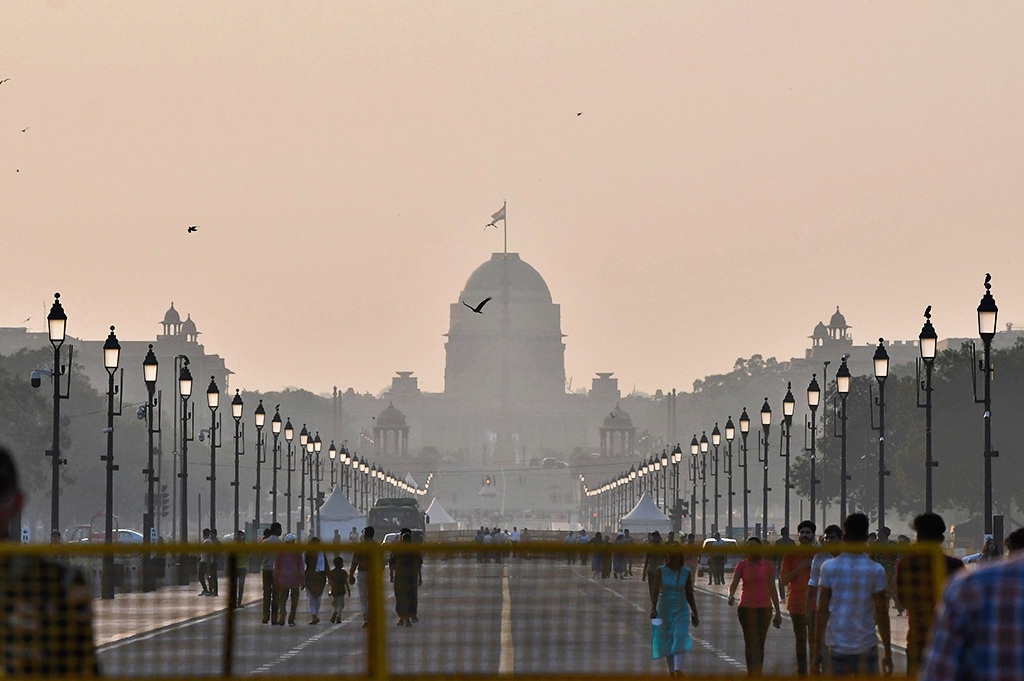
The contribution of farm residue burning across the northern plains is expected to rise to 15-18% by the day after Diwali, causing air pollution levels in the “very poor” and “severe” categories, according to Safar, an arm of the ministry of earth sciences.
The air quality index (AQI) could become “severe” on Diwali night, with illegal firecracker emissions and may remain in that range till at least October 26 till winds pick up speed, Safar said in its Diwali forecast. On Saturday, Delhi’s AQI was in the “poor” category with a reading of 265, as per Central Pollution Control Board’s daily national bulletin at 4pm, a deterioration from 262 on Friday.
Poor air quality places the elderly at risk, according to Safar. Very poor AQI triggers a health alert due to significant increase in respiratory problems. Severe air quality is termed an emergency when the general public experiences breathing problems.
Punjab, Haryana and Uttar Pradesh recorded 722 farm fires on Nasa’s satellite imagery in the past 24 hours, up from 523 on Friday, although their contribution to Delhi’s PM 2.5 worsening concentration was just 3%, Safar said. It is expected to rise to 5% on Sunday, 8% on Monday and reach up to 18% on Tuesday, as conditions become favourable for smoke transport, it said.
Safar delineated two scenarios in its forecast. In the first scenario, even when no firecracker emissions are factored in, Delhi’s AQI will be “very poor” on Diwali, owing to adverse weather conditions.
“The transport-level winds reaching Delhi will be from the northwesterly direction, where large stubble burning hot spots are expected. In addition, calm local winds are expected in Delhi with little over the next three days. Under this zero firecracker emission scenario, the level of PM2.5 is predicted to be in the ‘very poor’ category on Diwali day,” Safar said in its forecast. “However, with adverse weather conditions, 15-18% of stubble contribution and possibly firecracker related pollution from surrounding parts of Delhi, the AQI could touch the higher end of the ‘very poor’ category and even the lower end of ‘severe’ by October 25.”
In the second scenario, where Safar assumes firecracker emissions to be the same as last year, which was around 25% of the long-term average of firecracker emissions Delhi has seen, these already adverse weather conditions and the additional firecracker load will send Delhi’s air to “severe” on Diwali night and keep it there the day after as well.
“AQI will start to improve to the ‘very poor’ category again only from the evening of October 26 onwards as surface winds pick up and stubble transport slows down,” Safar said in its analysis.
Even a little addition of firecracker emissions to Delhi’s air was likely to be detrimental, sending it to the severe zone, said Gufran Beig, project director at Safar.
“Calm local winds and an increase in stubble emissions are both expected to deteriorate the air at this time and Delhi just needs some additional firecracker emission to push it to severe,” Beig said. “We also have to understand that firecracker emissions from neighbouring places in Delhi will also eventually reach the capital.”
Delhi’s AQI has been rising over the past seven days and has been poor since October 16, when it touched a value of 232. To control the rising pollution, the Commission for Air Quality Management had on October 19 imposed stage II of the Graded Response Action Plan (Grap), which means 12 measures will be in place.
These include a ban on diesel generator sets across NCR (barring emergency and essential service locations) and a ban on coal and firewood including in tandoors in hotels, restaurants and open eateries.
Winds are becoming calm after sunset, leading to stagnation in the air, said VK Soni, scientist at the weather office and part of the commission’s panel on Grap. Delhi also saw a slight haze on Saturday morning owing to mist.
“While visibility was between 1,000 to 2,000 metres, meaning this was not fog, but there was a haze and there is a gradual accumulation of pollutants in early morning and at night. With winds expected to become calm during the day, too, the AQI is forecast to touch very poor by Diwali,” Soni said.
Cooler Lower temperatures were another factor contributing to worsening air quality, he said.
Delhi recorded a minimum of 17.3 degrees Celsius on Saturday, one degree below normal, while the maximum was 31.7 degrees, also a notch below normal. While the maximum and minimum temperatures will be around 32 and 17 degrees on Sunday, it will be around 32 and 16 degrees on Diwali, the Met department said.
Stay updated with all top Cities including, Bengaluru, Delhi, Mumbai and more across India. Stay informed on the latest happenings in World News along with Delhi Election 2025 and Delhi Election Result 2025 Live, New Delhi Election Result Live, Kalkaji Election Result Live at Hindustan Times.


