
 E-Paper



Camelcade redux: Bootlegger caught again in Delhi using camels as liquor mules
Delhi Police had first uncovered the new tactic deployed by liquor traffickers to outsmart police surveillance in September last year.

 Prefer HTon Google


NEW DELHI: The arrest of a 48-year-old bootlegger on Monday has evoked a sense of déjà vu: this is the second time he, along with the same camels, has been arrested in six months for trying to smuggle liquor on camelback into the Capital from Faridabad through a forest stretch. Delhi Police had first uncovered the new tactic deployed by liquor traffickers to outsmart police surveillance in September last year.
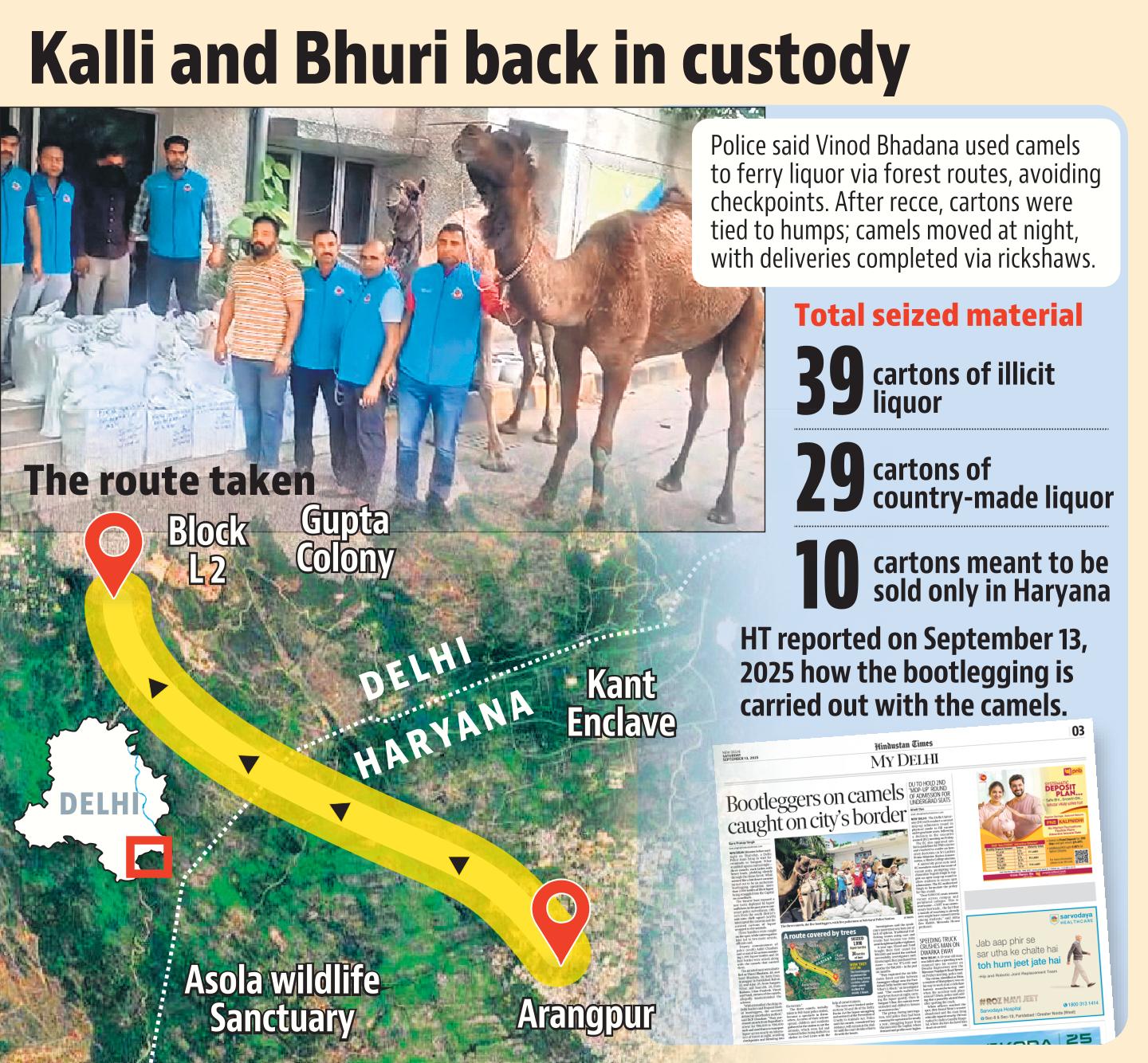
Acting on a tip-off, on Monday, police laid a trap for Faridabad resident Vinod Bhadana, who is out on bail in the first case, at Sangam Vihar and arrested him for attempting to smuggle 39 cartons of illicit liquor into Delhi on camelback. They also seized two camels, Kalli and Bhuri — who had also been used in the bootlegging operation six months ago and had been at an animal shelter till they were released to the accused 25 days.
“The contraband was seized and the camels were rescued and handed over to the concerned authorities,” said deputy commissioner of police (south) Anant Mittal. Police have registered a case under sections 33/38 of the Delhi Excise Act and Section 11 of the Prevention of Cruelty to Animals Act. Police recovered 39 cartons of illicit liquor — 29 cartons of country-made liquor and 10 cartons meant to be sold only in Haryana, containing 1,938 bottles.
On September 11 last year, in an operation, a Delhi Police team had arrested three handlers from the spot last year, while interrogation later led to two more arrests.
The arrested men included have been identified as Vinod, 48, his brother Sunil Bhadana, 38, both from Anangpur in Faridabad; Rahul, 22, and Ajay, 25, from Sangam Vihar; and Saurabh, 26, from Badaun, Uttar Pradesh. Vinod and Sunil, owners of the camels, allegedly masterminded the scheme.
However, the accused were released on bail a week later.
Meanwhile, the camels were sent to the Delhi Society for Prevention of Cruelty to Animals (DSPCA) shelter opposite the Tis Hazari Court Complex. “The camels stayed there, after which the accused approached the court for their release. They were released after about 25 days and the accused were asked to pay ₹25,000 for the same,” said an investigator aware of the details of the probe.
According to the officer, Vinod lives with his family in Faridabad’s Anangpur, adjacent to the forested area along the Asola Wildlife Sanctuary, where they also rear camels.
He, along with his associates, would deploy at least two people to conduct a recce of the forest before they start their journey to Delhi.
“It was only after the people who conducted the recce gave him a green signal that he would leave the village,” said the officer.
With the liquor mounted on the camels, they exploit the forest corridor between Anangpur village near the Faridabad-Delhi border and Church Colony in Sangam Vihar’s L-block. The camels walked for six to 10 kilometres at night, carrying the liquor quietly.
“From there, the liquor was usually taken by suppliers on pedal rickshaws,” the officer added.
On Monday, Bhandana was arrested around 4:30am, before the liquor could be taken by the suppliers.
Police said the syndicate’s innovation was born out of a lack of options. Traditional trafficking routes using cars and trucks had become too risky amid heightened police vigilance.
“Deterred by the strict checking on the roads connecting Delhi and Faridabad, the accused used camels and forest routes to transport illicit liquor, avoiding roads and police checkpoints. This unconventional method was adopted to evade detection during intensified enforcement under Operation Kavach,” said DCP Mittal.
According to investigators, Kalli and Bhuri are 15- and 25-years-old, respectively.
After the bust last year, police had said Vinod and Sunil had purchased a camel a year before for ₹60,000 and tested the method successfully. Encouraged, they purchased two more — one for ₹72,000 and another for ₹80,000 — in the six months ahead of the September 11 operation.
However, on Monday, investigators said, while Kalli was bought about a year and a half ago for ₹60,000, Bhuri had been with the family for about two decades.
“They would tie the cartons tightly onto the camel’s hump,” the police officer quoted abovesaid.


Stay updated with all top Cities including, Bengaluru, Delhi, Mumbai and more across India. Stay informed on the latest happenings in World News along with Delhi Election 2025 and Delhi Election Result 2025 Live, New Delhi Election Result Live, Kalkaji Election Result Live at Hindustan Times.


