
 E-Paper



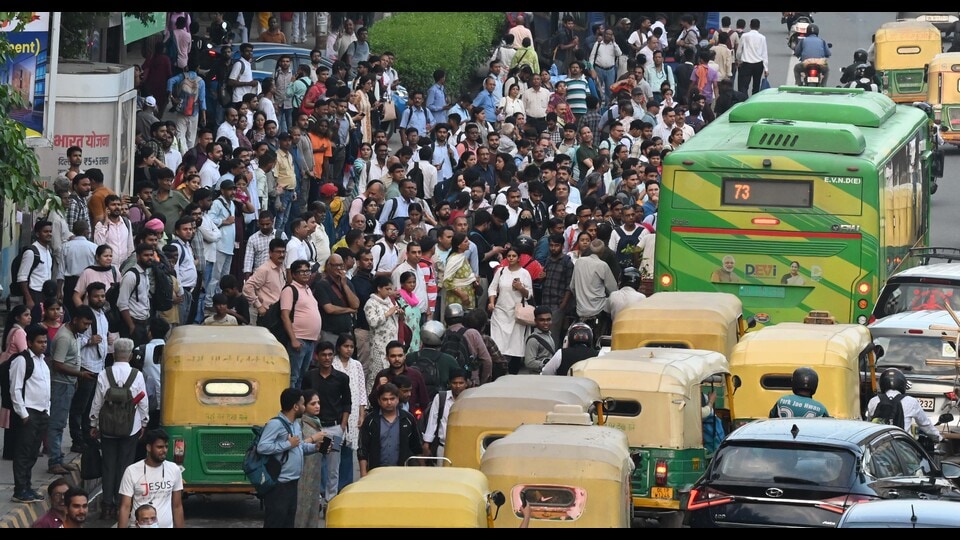
Central Delhi gridlocked as 17 metro stations shut
With several metro stations shut for several hours and extensive police barricading, large parts of central Delhi came to a standstill for another day on Wednesday as hundreds of people, young and old, continued to pour into the Jantar Mantar protest site in support of the students’ stir

 Prefer HTon Google


With several metro stations shut for several hours and extensive police barricading, large parts of central Delhi came to a standstill for another day on Wednesday as hundreds of people, young and old, continued to pour into the Jantar Mantar protest site in support of the students’ stir. The sudden closures left thousands of office-goers, students, and even security personnel scrambling for alternate routes, adding to the inconvenience caused by restrictions imposed on roads in light of the ongoing Parliament session.
It started around 10.53 am, when, in a post on X, the Delhi Metro Rail Corporation (DMRC) said the Janpath, Rajiv Chowk, Patel Chowk, and Central Secretariat Metro stations, which open into the immediate vicinity of the protest site, had been closed “due to security reasons”.
By 11.30 am, a total of 16 metro stations had been closed, with the shut down extending to Lok Kalyan Marg, Rajiv Chowk, Ramakrishna Ashram Marg, Barakhambha Road, Supreme Court, Seva Teerth, Mandi House, ITO, Delhi Gate, Indraprastha, Khan Market, Jor Bagh, and Shivaji Stadium. The closure of the Jhandewalan station was announced around 4.40pm.
To be sure, Rajiv Chowk, Mandi House, and Central Secretariat stations remained open for interchange, but passengers were not allowed to enter or exit from these stations.
With these closures, central Delhi was effectively inaccessible through the metro. Thousands of people use these routes daily, including those who work in the many offices, shops, courts, media houses, hotels, government institutions, and other establishments in the key city area. The area is also popular with tourists.
Metro closures added to the inconvenience commuters have been experiencing since Monday when new security measures were introduced with the start of the Monsoon Session of the Parliament. This coincided with the ‘Chalo Sansad’ march in which the protesters, angry over the recent paper leaks, attempted to march to the Parliament.
As of 9pm on Wednesday, google map showed red lines around Jantar Mantar, in the vicinity of Connaught Place, with Ashoka Road, Sansad Marg, and Tolstoy Road largely off-limits. Massive snarls were witnessed on the Connaught Place Circle, Parliament Street, Akbar Road, Kasturba Gandhi Marg, Janpath Road, Barakhambha Road, and Maulana Azad Road.
“We deployed several traffic personnel on the affected routes to regulate the flow of vehicles and clear traffic jam,” said a traffic police officer, who asked not to be named.
Visuals also showed hundreds of people on foot on various roads, including ITO, as they attempted to board buses, or hailed taxis and rickshaws.
Apart from the central Delhi, areas in the city bordering Uttar Pradesh and Haryana also witnessed traffic snarls as iron barricades were installed on the borders amid heightened security measures, especially on tractors, buses and trucks from the neighbouring states. The carriageways of Delhi-Meerut Expressway and National Highway (NH)-9 witnessed bumper-to-bumper traffic toward Ghaziabad.
The metro station restrictions appeared to be put in place particularly to keep protesters from reaching the Jantar Mantar site and triggered confusion, particularly at Rajiv Chowk and Mandi House, where commuters repeatedly approached security personnel for directions. Public announcements at these stations informed passengers that the stations were open only for interchange.
Throughout the day, the Central Armed Police Forces (CAPF) personnel were stationed across platforms, concourses and outside many of the stations.
Protesters heading to Jantar Mantar via the metro were, therefore, forced to get off at the New Delhi station, board e-rickshaws to Connaught Place’s Outer Circle, and then walk to the protest venue.
Anshu, a student who was at the station when the incident occurred, said: “It looks like a clear plan to stop people from reaching the protest venue. One of the students shouted slogans here and the security personnel held him and asked him to stop. This is not right. People have the right to express themselves, especially after the amount of inconvenience they are facing.”
Security personnel deployed for protest duty were also seen de-boarding at New Delhi instead of Rajiv Chowk because of the restrictions.
Around 3pm, a brief commotion broke out inside the Mandi House station when a protester raised slogans and several others joined in. Security personnel rushed in and exit gate No. 1 was briefly opened to allow people to leave the station and ease congestion.
The entry to Mandi House and Central Secretariat stations resumed around 5.45 pm, and by 6.30pm, all stations had been opened, the DMRC said in a post on X.
Metro staff at multiple stations said they did not know if such restrictions would continue in the coming days.
In recent years, closure of metro stations as a precautionary measure ahead of or during protests has been a theme. In February 2024, multiple gates were shut down at nine metro stations across the city in wake of the farmers’ protest.
In February 2021, again during the farmers’ protest, eight metro stations were shut down around central Delhi. A month prior, in January, 16 metro stations were shut down when farmers reached Delhi and clashed around Red Fort and ITO.
During the 2019 anti-CAA and NRC protests, DMRC had temporarily shut down as many as 20 metro stations across the city.
(With inputs from Karn Pratap Singh)



Stay updated with all top Cities including, Bengaluru, Delhi, Mumbai and more across India. Stay informed on the latest happenings in World News along with Delhi Election 2025 and Delhi Election Result 2025 Live, New Delhi Election Result Live, Kalkaji Election Result Live at Hindustan Times.


