
 E-Paper



‘Clock ticking non-stop’: The gruelling math in the life of a gig delivery rider
On January 13, quick-commerce platforms assured the Union government that they would remove standard 10-minute delivery deadlines.


At around 2.35pm on a sunny weekday afternoon, a 19-year-old Blinkit delivery executive picks up his first order of the day from a “dark store” in Ashram – a packet of bread and a few chips – and sets off on what the app promises will be a 10-minute ride to Nizamuddin. He reaches the address at 2.44pm, parks his motorcycle, rings the bell. A woman – presumably the domestic help – comes down from the third floor, collects the parcel and hands him a ₹500 note for a ₹265 order.
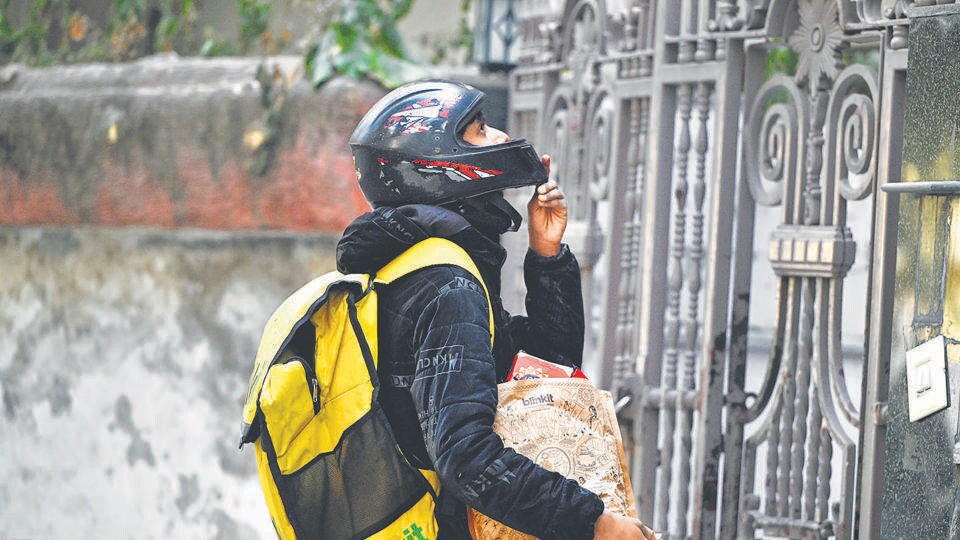
He doesn’t have change.
The woman asks him to wait and disappears upstairs with the money. He stands outside, helmet in hand, scrolling through short videos on his phone. He doesn’t ring the bell again. He doesn’t call. “If the customer gets upset, they can give me a poor rating,” he explains.
After 21 minutes, the woman finally returns. This time, she scans the QR code on his phone and pays online. The first delivery is done.
Time taken: 30 minutes. Earnings: ₹32.
He starts his motorcycle and heads back to the dark store. At 3.23pm, he is handed his second order – chocolates worth ₹250. On the way, he hits two red lights, crosses a waterlogged underpass and inches through traffic toward Gujjar Chowk in Sarai Kale Khan. When he reaches the spot, 2.1km away, he calls the customer, who tells him the location is only a landmark. The actual address is another 500 to 600 metres inside a narrow lane. He navigates potholes and congestion, finally delivering the order at 3.44pm.
Time taken: 21 minutes. Earnings: ₹31.
“Delays like these are part of more than half the orders I make,” he says. “Customers wait for us to arrive and then start making arrangements for payment. In cases where delivery locations are inside narrow streets, they drop a nearby landmark and then ask us to travel more without factoring in the additional time required.”
Those minutes matter. “Soon enough, these delays stack up, and we end up missing the stringent conditions imposed on us to meet incentives – which is more often the only way we can make sizeable bumps to our daily income.”
On January 13, quick-commerce platforms assured the Union government that they would remove standard 10-minute delivery deadlines.
He recalls one delivery that ran just five minutes late. “The customer got really furious and said I have ordered from Blinkit, not Flipkart,” he says.
The company, he adds, takes customer complaints seriously. “They can impose very serious consequences like permanent blocking of ID. So, I make bad customer behaviour a habitual experience, apologise quickly and move on.”
HT accompanied him on a nearly five-hour afternoon delivery spell on his motorcycle as he weaves through Nizamuddin, Sarai Kale Khan, Siddharth Extension and Jangpura. In that time, he completes six deliveries, earning ₹159 over roughly two hours and 50 minutes – an earning rate of just over ₹55 an hour.
A Blinkit spokesperson refused HT’s requests for comment about the pay structure.
When he passed Class 12 in 2023, he was the first in his family to do so. His parents – his family consists only of his father and mother – celebrated the milestone by gifting him a motorcycle. Unsure about pursuing higher education, he decided to take up delivery work.
“At the outset, the job looked easy and like a way to make quick money,” he says. “But that’s because I hadn’t factored in the physical labour it required.”
During the six deliveries, he does not once check his phone for time. He says he is “seasoned enough” now to know when he is running late. When he is behind schedule, he knows when to push harder.
“The pressure is high when I am on my way to deliver an order. With every breath I take, it feels like the clock is ticking. On the way back, I drive at a much slower pace.”
He tells HT that if no one were riding pillion, he would go faster and could ideally complete 10 to 12 deliveries in the same time.
Over time, he says, he has adapted – to customer tantrums, shifting weather, long traffic snarls and uneven roads – all to stay focused on meeting the tough criteria that qualify him for incentives.
Incentives, he says, are where the real money lies in gig delivery work.
“This is what you have to aim for if you want to make real money. If you’re just doing a few deliveries, you’re averaging ₹20 to ₹30 a pop. Even 10 deliveries a day means only ₹200 to ₹300.”
To qualify for incentives, he explains, a rider must work five straight hours in the morning shift between 9am and 3pm, or in the evening between 6pm and midnight – 11 working hours in total. If overall trip earnings cross ₹1,000 in a day, the rider becomes eligible for a ₹200 incentive.
“The fact that all three conditions need to be fulfilled is what makes it next to impossible,” he says. “To make trip earnings worth ₹1,000 in a day, one needs to deliver at least 50 to 60 orders, which is difficult because the number of riders around a dark store increases during morning and evening rush hours. Orders for individual riders decrease significantly.”
The challenges don’t end there.
Then there are “dynamic orders” – when a product is unavailable at one dark store and the order is transferred to another nearby store – he says no extra money is paid. “My dark store is in Ashram, but almost every day we get at least a few orders from nearby zones like Lajpat Nagar due to non-availability of products.”
“In such cases, we only get ₹12 flat on orders and ₹7 per kilometre. No additional payment is given when we work in areas that don’t fall in our zone.”
Refusing such orders comes at a cost. “If we ever decide to reject an order because of this, it means we will be disqualified from getting incentives,” he adds.
Not every delivery is a struggle. The third and fourth orders of the day went relatively smooth. In Sunlight Colony, a customer on the fourth floor has already lowered a bag tied to a rope, with ₹430 inside, for a packet containing perfume. In Nizamuddin, a security guard promptly scans the QR code to pay ₹512 for an extension board.
By 5.30pm, after his final delivery, he sits down for tea with the HT team. There is no immediate financial crisis, he says, but no illusion either. “I am a single child, and my parents don’t really put pressure on me,” he says. “They might not realise it presently, but I am the only one who will take care of them.”
His monthly earnings hover around ₹20,000. Of that, ₹5,000 to ₹6,000 goes toward petrol for his motorcycle.
“It’s good money to survive for now,” he says. “But this profession takes a toll on a man’s mind and body. It is non-stop hustle. I can’t do it for my entire life.”
Stay updated with all top Cities including, Bengaluru, Delhi, Mumbai and more across India. Stay informed on the latest happenings in World News along with Delhi Election 2025 and Delhi Election Result 2025 Live, New Delhi Election Result Live, Kalkaji Election Result Live at Hindustan Times.


