
 E-Paper



DDA’s plan for pedestrian-friendly makeover of Delhi streets remains on paper
DDA officials attributed the delay to the pandemic and subsequent lockdowns and restrictions, and said that they have already prepared walk plans in six key stretches

 Prefer HTon Google


Over two years after the Delhi Development Authority (DDA) notified the regulations for a pedestrian-friendly makeover of Delhi streets, the policy continues to remain on paper with the land-owning agency yet to even constitute a high-level committee under the chairmanship of Delhi lieutenant governor (LG) Anil Baijal to oversee its implementation. DDA officials attributed the delay to the pandemic and subsequent lockdowns and restrictions, and said that they have already prepared walk plans in six key stretches.
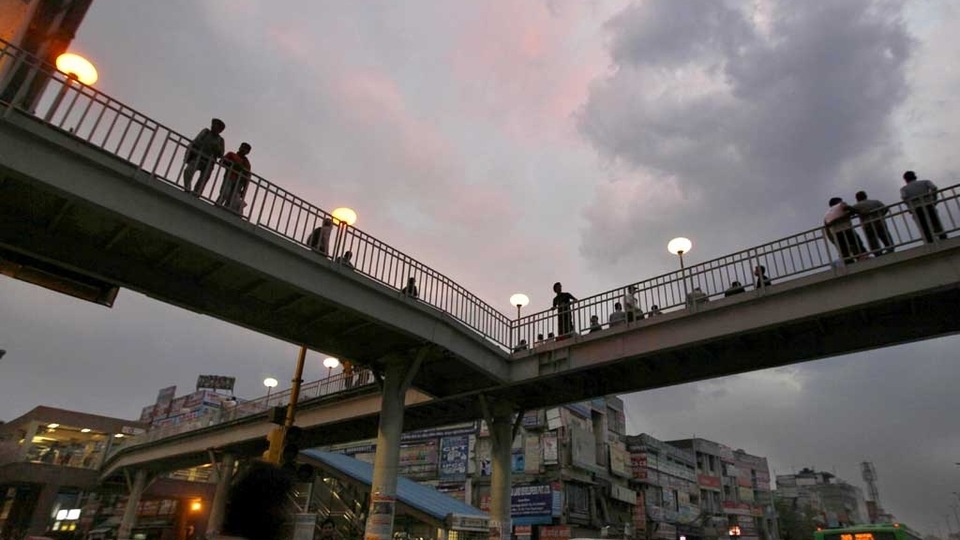
Notified on August 2, 2019, the Regulations for Enhancing Walkability in Delhi is aimed at making city roads accessible to all, especially areas around mass transit systems and residential neighbourhoods, and even proposed to allow citizens to rate the pedestrian facilities using a mobile application.
According to the policy, the DDA is supposed to prepare walk plans for 27 locations, mainly around Metro stations. The walk plans are basically area specific solutions to make road infrastructure, especially around Metro stations, markets and areas with high pedestrian and non-motorised transport volume, pedestrian-friendly.

When contacted, a senior DDA official said, “The committee is yet to be formed. But we are preparing the walk plans for 15 locations of which six are ready. These were approved by the Unified Traffic and Transportation Infrastructure (Planning and Engineering) Centre (UTTIPEC) in December last year. Now we are preparing detailed drawings of the six walk plans for implementing agencies.
The six plans have been prepared for INA Market and Metro Station, Hauz Khas–IIT Delhi, Delhi University’s North and South campuses, Kamla Nagar and Lajpat Nagar.
When asked about the delay in the implementation of the policy, a senior DDA official said, “The process got delayed due to Covid pandemic. For the preparation of the walk plans, we had to carry out surveys to get information about the traffic volume, identify key problem areas related to pedestrian accessibility to the Metro stations etc. But due to lockdown, followed by the restrictions and then the second wave of the pandemic, we couldn’t do the survey. The Metro services were restricted for five months initially and then were operating on reduced capacity.”
According to the policy, nearly 38% of all personal trips and 58% of trips to educational institutions in Delhi are walk-only. The policy provides for provision for continuous, barrier-free pathways, pelican crossings near schools and major pedestrian crossings, and earmarking of multi-utility zones (MUZs) to accommodate street vendors and other public activities,among others.
Transport planning and road safety experts feel that a pedestrian-friendly infrastructure in residential colonies, markets and Metro stations and bus stands will reduce the load on public transport.
According to the policy, almost 60% of all trips are less than 4km and 80% below 6km in Delhi.
The experts said it is important to develop the infrastructure to make Delhi a “walkable city”.
Ashok Bhattacharjee, former director of UTTIPEC, said that proper implementation of policy and its enforcement is the biggest problem in Delhi. “The street design guidelines were prepared by the UTTIPEC long back. While it is mandatory to construct as per the guidelines, we see that most streets don’t adhere to its specifications. Another problem is enforcement. The pavements shouldn’t be encroached. But almost all pavements have encroachment problems. It is difficult for pedestrians to walk.”
He said that a body such as Unified Metropolitan Transport Authority (UMTA) or like Transport for London in the UK is the need of the hour in Delhi to ensure proper planning and implementation of various transport and street design policies. “Just having policies is not enough, what’s important is its effective implementation and regular monitoring. For this, Delhi needs an independent authority,” he said.
While different agencies are carrying out work to make streets under their jurisdiction accessible to all, experts said they all are working in silos. “What Delhi needs is a comprehensive walkability plan so that there is continuity and uniformity in design and standards. There should be a standard template for implementation. Developing just 500m areas around Metro stations is not enough. It should connect the station to the residential neighbourhoods or markets. Also, we need to not just provide accessible pavements, but also plan for road crossing. There is a need to plan for at-grade crossing at all roads by providing table-top crossing etc; foot-over-bridges and underpasses should be discouraged,” said S Velmurugan, chief scientist, traffic and engineering and safety division, Central Road Research Institute (CSIR-CRRI).


