
 E-Paper



Dead fish on Delhi’s Yamuna raises effluent concern again
Thousands of dead fish have surfaced in Delhi's Najafgarh drain, worsening pollution, likely due to industrial effluents from Haryana, locals report.

 Prefer HTon Google


New Delhi
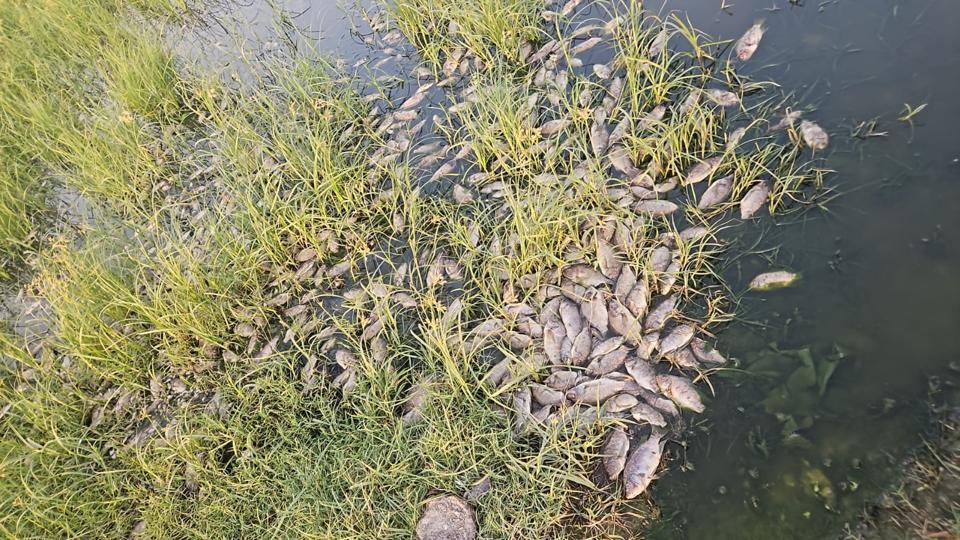
Thousands of dead fish have been floating along the Najafgarh drain, Delhi’s most-polluted stormwater drain that empties into the Yamuna, near southwest Delhi’s Rawta village over at least the past five days, with villagers alleging the water colour—usually, a dark shade of grey—has been darker and murkier.
The incident has been logged near the Dhansa regulator, locals said.
“The drain is always polluted and grey in colour. In recent days, the water is darker and smells strongly. The deaths are likely due to effluents being released by industries on the Haryana side,” said Ravi Phalswal, a farmer in the area, who said the water in the drain has a visible stench, possibly from industrial effluents.
“Since fields along the drain and Najafgarh Jheel are partially submerged due to the high groundwater table, we even have dead fish that are being seen floating in our fields too,” Phalswal said, adding that complaints over similar incidents in the past have changed little on the ground.
In July 2022, thousands of fish were found dead along the drain near the Delhi-Haryana border, and an inquiry committee later concluded that heavy rainfall caused toxic sediment from the drain bottom to rise, choking the fish and reducing dissolved oxygen levels, a scenario possibly aggravated by untreated waste from upstream drains.
The issue is also not limited to the Najafgarh drain. In May 2025 and prior to that, in July 2024, hundreds of dead fish were recorded along the Yamuna banks near Burari in north Delhi.
Data shared by Delhi’s environment department with the National Green Tribunal-appointed high level committee on the Yamuna in January 2023 identified the Najafgarh drain to account for 68.71% of wastewater being discharged into the Yamuna, followed by the Shahdara drain (10.9%) and the Barapullah drain (3.15%).
Experts, while attributing the deaths to a sharp dip in dissolved oxygen, said the reason for the dip needs to be assessed.
Bhim Singh Rawat, a Yamuna activist and member of the South Asia Network on Dams, Rivers and People (SANDRP), said that the river in this portion is receiving untreated effluents from Haryana, and the rise in temperature, coupled with industrial effluents, may have led to mass fish mortality.
“Such events are usually seen in summer as the flow of water in rivers and drains usually goes down and the concentration of effluents increases, depriving organisms of dissolved oxygen. Most fish cannot survive abrupt dips in dissolved oxygen,” he said.
In March, a Delhi Pollution Control Committee (DPCC) analysis of the Najafgarh drain found the biological oxygen demand at 60 mg/l, twice the safe limit of 30 mg/l.The most polluted section was where the Mungeshpur drain, a subsidiary drain, met the Najafgarh drain, with BOD levels touching 115 mg/l.
DPCC officials did not comment on the latest incident of fish deaths.



Stay updated with all top Cities including, Bengaluru, Delhi, Mumbai and more across India. Stay informed on the latest happenings in World News along with Delhi Election 2025 and Delhi Election Result 2025 Live, New Delhi Election Result Live, Kalkaji Election Result Live at Hindustan Times.


