E-Paper



Debate over share of farm fires in toxic air
Delhi-NCR has been in a grip of severe-plus air pollution as a toxic smog lingers over the Capital and its adjoining cities, leading to a public health emergency.

 Prefer HTon Google


Like a thick haze of smog that blots out visibility, mystery shrouds the exact contribution of stubble burning in worsening the air quality of Delhi-NCR.
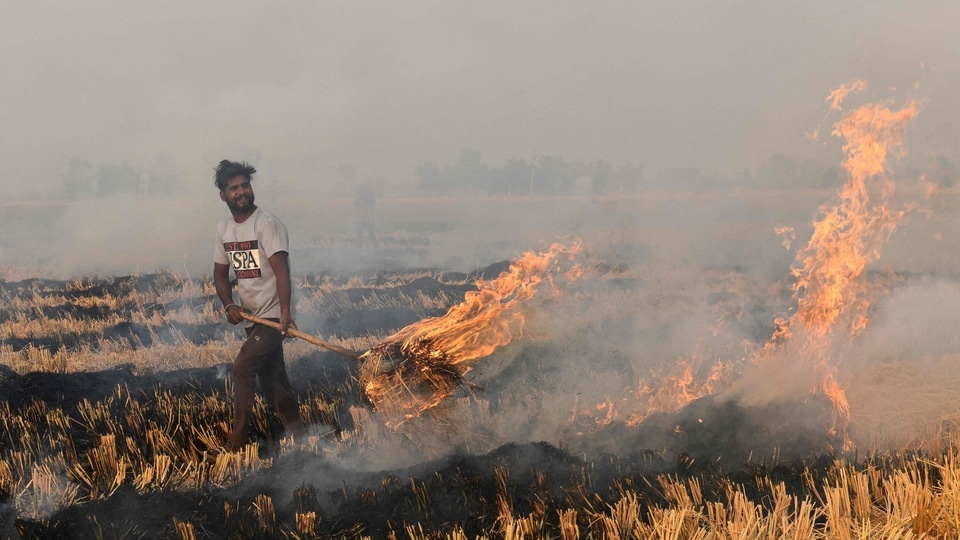
The Union government on Monday submitted before the Supreme Court that stubble burning is not a prime cause of pollution, adding that it contributes just around 10% to the total pollution. But the affidavit, placed by the Centre before the court in the same matter, also contains a finding that the stubble burning has been contributing about 35% to 40% of the total pollution load in Delhi-NCR.
Interestingly the same affidavit, at another point, refers to a scientific study to maintain that stubble burning contributes a meagre 4% to PM 2.5 and PM 10 pollutants during the pre-winter and winter weeks. The source of this scientific study has not been named in the affidavit.
Delhi-NCR has been in a grip of severe-plus air pollution as a toxic smog lingers over the Capital and its adjoining cities, leading to a public health emergency. This November has also seen the number of farm fires reaching a new high with the enforcement of a ban on the practice collapsing.
On Saturday, the Supreme Court stepped in, imploring the Centre and the Delhi government to take “emergent measures”, including imposition of a lockdown in the national capital, to “immediately” control rising levels of air pollution.
At the same time, the bench headed by Chief Justice of India NV Ramana, lamented that “bashing farmers” over stubble burning has become a fashion even though there are several other major contributors to the hazardous air quality.
When Delhi government’s counsel Rahul Mehra submitted that it is “probably” the stubble burning that has made the air quality index and PM 10 and PM 2.5 pollutants shoot up by several hundred points, the bench, which also comprised justices DY Chandrachud and Surya Kant, retorted: “What is this? Now, it has become a fashion to bash farmers, whether its Delhi government or someone else. You had imposed a ban on firecrackers in Delhi. But see what has been happening in the last 7-8 days. What are you doing? What are Delhi Police doing?”
When the proceedings resumed on Monday, solicitor general Tushar Mehta, representing the Centre, conceded that the court was right when it said that stubble burning is not a major contributor of air pollution. “I must admit stubble burning is not a major contributor. It contributes only 10%,” he said.
This prompted the bench to observe that the “hue and cry” over farm fires apparently had no legal, scientific or rational basis. The bench also noted that the Centre’s own affidavit refers to a study to say that stubble burning contributes only 4% to increase in PM 2.5 and PM 10, and therefore, “an insignificant source of pollution” was being targeted by everyone.
But the anomaly in the Union government’s response was sought to be highlighted by senior advocate Vikas Singh, who was appearing for the 17-year-old petitioner, Aditya Dubey. He contended that the Centre is trying to mislead the court by claiming stubble burning is causing less than 10% pollution. He said that the high-powered committee, comprising senior officials of the Centre and governments of Delhi, Punjab, Haryana and UP have recorded in the meeting on November 14 that stubble burning is responsible for 35%-40% of air pollution.
HT has reviewed the Centre’s affidavit cited by Singh. The minutes of the meeting of the commission for air quality management in Delhi-NCR and adjoining areas, held on Sunday, records it categorically that farm fires and stubble burning partakes a major share in rising levels of pollution.
“Post Diwali, there has been a spurt in the number of fire incidences owing to paddy stubble burning, particularly in Punjab where about 42,285 incidences have been reported in the last 10 days alone, out of the cumulative fire count of 62,863 till November 13 during this season. Likewise, the instances of paddy stubble burning in Haryana have also witnessed an increase compared to last year with 5,400 incidents being reported so far in 2021 against a cumulative figure of 3,635 in the corresponding period in 2020,” recorded the commission.
It also made a recommendation in this regard to the state governments concerned. “Efforts need to be intensified to control the instances of stubble burning to minimum as currently the paddy stubble burning has been contributing about 35%- 40% of the total pollution load in Delhi-NCR.”