
 E-Paper



Delhi bids farewell to the goddess with dash of red
Delhi government creates over 600 artificial ponds and ghats for Durga idol immersions to prevent pollution of the Yamuna river.


The Delhi government on Tuesday said over 600 artificial ponds and local ghats were created across the city for safe immersions of Durga idols and to prevent pollution of the Yamuna. This is the fifth consecutive year when Durga idols have not ended up in the Yamuna, instead were consigned to these specially created ponds. To ensure that no rules were flouted, teams comprising of officials from different government departments and local district administration were deployed along the length of the Yamuna, officials aware of the matter said on Tuesday.
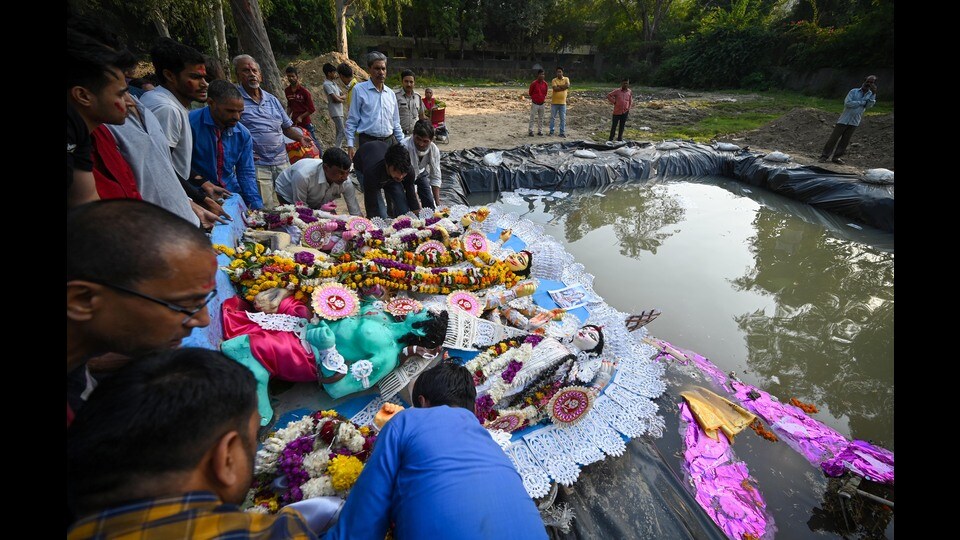
“Idol immersion leads to water pollution in Yamuna. Immersing these idols in polluted water is also not ideal and can hurt religious sentiments of some people. The irrigation and flood department has built nearly 600 artificial ponds and ghats across the entire city,” Delhi’s water minister Saurabh Bharadwaj said on Tuesday. He took part in the idol immersion ceremony at Astha Kunj near Nehru Place.
Idol immersion in the Yamuna was banned in Delhi in 2019, when the Delhi government took the decision to prevent toxic dyes and plaster of Paris (PoP) from ending up in the river, possibly polluting it further.
Tamal Rakshit, the vice-president of the B Block Samiti at CR Park, said over 40 idols were immersed in the artificial pond created locally, after the frames were removed by the evening. “We have been using these locally made ponds for the last few years, so the entire process is well-known to people. They brought their idols in a queue and the entire immersion ceremony completed without a hurdle,” he said.
Prodip Ganguli, general secretary of the Bengal Association and joint secretary of CR Park’s Kali Mandir, said while some puja organisers were using the locally created pits at Kali Mandir, most of them took their idols to a large 200x200 feet pit created at Astha Kunj Park. “The pits will be cleaned by the end of the day and any items collected on the side will be sent for proper disposal,” he said.
Before idol immersion women played the traditional ‘sindur khela’ and performed the ‘Dhanuchi’ dance.
A DPCC official said they plan to carry out water testing in the coming days, to assess whether any ghats were used for idol immersion. “Samples are collected each month and pre-immersion and post-immersion readings are compared. For the last few years, data shows there has not been any immersion as efforts to prevent idols from reaching the river have worked,” the official said.
In 2018, the last time when idol immersion took place in the river Yamuna, seven out nine ghats had a dissolved oxygen (DO) level of 0 mg/l post-immersion, whereas it should be at least 4 mg/l and above for aquatic lives to sustain. Similarly, the Biological Oxygen Demand (BOD), which should be a maximum of 3 mg/l at any water body, was recorded as high as 40 mg/l at Qudsia Ghat, followed by 35 mg/l at Kalindi Kunj Ghat. This changed dramatically in 2019, when not only the lack of immersion saw improvement in the total dissolved solids (TDS) count, which is generally high due to the heavy metals and toxic dyes introduced in the river, but both BOD and DO levels showed improvement.

Stay updated with all top Cities including, Bengaluru, Delhi, Mumbai and more across India. Stay informed on the latest happenings in World News along with Delhi Election 2025 and Delhi Election Result 2025 Live, New Delhi Election Result Live, Kalkaji Election Result Live at Hindustan Times.


