
 E-Paper



Delhi crosses annual rain mark despite disappointing monsoon
In fact, the monsoon, despite a late flurry in September, could only manage 516.9mm of rainfall between June and September – well below the average mark of 640.4mm for these four months.


Despite an underwhelming monsoon, Delhi has already recorded 790.1mm of rainfall till 5.30pm on Sunday, with a large volume of the annual rainfall coming in non-monsoon months, including January and October, India Meteorological Department (IMD) data shows.
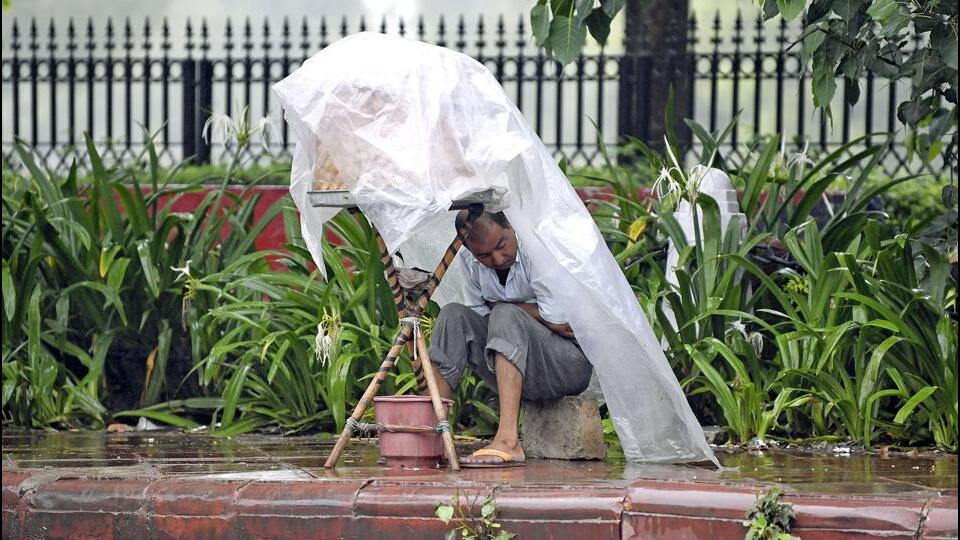
With 74.3mm rain on Saturday, Delhi crossed its normal annual rainfall mark of 774.4mm.
Normally, Delhi receives 134mm or 17% of its annual rainfall in the non-monsoon months of January to May and October to December. But this year, the contribution of these dry months has been as high as 273.2mm (around 35% of the total rainfall and over two times the normal), with contribution from November and December yet to be added.
In fact, the monsoon, despite a late flurry in September, could only manage 516.9mm of rainfall between June and September – well below the average mark of 640.4mm for these four months. IMD data shows this monsoon rainfall was Delhi’s lowest since 2019, when Delhi received only 404.3mm.
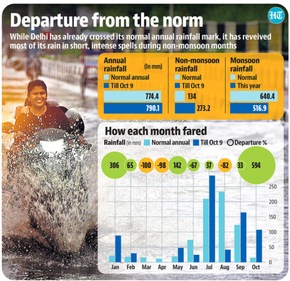
Delhi received only 24.5mm in June – a deficit of 67% over the normal monthly average of 74.1mm. July fared significantly better, receiving 286.3mm of rainfall – an excess of 37% over the monthly normal of 209.7mm, but August – traditionally Delhi’s wettest month, recorded only 41.6mm of rainfall. It normally receives 233.1mm of rainfall, a deficit of 82%, data shows.
This monsoon could have ended even worse, had it not been for the incessant rain between September 1 to September 24, which saw Delhi receive 111.6mm of rainfall. This year, September recorded a total rainfall tally of 164.5mm -- more than 33% over the normal monthly mark of 123.5mm.
In comparison, the winter months of January, February also broke rain records this year and October appears to be following the same trajectory. January saw Delhi record 88.2mm of rainfall – four times over the normal mark of 21.7mm, also making it Delhi’s wettest ever January in the last 121 years. February added another 29.7mm of rainfall, an excess of 65% over the normal monthly rainfall mark of 18mm, making it Delhi’s wettest February since 2014.
Meanwhile, October has already recorded 107.3mm rainfall -- around seven times over the normal monthly rainfall mark of 15.1mm, also making it the second wettest October so far between 2007 and 2022, IMD data shows.
Meanwhile, March and April were unusually dry. While the average rainfall in these two months is 15.9 and 12.2mm respectively, Delhi did not receive any rain in March and only recorded 0.3mm of rainfall in a single day in April.
Experts say over the last one decade, rainfall patterns have become harder to predict, with extreme weather events becoming the norm.
“Extreme weather events are becoming a more common occurrence over the last decade or so due to the climate crisis. However, receiving a strong spell of rainfall in the non-monsoon months is not unusual. This particular spell occurred due to the interaction of a western disturbance with moisture-laden easterly winds and such WDs can occur two to three times in a year in the non-monsoon months too. We are just finding the pattern slightly erratic and tough to forecast,” said RK Jenamani, scientist at IMD.
Last year too, Delhi saw unusual spells of rain in the month of May and October. While May saw 144.8mm of rainfall in the month – largely down to the impact of a Cyclone Tauktae, October witnessed late western disturbances bringing 122.5mm of rainfall in the month.
In fact, the IMD has this year revised its long-period average (LPA) for monthly rainfall for all states and Union Territories after considering the 50-year period of 1970-2020 as compared to 1960-2010, leading to October’s monthly average of 28mm being changed to 15.1mm of rainfall. This indicates over the last one decade, October received less than normal rainfall.
Madhavan Rajeevan, former secretary at the union ministry of earth sciences, said while no clear trend is emerging that non-monsoon months are recording more rain, but extreme weather events are certainly becoming more common. “Throughout the year, we are beginning to witness heavy spells of rain in a day and then more than usual rainfall in some months when it normally does not rain a lot,” he said.
 ABOUT THE AUTHORJasjeev Gandhiok
Jasjeev Gandhiok is an Assistant Editor with Hindustan Times, where he covers environment, climate change, the clean energy transition and wildlife at the National Bureau. Gandhiok has over a decade of experience in journalism and is based in Delhi. He has reported extensively on Delhi and the National Capital Region (NCR). This includes the region's air pollution woes, a polluted Yamuna and on urban wildlife still thriving in the region. He joined HT in October 2021. Prior to that, he had five-year stint at The Times of India in Delhi, where he also covered Delhi, with a focus on environment and wildlife. Gandhiok has covered some recent events around the Capital too, ranging from the farmers' protests, the northeast Delhi riots and the CAA-NRC protests, reporting from the ground on all of these. He also travels across the country to report on how environment and climate change impact everyday life, while also writing on endangered species. His reports in 2019 on toxic leachate from Delhi's landfills led to the National Green Tribunal (NGT) taking suo motu cognisance and ultimately asking the state government to start bio-mining to flatten and remove all three landfills in the capital. He also closely tracks the implementation of government policies on climate, renewable energy and environmental protection. His focus remains on impactful, public-interest journalism which explains how environmental decisions affect people's everyday lives.Read More



