
 E-Paper



Delhi HC stays move to advance constitution of school-level fee committees
On February 1, the DoE issued a notification directing all schools to constitute SLFRCs by February 10, instead of July 15

 Prefer HTon Google


The Delhi high court on Saturday stayed the Directorate of Education (DoE) decision to advance the constitution of school-level fee regulation committees (SLFRCs) to decide fees for three academic terms, beginning 2026–27.

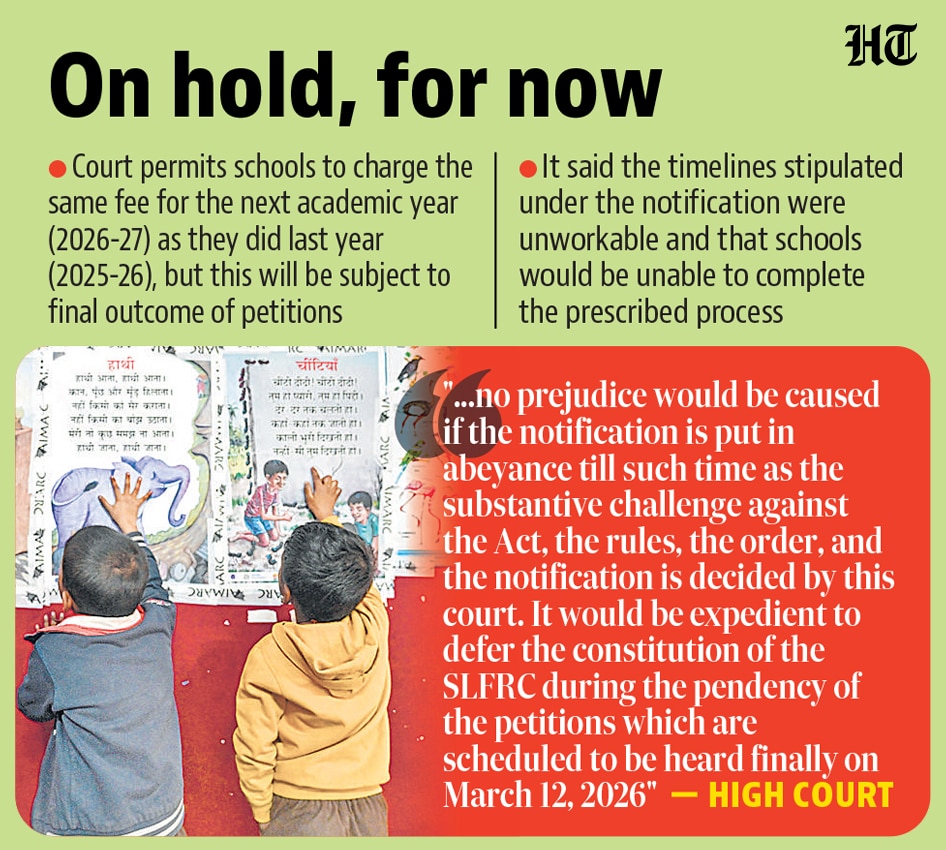
On February 1, the DoE issued a notification directing all schools to constitute SLFRCs by February 10, instead of July 15, as provided under the Delhi School Education (Transparency in Fixation and Regulation of Fees) Act, 2025. The notification required schools to form the committees within 10 days and submit details of the proposed fee structure within 14 days of their constitution.
“In view of the above, it would be expedient to defer the constitution of the SLFRC during the pendency of the petitions, which are scheduled to be heard finally on March 12, 2026. Accordingly, it is directed that during the pendency of the present petitions, the operation and implementation of clause 3(1) and (2) of the notification shall remain in abeyance... the petitioners shall be entitled to collect the same fees for the academic year 2026-27 as was collected for the previous academic year till the fees is fixed/approved in terms of the provisos of the act and the rules subject to the outcome of these petitions as provided in clause 3(6) of the notification...,” a bench of Chief Justice DK Upadhyaya and Justice Tejas Karia said.
“Any exorbitant fees charged by the schools for the academic year 2025-26 shall be regulated and dealt with in accordance with the law, subject to the outcome of the proceedings challenging the vires of the Act and the rules, presently pending before the High Court of Delhi and the Supreme Court.”
A detailed copy of the verdict is awaited.
The court passed the verdict on the petitions filed by the Forum of Minority Schools through advocate Romy Chacko, the Action Committee of Unaided Recognised Private Schools through advocate Kamal Gupta, the Delhi Public School Society, and the Rohini Educational Society seeking a stay on the decision.
In the petitions, the petitioners argued that the February 1 order was contrary to the Act, which mandates the constitution of the committees by July 15, and that any such change could only be effected through a legislative amendment and not by executive order.
They added that the notification disrupted the statutory framework, which envisages completion of the fee fixation process for the upcoming academic year (for instance, 2027–28) during the preceding academic year (2026–27).
Additional solicitor general SV Raju and Zoheb Hossain, who appeared for the DoE, said that the timelines prescribed under the Delhi School Education (Transparency in Fixation and Regulation of Fees) Act, 2025, are not “sacrosanct” and do not form part of its basic structure. They argued that the Act’s objective is to prevent commercialisation and profiteering, and that prescribed timelines can be modified to achieve that objective.
On February 16, the DoE defended the decision as a “one-time measure” to facilitate implementation of a regulated fee structure for the academic session 2026–27 commencing April 1. The DoE submitted that the department initially proposed to implement the Act from the academic year 2025–26, assuming the regulated fee structure would continue into 2026–27 until the SLFRCs fixed fees by August 2026. After deciding not to enforce the Act in 2025–26, the February 1 notification was issued.
The high court is scheduled to hear the petitions challenging the Act’s constitutionality on March 12.

Stay updated with all top Cities including, Bengaluru, Delhi, Mumbai and more across India. Stay informed on the latest happenings in World News along with Delhi Election 2025 and Delhi Election Result 2025 Live, New Delhi Election Result Live, Kalkaji Election Result Live at Hindustan Times.


