
 E-Paper



Delhi Jal Board proposes three-pronged solution to check sewage inflow into Yamuna
In its report, the DJB said seven assembly constituencies account for the sewage inflow into the Barapullah drain, with only two of them—Malviya Nagar and Greater Kailash—having proper sewerage networks

 Prefer HTon Google


The Delhi Jal Board (DJB) has formulated short-term, medium-term and long-term plans to resolve the issue of sewage inflow into the 16-kilometre-long Barapullah drain, which subsequently empties into the Yamuna, according to a submission made to the National Green Tribunal (NGT).
In a report dated July 4, which was made public on Monday, the DJB said its immediate plans include identifying points where sewage enters the Barapullah drain and its subsidiaries, within six months. Its medium-term strategy, to be executed in six months to a year, comprises the setting up of decentralised sewage treatment plants (STPs) and complete sewerage networks in unauthorised colonies. In its long-term plan, the DJB plans to connect drains from all colonies that empty into the Barapullah to five STPs, besides setting up more decentralised STPs, in one to three years, according to the submission.
In its report, the DJB said seven assembly constituencies account for the sewage inflow into the Barapullah drain, with only two of them—Malviya Nagar and Greater Kailash—having proper sewerage networks. The remaining five—Deoli, Ambedkar Nagar, Sangam Vihar, Chhattarpur and Mehrauli—do not have a proper sewerage network, it said.
“These assembly constituencies contribute sewage discharge into the sub-drains of Barapullah drain in the upstream of Defence Colony. This drain, flows through parts of south, central, and southeast Delhi, including areas such as Chirag Delhi, INA, Mehrauli, Defence Colony, Greater Kailash, Nizamuddin, and Pushp Vihar, before eventually meeting the Yamuna River...” it said in the report.
The DJB added that while it provided sewerage connections to 35 unauthorised colonies in these assembly constituencies, several more such colonies did not have a proper network as they were built on forest land. DJB was responding to a plea filed by the Nizamuddin Residents’ Welfare Association.
The NGT is hearing multiple pleas filed on Delhi’s stormwater drains, with petitions from residents of Nizamuddin West, Defence Colony, and Shahdara, among other neighbourhoods across the city, seeking action against the sewage flowing through the Capital’s drains. The pleas have pointed out that the sewage has led to foul smell and waterlogging during the monsoon.
In a previous hearing on May 21, the NGT sought a response from the DJB on action being taken to prevent sewage inflow into the Barapullah drain and its subsidiary stormwater drains.
In its latest submission, the DJB said these short-term, medium-term and long-term action plans should help solve the problem of sewage in these stormwater drains. “In the immediate action….DJB is further identifying other locations where sewage flow in the drain can be trapped in to the existing network…” it said in the report, adding it wanted to reduce treated effluents from STPs from flowing into the drain, and instead, use it for horticulture.
For the medium-term plans, the DJB said modular decentralised STPs were being explored, along with a target of providing house service connections (HSC).
“There are 30 un-authorized colonies in the upstream of Chirag Dilli drain in which sewerage network has been laid. In order to provide house service connections (HSC) i.e. last mile connectivity, estimate is under the process of approval,” the DJB said in its report.
In the long run, it said unauthorised colonies will be connected to existing STPs, including facilities at Okhla and Ghitorni. “Further, DSTPs are proposed at Fatehpur Beri. It will serve 8 unauthorised colonies. DJB is preparing an estimate to extend to five more unauthorised colonies and villages too. Another DSTP will be set up at Chandan Hola Satbari (serving 10 unauthorised colonies and four villages), another at Maidangarhi (eight unauthorised colonies and one village) and the final one at Chhatarpur extension, which will serve five unauthorised colonies,” it said in the submission.
“It is humbly submitted DJB shall make all efforts to stop flow of sewage into the stormwater drains...” it added.
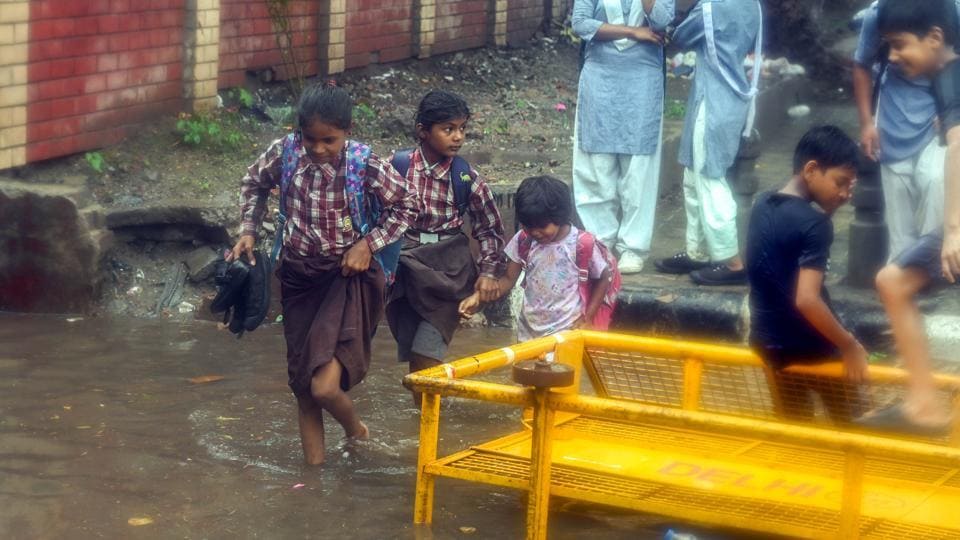
Last year, multiple localities, including Lutyens’ Delhi and south Delhi, suffered severe waterlogging across, as record rainfall—including a 228mm spell in a 24-hour window on June 28—lashed the city. Civic agencies came under the scanner for failing to clear silt from key drains in time, resulting in backflow and flooding. Much of the backflow onto roads and residences comprised sewage.


Stay updated with all top Cities including, Bengaluru, Delhi, Mumbai and more across India. Stay informed on the latest happenings in World News along with Delhi Election 2025 and Delhi Election Result 2025 Live, New Delhi Election Result Live, Kalkaji Election Result Live at Hindustan Times.


