E-Paper



Delhi records second ‘good air’ day in 23 days, another one likely today: IMD
Good air days, when the AQI reading is 50 or less, are a rare occurrence for the Capital with only 12 such days recorded since early 2015, when the AQI was first launched.

 Prefer HTon Google


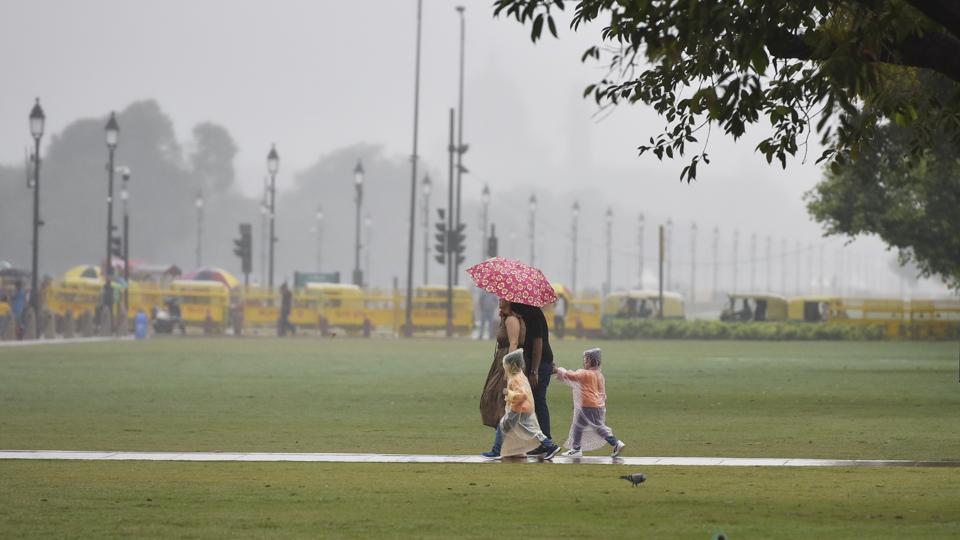
The Capital recorded its second “good” air day of the year on Sunday, with overcast skies, intermittent rain and breezy conditions lowering the Air Quality Index (AQI) reading to 47, as per the Central Pollution Control Board (CPCB)’s daily 4pm national bulletin. Delhi had recorded its first “good” air day this year on September 16, when similar overcast skies, light rain and gusty winds caused Delhi’s air quality to be recorded at 47.
To be sure, an AQI reading between zero and 50 is considered “good”, 51 and 100 “satisfactory”, 101 and 200 “moderate”, 201 and 300 “poor”, 301 and 400 “very poor”, and 401 and 500 “severe”.
Good air days, when the AQI reading is 50 or less, are a rare occurrence for the Capital with only 12 such days recorded since early 2015, when the AQI was first launched.
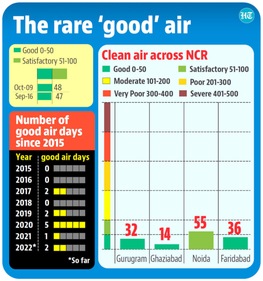
Last year, Delhi only recorded one such day due to unexpected rain on October 18, while in 2020—when most of the year witnessed pandemic-induced lockdowns—the Capital could only manage five such days.
According to weather data, a majority of these “good” air days usually occur during the monsoon months and almost always occur when strong winds blow in the region and help settle pollutants. In 2015, when the Air Quality Index (AQI) was launched, Delhi recorded no “good” air days. The Capital fared no better in 2016. It was only in 2017 that Delhi saw its first “good” air day since the launch of the index—during the monsoon on July 30 and 31, when the AQI readings dropped to 43 and 47. Both days saw overcast conditions with isolated spells of rain across the city.
In 2018, not a single day made the cut, but 2019 saw Delhi’s cleanest air spell during the monsoon when the Central Pollution Control Board bulletin recorded an AQI reading of 49 on August 18 and 19.
In 2020, four of the five “good” air days occurred in August during the monsoon, with only one non-monsoon day, March 28, recording “good” air—a result of the pandemic-induced national lockdown. On August 13 and 20, 2020, Delhi recorded an AQI reading of 50 each, which fell to 45 on August 24. On August 31, Delhi recorded its lowest-ever AQI reading at 41. While the first two “good” air days were due to heavy rain, the last two were primarily due to good wind speed.
According to SN Tripathi, professor at the department of civil engineering at IIT Kanpur, while Delhi continues to rely on meteorological factors to achieve “good” air, there is a small transition towards relatively cleaner air days in the “moderate” or “satisfactory” categories. “In the short term, it is still easy to achieve a ‘good’ air day as one only needs favourable meteorological conditions such as strong winds and rain. However, to consistently achieve it, pollutants from almost all sources need to be brought down to the bare minimum and that will take time,” he said, adding on a “good” air day, neither the PM2.5, nor the PM10 concentration in the air is harmful. “While the aim is to reach good air, we can gradually reach that goal by increasing the satisfactory and moderate days first,” he said.
While PM 2.5 is fine, inhalable particulate matter with diameters of 2.5 microns made up of hundreds of chemicals, PM10 is suspended coarse particulate matter, either solid or liquid, with a diameter of 10 micrometres (µm) or less.
Meanwhile, Delhi’s air has gradually improved over the last four days, owing to a change in wind direction and the subsequent spell of rain. Delhi’s AQI reading was 211 (poor) on Wednesday, before wind speed picked up and brought it down to 79 (satisfactory) the day after that. On Friday, it dropped to just 55 (satisfactory), and was recorded at 56 (satisfactory) on Saturday.
Forecasts by the Early Warning System (EWS)—used by the Commission for Air Quality Management (CAQM) sub-committee which executes the Graded Response Action Plan—shows Monday’s AQI reading could hover between the “good” and “satisfactory” categories as well.
“The AQI reading is likely to be in the ‘good’ to ‘satisfactory’ category on Monday. It will remain in the ‘satisfactory’ category for Tuesday and Wednesday. The outlook for the subsequent six days meanwhile shows ‘satisfactory’ to ‘moderate’ AQI readings,” said the EWS on Sunday.
Anumita Roychowdhury, executive director, research and advocacy, at the Centre for Science and Environment (CSE) said while Delhi witnessed “good” air on Sunday, almost all of it was induced by meteorological conditions, not the control of pollution sources.
“What we have achieved with the wash-out effect of rain needs to be attained with stringent action on all pollution sources across a large region. Weather and the behaviour of farmers in the next two weeks will determine how the early part of winter pollution, particularly in October, plays out. With this late rain spell, it is possible the crop fire window gets postponed and gets concentrated around the time when inversion conditions (when cold air at the surface gets trapped under a layer of warmer air) are expected to set in,” she said.