E-Paper



Delhi sees its cleanest air day since August 2020
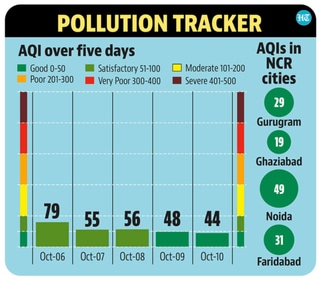
Monday’s AQI reading was an improvement on Sunday’s reading of 48, and was only surpassed by the reading on August 31, 2020, when the AQI was 41.

 Prefer HTon Google


Delhi on Monday saw its cleanest day in terms of air quality in more than two years, recording an air quality index (AQI) of 44 -- the second consecutive day that the Capital’s average AQI was in the ‘good’ category.
The Central Pollution Control Board (CPCB) classifies an AQI of 50 or lower as ‘good’, between 51 and 100 as ‘satisfactory’, between 101 and 200 as ‘moderate’, between 201 and 300 as ‘poor’, between 301 and 400 as ‘very poor’ and over 400 as ‘severe’.
Monday’s AQI reading was an improvement on Sunday’s reading of 48, and was only surpassed by the reading on August 31, 2020, when the AQI was 41. It was also only the 13th day since 2015 -- when the CPCB started keeping records of the Capital’s AQI -- that Delhi recorded a ‘good’ air day.
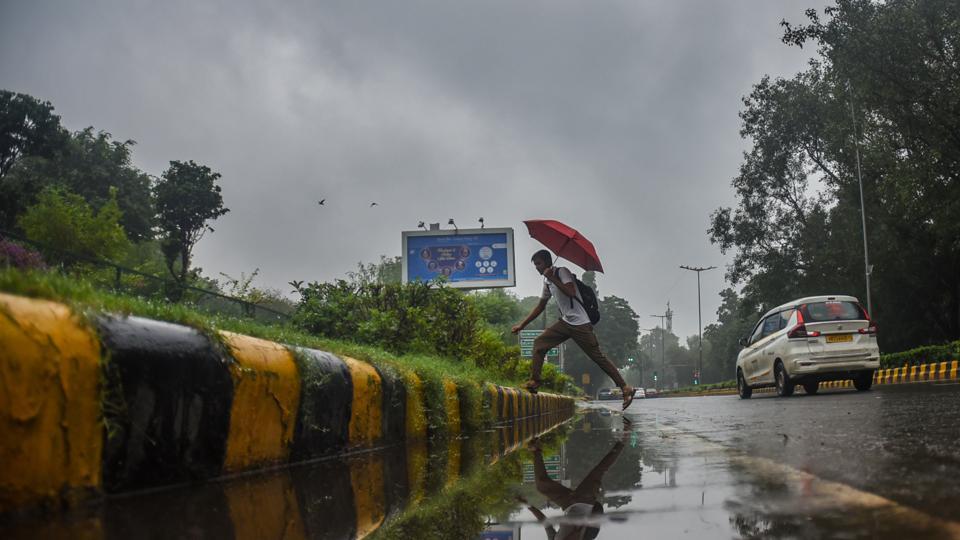
Anumita Roychowdhury, executive director, research and advocacy at the Centre for Science and Environment (CSE) said this spell of good air is largely down to favourable meteorological conditions, noting that the city has received rain over the last four days.
“Once the rains go away, AQI will once again start rising and with an early Diwali this year, air pollution will depend on a lot on adherence of the firecracker ban and the behaviour of farmers in terms of stubble burning,” she said.
The Capital received 21.8mm of rainfall in a 24-hour period from 8:30 am on Sunday, with another 0.2mm of rainfall added over the next nine hours. This light rain activity was accompanied with winds of 15-20 km/hr in parts, further facilitating dispersal of local emissions and pollutants.
However, the rain activity will not last long and is likely to reduce this week. “Rain activity will reduce considerably in the next 48 hours and only isolated very light rainfall will occur in some parts. Cloudy skies will continue to prevail till Wednesday and from Thursday onwards, no rain is expected,” said a met official.
In terms of good air quality, 2022 has now emerged as the second most productive year with three good air days, behind only five days in 2020, a year which saw cleaner air largely due to the pandemic-induced restrictions.
In 2021, Delhi recorded only one ‘good’ air day -- October 16, when the AQI was 46 -- while 2019 and 2017 recorded only days when the AQI reading dipped below 50. No such days were recorded in 2018, 2016 and 2015.