
 E-Paper



Delhi air ‘poor’ for 1st time since June, Graded Response Action Plan in effect
Delhi on Wednesday recorded an AQI of 211, according to the Central Pollution Control Board’s (CPCB) 4pm bulletin. This was a sharp upswing from 150 (moderate) on Wednesday, and the highest reading since June 25 this year, when the AQI was 230.


Slow winds and local emissions worsened Delhi’s air quality on Wednesday, pushing the Air Quality Index (AQI) reading it into the “poor” zone for the first time in 102 days, and leading to the implementation of the first level of the Graded Response Action Plan (Grap) aimed at pre-emptively controlling pollution levels in the National Capital Region (NCR).
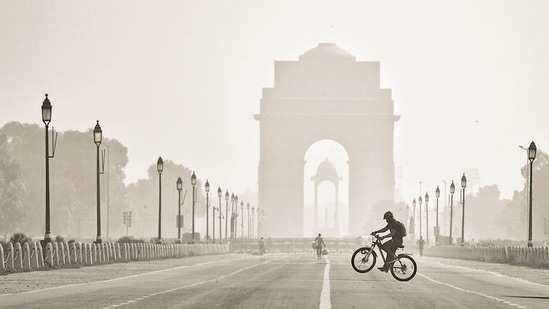
Delhi on Wednesday recorded an AQI of 211, according to the Central Pollution Control Board’s (CPCB) 4pm bulletin. This was a sharp upswing from 150 (moderate) on Wednesday, and the highest reading since June 25 this year, when the AQI was 230.
An AQI between 101 and 200 is categorised as moderate, and one between 201 and 300 as poor.
The pollution levels meant that Stage 1 of the Grap measures came into effect on Wednesday, after directions by a subcommittee of the Commission for Air Quality Management (CAQM). The measures under this stage can be enforced anytime across NCR when Delhi’s AQI hits at least 201.
Under this stage, 24 measures will have to be enforced on the ground: Agencies must sprinkle water on roads and sweep them with machines; work must be stopped at all construction and demolition projects with an area of over 500 square metres that have not registered themselves on the state government’s web portal; fines are levied on construction and demolition (C&D) sites and visibly polluting vehicles; diesel generators can no longer be used as a regular power source and are allowed only as a backup, among other measures.
With AQI reaching 208 at 12pm on Wednesday, the CAQM subcommittee called an emergency review meeting at 4pm.
“It was noted that there has been a sudden dip in air quality parameters in the last 24 hours in the region, leading to the AQI for Delhi moving into the ‘poor’ category. While this is likely to a localised influence and forecasts do not predict any further deterioration, in an effort to maintain the AQI in the moderate category, as a precautionary measure, the subcommittee has decided that all actions as envisaged under Stage 1 of the GRAP (‘poor’ air quality) will need to be implemented in right earnest by all the agencies concerned, with immediate effect in the NCR,” said the CAQM subcommittee’s order.
Grap prescribes a list of curbs when air pollution levels in Delhi hit certain trigger points. The restrictions get stricter as AQI worsens. The updated plan, released by CAQM on July 13, now takes into account AQI, and not just PM2.5 and PM10 levels as triggers for the curbs.
Stage 2 is imposed when it is “very poor” (between 301 and 400), stage 3 when it is “severe” (between 401 and 450), and stage 4 when AQI is in “severe plus” (above 450).
VK Soni, scientist at the India Meteorological Department and part of the CAQM subcommittee, said wind conditions became calm after 10pm on Tuesday, leading to a gradual accumulation of pollutants and the AQI rocketing into the “poor” zone.
“With calm wind conditions, local emissions and pollutants were not able to disperse freely, and by morning, AQI was on the brink of the ‘poor’ category.”
While Grap measures could have been enforced any time after October 1, the subcommittee was relying on the Early Warning System (EWS) developed by the Indian Institute of Tropical Meteorology (IITM) for its forecasts, which predicted only “moderate” air in Delhi on Wednesday.
Experts said the prediction system may need to be tweaked to better forecast Delhi’s pollution.
Professor Mukesh Khare, from the department of Civil engineering at IIT Delhi, said the fact that the AQI fell into “poor”, bucking the prediction, showed that some emissions may not have been factored into the forecasting system.
“This gives us a good opportunity to check the meteorological data being used for the forecasting system that CAQM is relying on. With effigies being burnt and the temperature gradually dipping, particularly at night, it is possible some local emissions are not being factored in,” he said, adding that measures under the ‘poor’ category should have been enforced much earlier, in order to prevent AQI from reaching this range.
Rain likely tomorrow, to impact air quality
Air quality forecasts by EWS showed that light rains expected in the region on Thursday could push AQI back into the “moderate” category, or at least to the lower end of the “poor” zone.
“The air quality is likely to improve further only on October 7, but it will still remain in the moderate category. Moderate AQI is also expected on October 8,” said the EWS forecast, issued on Wednesday.
A CAQM official, who asked not to be named, said the measures under the “poor” category will remain in place until another meeting is held to revoke these orders.
Stay updated with all top Cities including, Bengaluru, Delhi, Mumbai and more across India. Stay informed on the latest happenings in World News along with Delhi Election 2025 and Delhi Election Result 2025 Live, New Delhi Election Result Live, Kalkaji Election Result Live at Hindustan Times.


