
 E-Paper



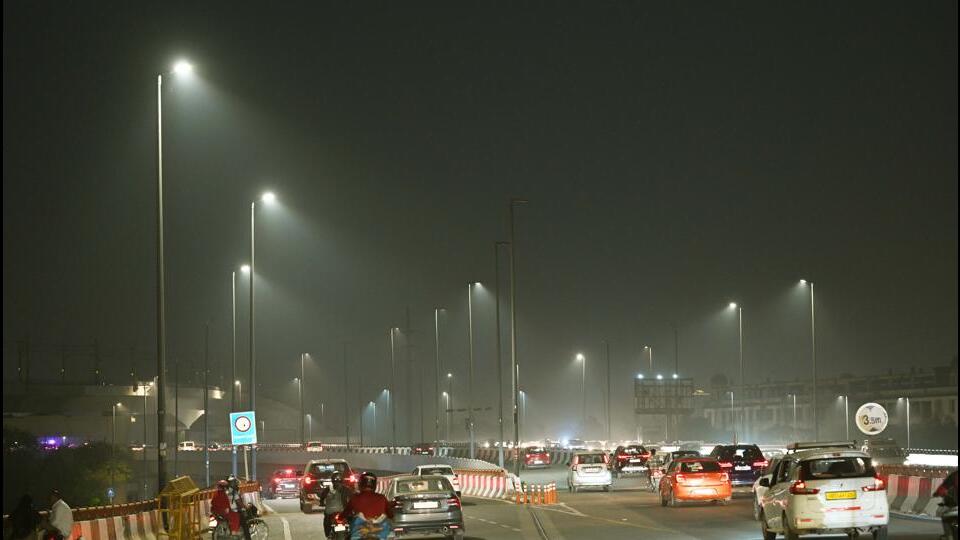
Delhi’s air quality slips to ‘very poor’ as CPCB faces server glitch
Delhi AQI: Forecasts show the Delhi AQI is likely to stay “very poor” on Monday, too, before possibly improving again as wind speed may increase marginally.

 Prefer HTon Google


The air quality in the Capital deteriorated further to the “very poor” category on Sunday after two days of recording “poor” air. The 24-hour average air quality index (AQI) on Sunday was logged at 315, as compared to 292 on Saturday, as per the Central Pollution Control Board (CPCB) data.
The CPCB’s daily bulletin of 4pm was released at 11pm on Sunday, due to a technical glitch. Data on CPCB’s Sameer app was also not updated after noon. Officials said while 39 stations in the city were active and gathering data, a server glitch lead to no updates in both CPCB’s website and app.
“Our stations are functional but there was a glitch, which was not allowing the servers to be updated,” said a senior CPCB official, involved with the air laboratory.
Despite the server issue, hourly readings for all eight pollutants used to calculate the AQI — including PM10, PM2.5, NO2, SO2, CO, O3, NH3, and Pb — were available on the Delhi Pollution Control Committee’s (DPCC) website, indicating that data was still being gathered.
Such similar glitches have been witnessed in the recent times too. On January 1, data for AQI stations across Delhi-NCR was unavailable due to a similar server issue. On November 14, 2023, data for several hours was only available for 9 out of the 40 stations, with DPCC’s stations not being able to share or transmit data to the CPCB.
On October 31, 2022, data was not updated for over 11 hours due to a similar glitch. Data on CPCB’s app remained stuck between 5am and 4pm, however, the day’s national bulletin was released that day.
Forecasts show the AQI is likely to stay “very poor” on Monday too, before possibly improving again as wind speed may marginally increase.
The AQI worsened amid the transport sector emissions within Delhi and cross-boundary pollution, however, the estimated contribution of stubble burning touched a season-high of 3.71% on Sunday, data from the Centre’s Decision Support System (DSS) showed.
Prior to Sunday, the highest contribution of farm fires in a single day was 3.45% on Friday. The contribution on Saturday stood at 0.98%. DSS calculates the estimated contribution by sources of pollution to Delhi’s PM 2.5 levels, including emissions from the 19 NCR towns.
Typically, farm fires contribute up to 35% of Delhi’s total PM 2.5 levels when stubble burning touches its peak, usually in the first week of November. A change in the wind direction — from the existing northwesterly to easterly — from Monday is likely to prevent stubble intrusion in the coming days.
As per DSS, the biggest contributor to Delhi’s PM 2.5 on Sunday was the “others” category or unaccounted sources from outside Delhi (20.6%), followed by 15.5% from Delhi’s transport sector. Around 7.57% was estimated to be coming from Gautam Buddha Nagar.
“Delhi’s air quality is very likely to be in the ‘very poor’ category on October 27 and in the ‘poor’ category on October 28 and 29,” said the Early Warning System for Delhi (EWS) in its daily forecast.
An AQI of 51 to 100 is classified as “satisfactory”, and between 101 and 200 is classified as “moderate”, between 201 and 300 is “poor”, between 301 and 400 is “very poor”, and over 400 is “severe”, as per the CPCB.
CPCB data showed that out of Delhi’s 39 active air quality stations, Anand Vihar was in “severe” zone, with an AQI reading of 421.
The Commission for Air Quality Management (CAQM) had invoked Stage 2 of the Graded Response Action Plan (Grap) on October 19 when the AQI crossed 300. Delhi’s AQI had crossed 200 for the first time this season on October 14, prompting Stage 1 of Grap to be issued immediately. Stage 3 measures will kick in if the AQI crosses 400.
Grap’s Stage 1 focuses on dust mitigation at construction sites, waste management and reducing emissions.
Stage 2 restricts the entry of inter-state buses (other than EVs / CNG / BS-VI diesel) from NCR states into Delhi, while also calling for an increase in use of public transport.
Sunday was the fifth “very poor” air day in Delhi this winter season. Experts said that reduced impact from stubble burning and an early Diwali – aided by relatively favourable conditions, has prevented AQI from deteriorating to “severe”.
“Stubble burning is not a key factor yet, as we are seeing a delayed harvest. Diwali was also early this year and despite more firecracker emissions, favourable conditions such as good wind speed and higher temperature also helped Delhi,” said Sunil Dahiya, founder and lead analyst at the think-tank Envirocatalysts.


Stay updated with all top Cities including, Bengaluru, Delhi, Mumbai and more across India. Stay informed on the latest happenings in World News along with Delhi Election 2025 and Delhi Election Result 2025 Live, New Delhi Election Result Live, Kalkaji Election Result Live at Hindustan Times.


