
 E-Paper



Delhi gasps as AQI peaks at 391, CAQM holds off Grap-3 restrictions
Smog gripped the Capital Sunday morning, but improved winds and lower stubble share kept CAQM from imposing the next round of pollution curbs.

 Prefer HTon Google


Residents woke up to another morning of burning eyes and difficulty in breathing as a thick layer of smog shrouded the Capital Sunday morning, with the air quality touching a season-high in the early hours.
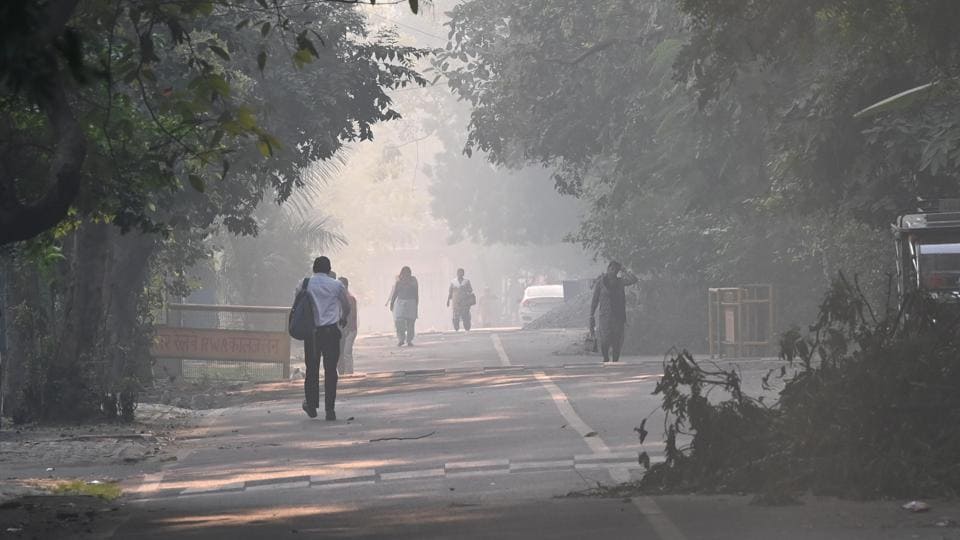
At 8 am, AQI was at 391 (very poor), on the brink of the ‘severe’ category, according to the Central Pollution Control Board (CPCB). It saw marginal improvement as winds picked up later in the day, recorded up to 15 km/ hour, along with bright sunshine. Sunday’s AQI crossed an earlier season-high of 388 at 10 am on November 2.

Taking a note of the air quality, the Commission for Air Quality Management (CAQM) called a review meeting at 4 pm, but decided not to invoke the next stage of the Graded Response Action Plan (Grap) across NCR. Citing a trend in the 24 hour average and no forecasts of ‘severe’ air ahead, it said, Stage-3 curbs — such as a ban on private BS-3 petrol and BS-4 diesel four-wheelers — were “not required at the moment”, while, 1 and 2 will continue to remain in place.
It added that the sub-committee was “keeping a close watch on the situation” and will review the air quality scenario of Delhi-NCR accordingly.
The improvement in AQI, experts said, was because of rising wind speeds, with the share of stubble burning also reducing marginally. Further, the wind direction fluctuated to westerly and southwesterly, as compared to northwesterly, which brings farm fire smoke to Delhi, on Saturday.
Data from the Decision Support System (DSS), which estimates the contribution of sources to Delhi’s PM 2.5, said the contribution of stubble burning was 5.38% on Sunday, down from a contribution of 8.64% on Saturday. It has not forecast any stubble contribution for Monday.
Mahesh Palawat, vice president at Skymet, said winds were becoming calm overnight, with temperatures dipping. However, strong winds are being seen during the day, aiding dispersion of pollutants. “In comparison to Saturday, where the wind direction was northwesterly, thus bringing more smoke from Punjab and Haryana, it was southwesterly to westerly on Sunday, meaning it was coming from Rajasthan and south Haryana. Thus, possibly the impact of farm fires was lower.”
Palawat said accumulation was seen till Sunday morning but winds of 14-15 km/hr were then recorded on Sunday post noon. “Saturday also had a slightly higher moisture content, which can again negatively impact pollution,” he added.
The capital has not officially recorded a ‘severe’ air day so far this year. The last such reading was on December 23, 2024, when the AQI was recorded at 406. The AQI at 4pm — when Central Pollution Control Board (CPCB) releases its national bulletin, was 370 (very poor) and 352 at 10pm.
Meanwhile, forecasts by the Centre’s Air Quality Early Warning System (EWS) for Delhi said ‘severe’ air is unlikely in recent days. “Delhi’s air quality is very likely to be in the ‘very poor’ category from November 10 till November 12,” said the daily bulletin, adding the forecast for the subsequent six days also shows ‘very poor’ AQI.
An AQI of 51 to 100 is classified as “satisfactory”, and between 101 and 200 is classified as “moderate”, between 201 and 300 is “poor”, between 301 and 400 is “very poor”, and over 400 is “severe”, as per the Central Pollution Control Board (CPCB).
Environment minister Manjinder Singh Sirsa said that the air was polluted for 10 years under the Aam Aadmi Party government and was improving under the current government of Rekha Gupta.
He said, “I want to tell the people of Delhi that all the high-rise buildings now have anti-smog guns installed on them. We have brought over 8,000 industries under pollution control and fixed their emission measurements. All the buses being added to Delhi’s fleet are electric, and our last-mile connectivity is now linked with the Metro...I assure you, Gupta ji is continuously working on this. We will improve, but people must understand — there’s a ten-year insurance on the damage AAP has done.”
In a statement, the CAQM sub-committee on Grap noted that the AQI had dipped from 391 at 10 am to 365 at 5 pm. “Given that Delhi’s daily average AQI has since shown a consistent declining trend....with the dynamic model and forecasts for weather and AQI by IMD and IITM also indicating the overall AQI of Delhi to stay in ‘Very Poor’ category in the coming days, the sub-committee on Grap opined that invocation of Stage-3 of Grap is not required at the moment and ongoing measures under Stages 1 & 2 of the extant schedule of GRAP to continue in the NCR..” it said.
Grap’s Stage 3 brings with it a ban on private BS-3 petrol and BS-4 diesel four-wheelers in Delhi, Gurugram, Faridabad, Ghaziabad, and Gautam Budh Nagar; blanket curbs on private construction and demolitions, and restrictions on the use of stone crushers, mining and associated activities. Further restrictions include a prohibition on non-essential diesel-operated BS-4 medium goods vehicles (MGVs), and a ban on BS-4 and lower diesel-operated light commercial vehicles registered outside Delhi, except for those carrying essential goods or providing essential services. Schools up to Class 5 in Delhi and its neighbouring districts will also have to mandatorily shift to “hybrid” lessons, while stage-3 also asks the Delhi and NCR state governments to stagger timings for public officers and municipal bodies in Delhi, Gurugram, Faridabad, Ghaziabad and Gautam Budh Nagar.
At 10 am — when the AQI was at its peak — 24 out of the city’s 39 active stations were in ‘severe’, with the Bawana (438) the worst impacted.
Delhi’s AQI at 4 pm on Saturday was 366 at 4 pm. In the day, Delhi chief minister Rekha Gupta advised residents to opt for carpooling and use public transport more frequently, and encouraged private institutions to give preference to work-from-home arrangements in view of the pollution. On Saturday, the Delhi Pollution Control Committee (DPCC), also held a press conference and denied allegations of bad data and potential manipulation at stations as it cited an improvement in AQI in the November first week compared to 2024.
Meanwhile, Delhi continued to feel the chill, recording a minimum temperature of 11.6°C on Sunday, which was three degrees below normal. This was marginally higher than Saturday’s season low of 11°C. The maximum was 28.1°C, which was a degree above normal. The India Meteorological Department (IMD) has forecast shallow fog on Monday morning, with both maximum and minimum to stay in a similar range.


Stay updated with all top Cities including, Bengaluru, Delhi, Mumbai and more across India. Stay informed on the latest happenings in World News along with Delhi Election 2025 and Delhi Election Result 2025 Live, New Delhi Election Result Live, Kalkaji Election Result Live at Hindustan Times.


