
 E-Paper



Delhi’s EV policy will be model for others: Govt
Transport minister Pankaj Singh said the government will focus on EV infrastructure in housing societies, under flyovers, and on vacant land

 Prefer HTon Google


Delhi’s electric bus fleet has expanded nearly ninefold in less than a year — from 400 in February to 3,400 today — and is expected to touch 6,000 by the end of 2025, and close to 8,000 by February next year, transport minister Pankaj Kumar Singh said on Monday. He added that the city’s upcoming Electric Vehicle Policy 2.0, due around the same time, will focus on charging infrastructure, scrapping of old vehicles, and incentives for wider adoption.
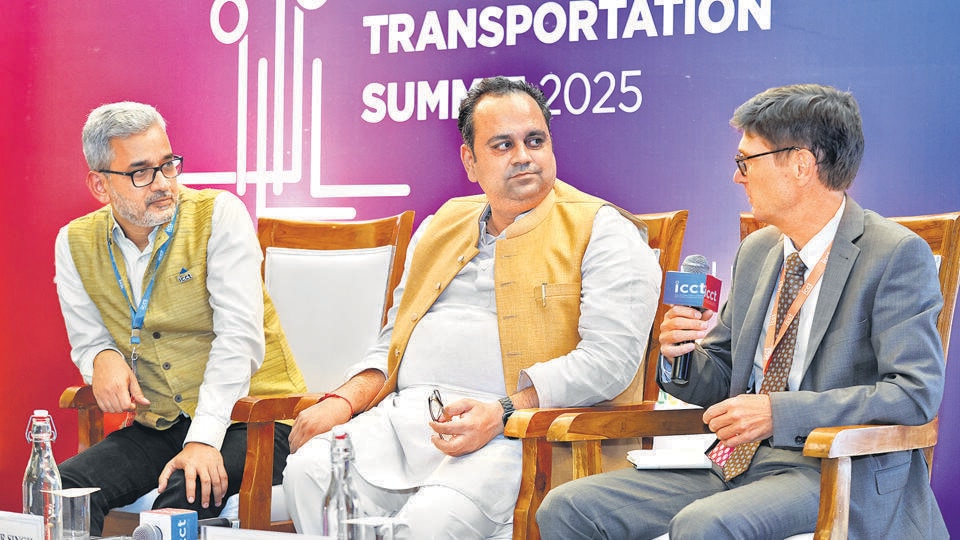
Speaking at the India Clean Transportation Summit 2025 at the India International Centre on Monday, Singh said Delhi’s transformation into a cleaner and greener capital will serve as a model for other Indian cities.
“As per our estimates, Delhi requires between 7,000 to 8,000 buses based on the ongoing route rationalisation. We should be able to reach that by February. The number has grown rapidly from 400 buses when I took charge to 3,400 now. This includes our successful ‘Devi’ buses, which are popular among commuters and helping solve last-mile connectivity problems,” Singh said, while speaking as part of the session called the ‘Delhi-Oslo Dialogue on Clean Transportation’.
Also read: India working to ease financing of electric vehicles: Govt official
The two-day annual flagship summit, organised by the International Council on Clean Transportation (ICCT) with Norway as the partner country and supported by the Union ministry of heavy industries, brought together policymakers, industry leaders, and international experts.
Hindustan Times is the media partner for the event.
‘Dosti’ with Oslo
Singh highlighted that Delhi could draw key lessons from Oslo’s experience in expanding EV infrastructure. Referring to the word dosti (friendship), which experts at the summit also framed as the Delhi-Oslo Smart Transport Initiative, Singh said: “Adequate charging infrastructure will be the backbone of Delhi’s new EV policy. We aim to bring the policy out by February, or even earlier. Our focus is on EV infrastructure in housing societies, under flyovers, and on vacant land in outer Delhi. For this, we will involve RWAs, explore PPP models, and ensure efficient traffic management around charging points.”
He added that the new policy will be “robust, comprehensive, and loved by the public” as it addresses scrappage of older vehicles, road tax rationalisation, and incentives for private adoption. “After buses, our next priority will be pushing for more e-two-wheelers and e-rickshaws. Through this policy, we want Delhi to become India’s model city for electric vehicles,” Singh said.
Representing Oslo, Audun Garberg, vice director and head of the climate department, drew parallels with Norway’s early challenges. “In 2006-07, we faced a similar problem of inadequate charging infrastructure. People will not switch from gasoline to electric unless they feel public infrastructure is sufficient. Now, charging points are common, and we are moving towards infrastructure for public transport, particularly e-trucks,” he said.
Garberg explained that Norway’s parliament pushed for EV charging access in housing cooperatives, even in the face of local resistance, which eventually proved critical to adoption. “This is a lesson for all cities — charging must be convenient where people live and work,” he said.
The Delhi government has positioned the upcoming EV Policy 2.0 as a major driver of electrification in the capital. Singh said that beyond infrastructure and incentives, the government would also look at adopting best practices and technologies from global leaders such as Oslo.
“Our focus is dosti — friendship — and this exchange of knowledge will help Delhi move in the right direction,” he said, during a session moderated by Amit Bhatt, ICCT’s managing director for India.
The minister stressed that electrification of public transport is only the beginning. “Once we achieve adequate bus numbers, the focus will shift to ensuring two- and three-wheeler electrification. These modes form the bulk of Delhi’s vehicular population and addressing them will bring a real reduction in pollution levels,” he said.
Industry experts at the summit noted that Delhi’s progress on electric buses reflects both the urgency of the city’s clean transport transition and the government’s prioritisation of public mobility. However, they also flagged issues of high operational costs, grid readiness, and the need for a city-wide charging master plan.
With its ambitious targets and the promise of a new policy framework, Delhi is looking to consolidate its position as India’s leading EV hub. As Singh summed up: “The world is watching. If Delhi can show that large-scale electrification is possible, other cities will follow.”


Stay updated with all top Cities including, Bengaluru, Delhi, Mumbai and more across India. Stay informed on the latest happenings in World News along with Delhi Election 2025 and Delhi Election Result 2025 Live, New Delhi Election Result Live, Kalkaji Election Result Live at Hindustan Times.


