
 E-Paper



Crime against women: Delhi’s daily battle
For women in the Capital, the concept of safety remains not just a pipe dream, but a concept that many have long given up hope on.

 Prefer HTon Google


Delhi, India’s sprawling Capital with over 20 million residents, has always been a city of stark contrasts — it boasts of a rich history, a vibrant melting pot of cultures and perhaps the best infrastructure in the country, yet it carries with itself the shameful burden of two infamous labels: “crime capital” and “rape capital.”
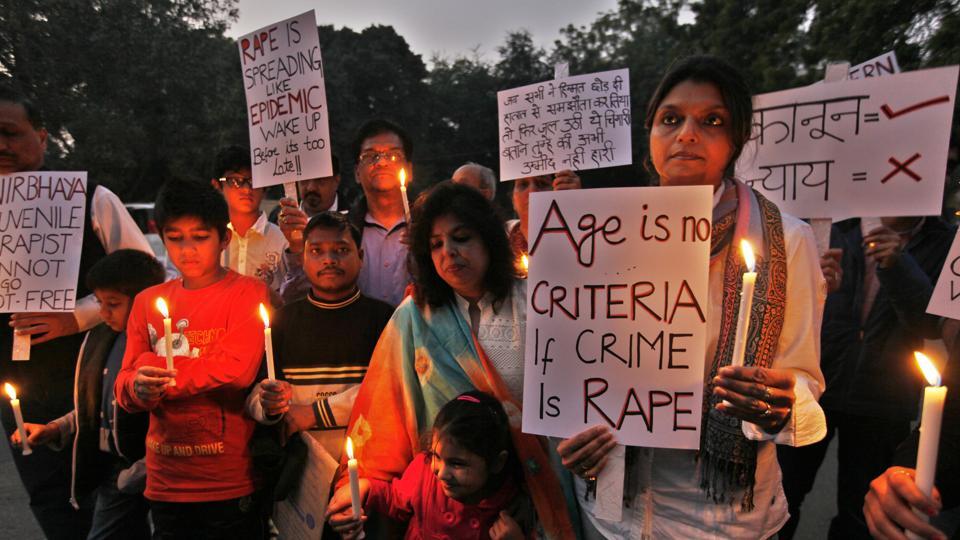
For women, regardless of age, class, or creed, there is one unifying, macabre reality: an overwhelming sense of inescapable insecurity.
Ask any woman who has lived in Delhi long enough, and you’ll hear harrowing tales of public spaces turned hostile. From unlit streets to crowded markets, from colleges to nightclubs, from taxis to its metro network, the city offers no refuge, no safety.
For them, the concept of safety remains not just a pipe dream, but a concept that many have long given up hope on.
But Delhi is also a city that knows the power of outrage — it is the only Indian city where women’s safety is a regular election issue and one that even brought down a government.
The city saw the biggest protests on women’s safety seen in India in decades, one that shook the central government, prompted changes in India’s rape laws, and awakened a generation.
In December 2012, the gruesome gang rape and murder of a 23-year-old paramedical student shook the city out of its slumber, and thousands of people – students, parents, activists, the young and the old, men, women, and children – marched to India Gate, demanding a safer city. Frothing public anger singed then chief minister Sheila Dikshit, who lost the elections the next year.
Women’s safety was a key theme which in 2012 gave birth to a widespread movement that eventually led to the birth of the Aam Aadmi Party (AAP) – which has now been ruling the city-state’s government since 2013.
The scars of 2012 linger, as do memories of earlier high-profile cases that cemented Delhi’s dark reputation. Priyadarshini Mattoo, a law student, was raped and murdered by her stalker in 1996. Jessica Lal, a model, was shot dead in 1999 for refusing a drink at a party. Acid attacks, such as the one that disfigured Laxmi Agarwal in 2005, and the 2008 killing of journalist Soumya Vishwanathan during a robbery attempt, tell of a city long unsafe for its women.
But more than a decade on, little has changed in the unsafe lives of millions of women.
And while high-profile cases continue to make headlines, it’s the everyday acts of violence — the catcalls, the gropes, the threatening glances — that compound the dread.
A grim story of numbers
NCRB is yet to release data for 2023 and 2024. The Delhi Police shared data saying a total of 1,990 rape cases were lodged last year in Delhi against the 2,141 rapes in 2023. Police said over 1,897 cases of molestation were lodged last year against the 2,345 molestation cases in 2023. The incidents of eve teasing also decreased from 381 cases in 2023 to 360 cases in 2024.
According to the National Crime Records Bureau (NCRB), Delhi recorded the highest number of crimes against women among major Indian cities in 2022. A whopping 30% of the 48,755 crimes reported in urban centres occurred here.
Perhaps the most damning statistic is this: On average, five rapes are reported every day in Delhi.
Last year alone, the city lodged over 1,990 rape cases, 1897 incidents of molestation, and 360 cases of eve-teasing.
Behind these figures are lives forever altered—students, professionals, homemakers, and children targeted in schools, streets, and public transit.
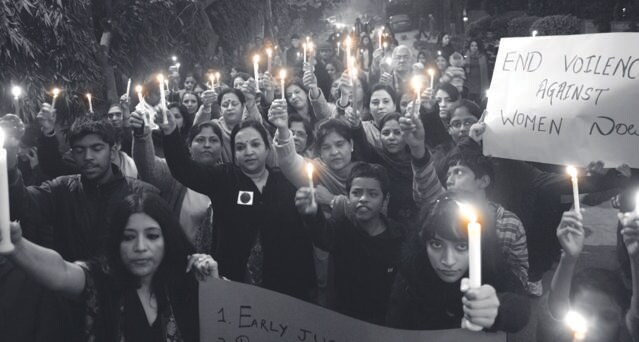
The horror of these numbers becomes more palpable when viewed through individual stories.
In one particularly heinous case last October, a 34-year-old woman was raped repeatedly by three men near ITO and Sarai Kale Khan. One of the accused was a beggar; another was a scrap dealer. When an autorickshaw driver noticed the assault, he joined in the violence instead of helping. The victim, described as mentally challenged, was hospitalised for weeks.
Experts argue that while law enforcement plays a vital role, societal attitudes and deeply entrenched misogyny fuel this crisis. Activists emphasise that safety isn’t just about policing but also about creating an environment where women aren’t treated as second-class citizens.
Kalpana Viswanath, CEO of Safetipin, an organisation that works on gender, said, “I feel there is need for improvement in infrastructure in public spaces for women safety. However, some of the things have been improved by the authorities over the years. I see free bus rides for women, better lit areas than before, safe metro and bus rides etc. However, there is always a scope for improvement. I believe last mile connectivity, regular safety audits, and alternate response systems can be worked on."
“We need alternate and better helplines and response systems in case one is not able to reach police. We are working towards flagging safer routes, public spaces, bus terminals and other services to help women navigate the city better,” Viswanath added.
Psychologists warn of the mental toll such constant fear takes on women, leading to heightened anxiety, restricted freedom, and lost opportunities.
A city under surveillance
Delhi’s response to its reputation has been to flood its streets with surveillance cameras. The Public Works Department claims over 246,000 cameras keep watch across the city, supplemented by over 10,000 police-operated cameras and countless private installations. The city now proudly boasts the highest number of CCTV cameras per square kilometer globally.
Yet, technology alone cannot shield women from harm. Crimes persist, emboldened by systemic failures and apathy.
Arushi Kumar, a philosophy student at Lady Shri Ram College, recounts the constant vigilance required to navigate her day. “Even leaving college isn’t safe,” she says. “Men stand outside the gates, openly masturbating at us. We started a group called ‘Commuting Safely’ just to travel in numbers. It’s terrifying—we plan our exits based on which gate seems safer.”
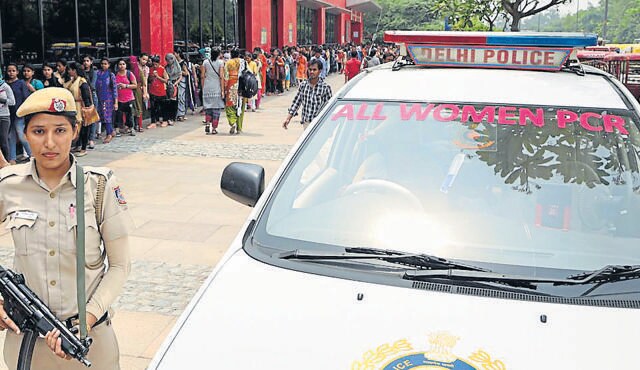
She describes an incident where a man accosted her near a PCR van. Despite her attempts to ignore him, the harassment continued while officers sat passively nearby. “They did nothing,” she says, her voice heavy with frustration.
Chhaya (who goes by only her first name), 43, a resident of Zamrudpur, said, “I have been working in Kailash Colony for over 20 years now. Life is a horror story for every domestic help in the city… I called my niece and got her to work at one of the houses. She called me a week later and told me that the son (of the employer) was molesting her. What can we do? One of my friends, who works as a nanny, was abused by the baby’s grandfather.”
When asked if any of the women filed a complaint, she said, “Look at us. Do you think police will listen to us? I just sent my niece back to our hometown. Now, people put CCTVs everywhere. I just feel they are useless. Powerful men in the city can do whatever they want…”
Aditi Drall (26), a lawyer and resident of Tikri Kalan, said, “Despite being a lawyer and knowing laws and amendments, there’s nothing one can do when you are being molested or catcalled. I see CCTVs everywhere but I have seen men do ‘silent catcalling’ through inappropriate gestures. It’s not safe to travel in public transport.”
Aishwarya M, an accountant and resident of Dwarka Mor area, said, “I feel CCTVs only work in a few cases…Mostly, CCTVs are either defunct or police don’t access them because they don’t wish to file a complaint. Also, there are areas where CCTVs are there but men still harass women. In metros, I have seen men catcalling and flashing. It’s just scary.”
Law enforcement claims it is doing its best.
Senior officials point to increased patrolling, the presence of all-women police stations, and initiatives like self-defence workshops. However, critics argue that these measures are reactive rather than preventive, and public trust in the police remains low.
Delhi Police officials, however, point to a decline in official statistics that depict a drop in crimes against women.
A police spokesperson said, “There is at least a 11% dip in crimes against women in the national capital. This shows how police deployment, women helplines, women-friendly pink booths, women operated patrolling teams and online portals are helping people in Delhi. There’s also a 19% dip in cases of molestation as police patrolling, picket teams and CCTVs put up by police are helping us catch eve teasers and bad characters. We have a strict policy of filing CAW (crimes against women) complaints the same day as we receive them. We ensure there’s no delay and a fast-track probe follows this.”
Politics and promises
As the 2025 elections approach, women’s safety looms large as a campaign issue once again. In 2013, public outrage over women’s safety contributed to the Congress’s loss of power. The AAP, led by Arvind Kejriwal, capitalised on the sentiment, promising change.
But have these promises translated into tangible results? Political parties continue to spar over statistics and credit for existing measures. Then there’s the blame-game – the AAP government has squarely blamed the Bharatiya Janata Party (BJP) – in opposition in the city, and power at the Centre – over the law-and-order situation in the Capital.
And while the political pot-shots continue for years, the lived reality of women tells a starker tale.
The unfinished fight
For the women of Delhi, the fight for safety is far from over. It is a battle waged every day—on crowded streets, in dimly lit subways, and even under the glare of surveillance cameras. It is a shared struggle that cuts across divides, uniting women in their quest for something as basic as dignity and security.
“Not much has changed in Delhi since the 2012 gangrape and murder case of a young woman. A list of recommendations was given by a court after the incident which included lighting up dark spots in cities, committees in each organisation to deal with workplace harassment and other schemes. They have not been implemented properly. Even the Nirbhaya Fund — aimed at improving safety and security for women in public spaces and creating One Stop Centres — has not utilised by most states. CCTVs won’t help unless the police increase patrolling and awareness among public,” said Prakash Singh, former DG of BSF and DGSP of Assam and Uttar Pradesh.
As Delhi prepares for its next political chapter, the question remains: Will women’s voices finally echo loud enough to turn promises into action?
Aishwarya added, “I don’t leave home at night to meet friends. I always go along with my sisters. Sadly, Delhi is just not safe for women. There was this one time my college friend had caught a guy who was stalking her and was shouting at him. Rather than helping her, people mocked her and a few people, including women, recorded a video… It’s just sad to be a woman in Delhi. You can be judged and catcalled for wearing a lipstick, a crop top or for buying a cigarette.”



Stay updated with all top Cities including, Bengaluru, Delhi, Mumbai and more across India. Stay informed on the latest happenings in World News along with Delhi Election 2025 and Delhi Election Result 2025 Live, New Delhi Election Result Live, Kalkaji Election Result Live at Hindustan Times.


