
 E-Paper



Delhiwale: Don’t take this with a pinch of salt
An extraordinary roadside stall.


Imagine if Emperor Shahjahan had decided on this beautifully tinted marble instead of the ordinary white, the Taj Mahal would have been a translucent pink. Or, if he had chosen that black marble lying over here, the mausoleum would have shone as dark as the deepest shade of midnight.
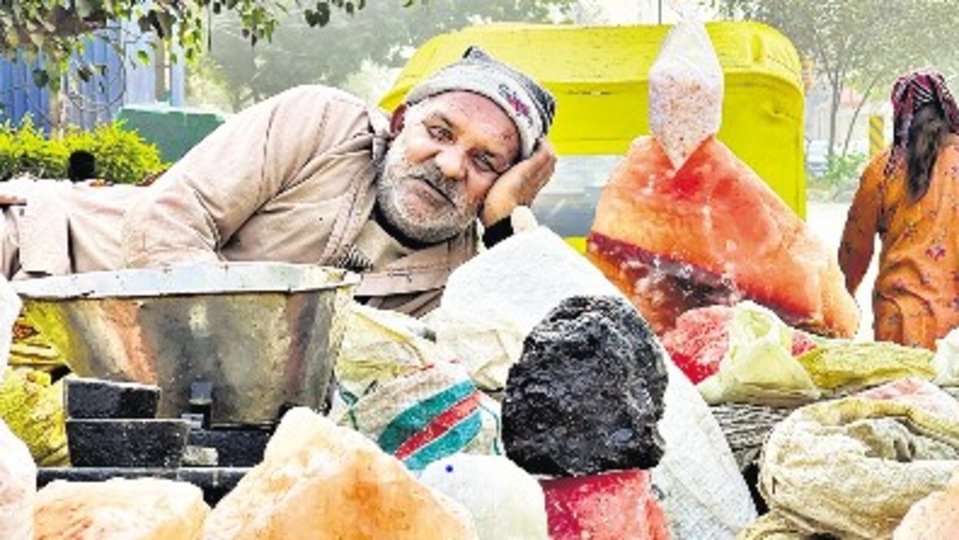
But this is not ordinary marble, the seller Naresh admonishes. Neither is he a seller of any kind of stones, he protests. “I deal in namak.” This is salt, he insists, gesturing towards these unshapely rock-like objects that look like huge pieces of marble possibly excavated from the arid hills of Rajasthan.
Naresh parks his cart daily on a dusty roadside in Gurugram’s Sector 14.
The setting is conventionally dull, with the noisy traffic choking the air with nauseating fumes. But the horse-drawn cart, loaded with these curious-looking salt rocks, makes the place appear exceptional.
You don’t get this namak in India, claims Naresh. These boulders of salt arrive from Pakistan, he informs authoritatively, “and that’s why it is also called the Lahori Namak,” referring to the city in Pakistan’s Punjab. Some moments later, a pedestrian stops by and sceptically asks if it is indeed Lahori namak. Naresh nods silently.
Lying sprawled atop the cart, as if it were his bed, he points to a row of stony fragments in light pink. “They are called the pink salt.” He next points towards similar pieces in black. “Those are called the black salt.”
Pink salt is used in the preparation of dal sabzi, while black salt is sprinkled over chopped fruit, or chaat, Naresh says mechanically, sounding like an announcer at a railway station.
This smoggy afternoon, the sun is shining palely but these salt rocks are glistening in an inner light of their own, as if each one of them is embedded with a small electric lamp.
The salt is sold in whole pieces ( ₹80 per kg), though Naresh also stocks splintered and powdered varieties (processed in a ‘chakki’, or mill), which are easier to use in the kitchen, and slightly more expensive. A native of Rohtak in Haryana, he has been a salt trader for 20 years. “Before that, I used to work at a brick kiln.”
Soon, another passerby pauses, looking wondrously at the salt rocks.


Stay updated with all top Cities including, Bengaluru, Delhi, Mumbai and more across India. Stay informed on the latest happenings in World News along with Delhi Election 2025 and Delhi Election Result 2025 Live, New Delhi Election Result Live, Kalkaji Election Result Live at Hindustan Times.


