
 E-Paper



Delhiwale: Walking down the history lane
Aurangzeb's intolerance led to the martyrdom of Sarmad, a mystic executed for his beliefs. Sarmad's grave in Delhi symbolizes this tragic history.


Consider the sixth Mughal emperor. He ill-treated his elderly father, executed his older brother, and was greatly intolerant to his people, especially those not sharing his Islamic orthodoxy.
While the infamous Aurangzeb lies buried far from Delhi, a few of the material remains of his time subsist in our city. Such as the Sheesh Mahal monument in Shalimar Bagh where he was crowned emperor some 350 years ago, and the icy white Moti Masjid he later built within the Red Fort.
That said, one Delhi monument that singularly conveys a truer appraisal of his era barely hints at being an important monument. It is very small, not imposing at all, and isn’t frequented by tourists. It is the grave of a man martyred by Aurangzeb. Indeed, Sarmad is today known as Shahid, the martyr. His grave in Old Delhi lies between the Jama Masjid and Meena Bazar. The legend describes Sarmad as an Armenian Jew from Iran who converted to Islam, emigrated to Sindh, where he fell in love with a young Hindu man. Eventually, he grew oblivious to society’s conventions, jettisoned clothes, became a fakir, and settled in Delhi.
It is this unclothed Sarmad that appears on the cover of a book copies of which are hawked at a trinket stall right outside his memorial. It shows a skinny man sitting in a yogic posture against the backdrop of Jama Masjid. Wearing a beatific smile, one of his arms is raised in defiance towards the figure of Aurangzeb, who is angrily scowling down at him. Per the historians, Aurangzeb despised Sarmad because of his unworldly nudity, his stubbornness in reciting only the first half of Kalimah — the Muslim declaration of faith — and his proximity to Dara Shikoh, the original heir-apparent. Aurangzeb finally had Sarmad executed.
The legends on Sarmad’s final moments are gruesome and sublime. It is said that the ascetic continued to fearlessly recite poetic verses as the executioner’s sword was slicing off his head. The execution was staged outside the Jama Masjid, in full view of a massive crowd. Immediately after the beheading, the legend has it, Sarmad picked up his bleeding head, serenely walked up the mosque’s red sandstone stairs and ascended to heaven.
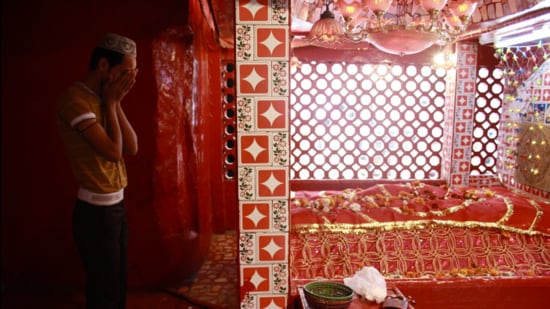
Over the centuries, the spot under the neem tree where Sarmad’s earthly remains were interred transformed into a peaceful Sufi dargah (it houses the grave of one more mystic, Hazrat Hare Bhare Shah). At a point in time, Sarmad’s portion of the shrine used to be completely red; the blood-red would evoke his persecution. A series of renovations have diluted the red, making the shrine’s visual aura less overwhelming. But years ago, this reporter visited the dargah in its former avatar. The sweeping red interiors strove to invoke the very spirit of Hazrat Sarmad Shahid’s martyrdom. It was surreal—see photo.


Stay updated with all top Cities including, Bengaluru, Delhi, Mumbai and more across India. Stay informed on the latest happenings in World News along with Delhi Election 2025 and Delhi Election Result 2025 Live, New Delhi Election Result Live, Kalkaji Election Result Live at Hindustan Times.


