
 E-Paper



DPCC claims Delhi air cleaner this yr
The lower stubble contribution — rather than regulatory action — may explain much of the year-on-year AQI improvement, raising questions about authorities claiming credit for better air quality.

 Prefer HTon Google


The Delhi Pollution Control Committee credited government action on Saturday for improving air quality during the first week of November compared to last year, even as the capital’s hourly AQI reached 380 in the evening — the season’s worst reading.
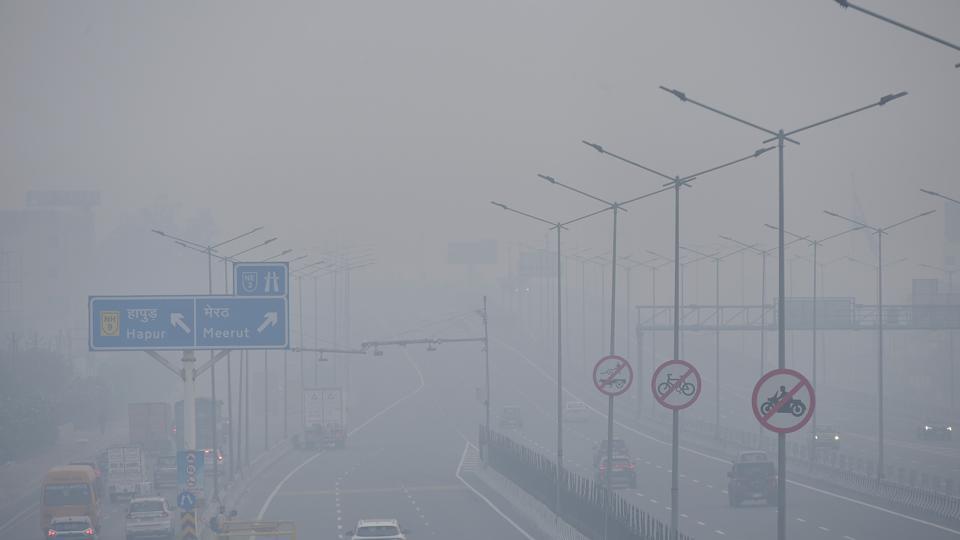
According to Central Pollution Control Board data cited by DPCC chairman Sandeep Kumar, the capital’s AQI was 322 on November 7 this year compared to 377 on the same day last year. Similar year-on-year improvements were recorded on five other days: 311 versus 352 on November 6, 202 versus 373 on November 5, 291 versus 381 on November 4, 309 versus 382 on November 3, and 303 versus 339 on November 1. Only November 2 showed worse conditions this year, with an AQI of 366 against 316 last year.
“Out of the first seven days of November, six have recorded better AQI this year. This has been possible due to the suggestions and instructions we have given to various government departments and their timely implementation,” said DPCC chairman Sandeep Kumar.
However, the improvement coincides with stubble burning contributing far less to Delhi’s pollution this year, according to the government’s own data.
Decision Support System data shows agricultural fires contributed just 9.03% on November 1 this year versus 35.2% on the same day in 2024. Daily contributions through the week remained similarly suppressed: 3.5% on November 2 against 15% last year, 4.07% on November 3 against 19.7%, 2.07% on November 4 against 23.4%, 1.26% on November 5 against 20.3%, 9.5% on November 6 against 22.7%, and 8.68% on November 7 against 17.8%.
The lower stubble contribution — rather than regulatory action — may explain much of the year-on-year AQI improvement, raising questions about authorities claiming credit for better air quality.
However, weather conditions too play a significant role in air quality and vary year to year.
And last year’s early November pollution was also influenced by Diwali celebrations on October 31, with firecracker emissions affecting readings in the first days of November. This year, Diwali fell earlier on October 24, separating the festival’s pollution impact from the early November period.
Kumar said with continued effort from government departments and residents, Delhi might avoid implementing Stage 3 and Stage 4 of the Graded Response Action Plan. “Last year, GRAP 3 had been implemented on November 13. This time, with support from all departments and the residents of Delhi, we hope to prevent reaching that stage,” he said.
When asked about missing air quality data in recent days and its impact on the city’s average readings, Kumar said DPCC’s 24 of Delhi’s 39 monitoring stations had complete data. “We have the entire data from these 24 stations and there is no data missing from our stations,” he said.
However, a Hindustan Times analysis published on November 5 identified missing data, suspicious measurement patterns and algorithmic loopholes in how the city’s average AQI is calculated — a combination of issues that hide ground conditions. The analysis of 168 hours of data from October 28 to November 4 found missing station data was not random, with more data absent during polluted hours than clean ones — a pattern that would make Delhi’s air quality appear better than actual conditions.
The investigation documented anomalies including the ITO monitoring station showing PM 2.5 and PM10 readings below 50 between 4-5 a.m. before data transmission stopped, then resuming at noon with both indices above 350 — a trajectory difficult to explain through normal atmospheric conditions.
When asked about videos circulating of water being sprinkled specifically around air quality monitoring stations and public concerns about data manipulation, Kumar said water sprinkling is conducted citywide. “Wherever there is pollution, including the 13 pollution hotspots, water sprinkling will be done. There is no specific direction to specifically sprinkle water at the stations,” he said.
DPCC member secretary Sandeep Mishra said concerns about water affecting readings were based on a misconception. “There is a misconception that if water sprinkling is done near the station, the data will go down but the station measures the pollution in a two-three kilometre radius,” he said.
Environmental analysts have previously raised concerns about water sprinkling near monitoring stations potentially affecting sensor readings, particularly during hours when pollution levels are highest.
During the briefing, officials said multiple agencies have received directives to control dust and vehicular pollution, and to enforce regulations against biomass burning and industrial emissions. “Mechanical road sweeping and water sprinkling have been intensified. Over 100 machines are currently being operated by various municipal bodies for mechanical sweeping. Road agencies have been directed to repair potholes,” Kumar said, adding that landfill sites are being managed and anti-smog guns are being deployed at several locations.
The transport department has been instructed to conduct more checks on polluting vehicles. Kumar appealed to resident welfare associations and private companies to discourage biomass burning, especially as temperatures drop, and provide electric heaters to security guards.
“As per provisions of the Commission for Air Quality Management, if need be, staggered office timings might be introduced. Last year, this had been implemented from November 18,” he said, urging residents to use approved fuels, ensure proper engine tuning and tyre pressure, and opt for public transport and electric vehicles whenever possible.
Kumar asked people to report complaints through the ‘311’ and ‘Green Delhi’ apps if they spot scattered debris, biomass burning, solid waste or construction waste.
The Commission for Air Quality Management (CAQM) held review meetings with the State Governments of Punjab and Haryana regarding efforts to curb stubble burning during the 2025 paddy harvest season.
The Commission noted that while Punjab has shown a marginal reduction in stubble burning incidents compared to last year, with 3,284 incidents from mid-September to early November (down from 5,041), certain districts like Muktsar and Fazilka have seen an increase in fire counts, raising concerns. The Commission stressed the need for Punjab to intensify actions, including better crop residue management, support for Compressed Biogas (CBG) plants, and stronger enforcement with accountability for officials linked to farm fires.
In Haryana, proactive incentive schemes and enforcement have led to a significant decrease in farm fire incidents, from 888 last year to 206 this season, CAQM noted. The Commission also reviewed pollution sources from vehicles, industries, dust, and waste management in Haryana and called for stricter pollution control measures. The Commission emphasized enhanced inter-state coordination, targeted implementation of action plans, and strict enforcement of statutory directions to ensure sustainable crop residue management and improve air quality across the region.

Stay updated with all top Cities including, Bengaluru, Delhi, Mumbai and more across India. Stay informed on the latest happenings in World News along with Delhi Election 2025 and Delhi Election Result 2025 Live, New Delhi Election Result Live, Kalkaji Election Result Live at Hindustan Times.


