
 E-Paper



Fewer stubble fires so far, but likely to flare up, say experts
NASA data shows that farm fires were spotted in Punjab around September 15, with around 10-15 showing up on satellite data. The numbers started picking up around September 27, when the count reached 40.

 Prefer HTon Google


Between September 1 and October 10, there were fewer cases of stubble burning in Punjab and Haryana than in the corresponding period last year, the National Aeronautics and Space Administration’s (NASA) satellite data has shown. But experts say this may not be a good indicator of the things to come as the late withdrawal of the monsoon from northwest India may just have delayed the fires.
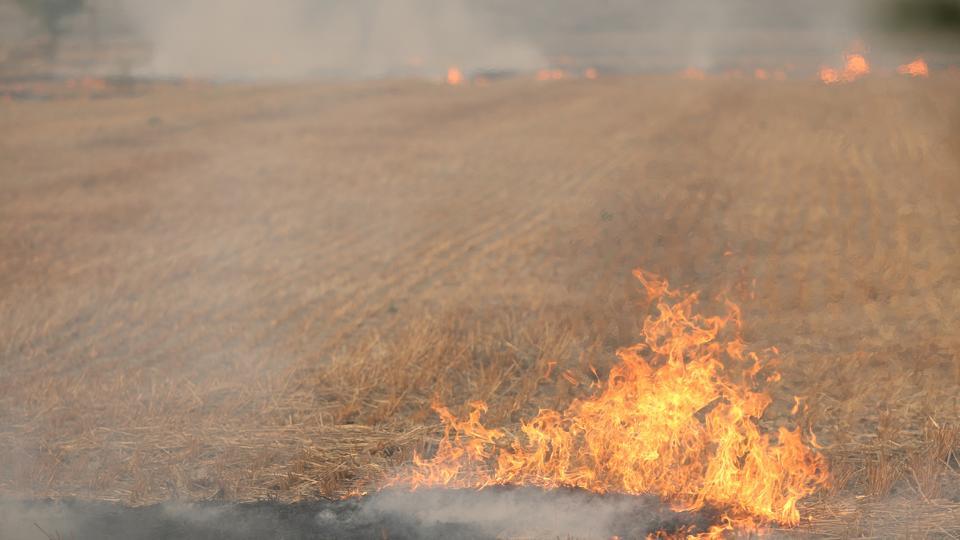
NASA data shows that farm fires were spotted in Punjab around September 15, with around 10-15 showing up on satellite data. The numbers started picking up around September 27, when the count reached 40.
Data also shows that while September largely saw inconsistent fires in some districts, there has been a steady rise in stubble fires since October 7, a day after the India Meteorological Department (IMD) officially announced the withdrawal of monsoon from Delhi and other parts of northwest India.
Between October 7 and October 10, 80-170 fires have been reported daily.
In Haryana, apart from one or two fires in September, stubble fires started from October 1. On October 8, 32 such fires were noticed in the state, which rose to around 80 on October 9 and 170 on October 10.
“So far, fires are low in number as compared to last year. But this is not indicative of how the season is going to be. We will have to wait and assess,” said Pawan Gupta, a research scientist at the Goddard Earth Sciences Technology and Research (GESTAR), Universities Space Research Association, Washington DC.
Every year, as winter sets in, Delhi’s air quality nosedives, with pollution levels deteriorating to emergency levels on certain days. The annual air emergency begins around mid-October, as farmers from the neighbouring states of Punjab and Haryana start setting their fields on fire to get rid of crop stubble and prepare their fields for the next crop season. The change in wind patterns after the withdrawal of monsoon facilitates plumes of thick smoke to travel into the capital from these agrarian states, impacting Delhi’s air.
NASA’s data shows that last year in Punjab, stubble burning started by September 17. On September 25, around 180 fires were reported. Between October 1 and October 10, over 200 fires were being reported daily in different districts in Punjab. Haryana on the other hand, reported 30-70 daily stubble fires last year in the same period.
Weather forecasters and environmentalists warned that the fires are likely to pick up in the coming week.
“Monsoon withdrawal was later than usual this year. And another anomaly was that September was also unusually wet this time; farms cannot be set on fire when it’s wet. Fires are likely to pick up in the coming week and as temperatures in Delhi start falling, the impact of these fires will also be more visible in our AQI (air quality index),” said a senior IMD scientist.
Experts also pointed out that apart from the late monsoon withdrawal, the delay in paddy procurement by the Centre could also have resulted in the delay in harvest. The food ministry had said on Thursday that the procurement of paddy in Punjab and Haryana was pushed back to October 11 due to heavy rain recently.
“Many factors can delay the onset of burning. Key burning trigger, though, is harvest, and in 2021, I think, the harvest has been delayed due to MSP (minimum support price) procurement date shift from the end of September to October 11, two weeks or so later than 2020,” said Robert Berry, professor emeritus at Aston University, United Kingdom.
The original procurement date of paddy at MSP for the 2021-2022 Kharif marketing season was October 1 in Punjab and September 25 in Haryana.


