E-Paper



Finite supply, rising demand: Is Delhi facing a water crisis?
Delhi faces water shortages due to a heatwave, low Yamuna River levels, and high demand. Government measures include rationalizing supply timings.

 Prefer HTon Google


A heatwave and surging water demand have led to supply shortages and reduced supply pressure in various parts of India’s capital over the last 10 days, prompting the government to announce measures such as rationalising supply timings and enforcing fines for wastage.
A look at the scale of the problem, the factors behind it and what to expect:
How does Delhi get its water?
Delhi depends on neighbouring states to meet around 86.5% of its drinking water supply. The Yamuna, the carrier lined channel (CLC) Munak, and the Delhi sub-branch (DSB) canals from Haryana, and the Upper Ganga Canal via Muradnagar from Uttar Pradesh send water to nine water treatment plants around the city. The remaining 13.5% is from internal sources, primarily tube wells and Ranney wells.
What’s happening with Delhi’s water supply?
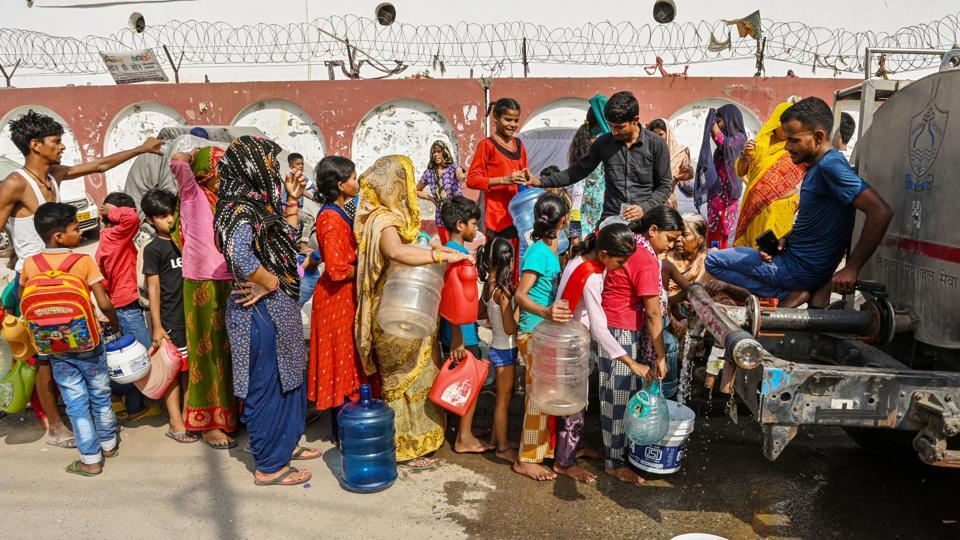
Delhi, India’s capital city, has been grappling with water shortages and reduced supply pressure for the past 10 days. The issue has affected various parts of the city, particularly residential areas located at the tail-ends of the extensive, 15.473-km water pipeline network. Shortages are also being reported in areas where the Delhi Jal Board supplies tankers, with demand having risen substantially. The Delhi government has announced measures to address the situation, such as adjusting supply timings and imposing fines for water wastage.
Why is there a water shortage?
The primary reason for the shortage is the low water level in the Yamuna River. According to Delhi Jal Board (DJB) reports, the low river level has led to a deficit of 10-30 million gallons per day (MGD) in the city’s water supply. Additionally, power outages at water treatment plants and high turbidity in the Upper Ganga Canal have contributed to the problem.
How much water does Delhi need?
The Delhi economic survey estimates that the city’s projected water demand is around 1,290 MGD, based on the goal of providing at least 60 gallons of water per person daily. However, the demand-supply gap widens during the peak summer months, typically in June. Surprisingly, the shortages have occurred earlier this year.
What is the current water supply situation?
The DJB aimed to supply 1,000 MGD under its summer action plan. However, data shows that on May 27, the supply dropped to its lowest level this season, with only 966.16 MGD provided—33.84 MGD below the usual supply. The situation has marginally improved in the last two days.
How are residents affected?
Residents in affected areas are receiving less daily water allocation, experiencing reduced water pressure, and dealing with shorter supply durations.
Some people have resorted to buying water from private tankers, which have significantly increased their prices due to high demand.
Tail-end areas of the supply network, such as Vasant Kunj and parts of Dwarka, are facing the worst of the crisis. According to DJB officials, shortfall of one MGD impacts around 21,500 people in the form of reduced water supply pressure and lower volumes.
In the north, Ashok Bhasin, from the North Delhi Residents Welfare federation, said the supply time has been curtailed to 1 hours and 55 minutes and the water pressure has become low. “The problem is more acute in the tail-end areas,” he said.
In the south, Rajesh Panwar, who heads the federation Vasant Kunj residents’ welfare associations, said the supply pressure has consistently gone down. “If a household was getting 1,000L of water a day, it has gone down to 400-500L. Our RWA groups are flooded with complaints and we had more than a hundred complaints yesterday,” he said.
Panwar explained that Vasant Kunj is fed by a series of underground reservoirs in various pockets connected to main reservoir in B1 sector. “These too are not getting filled. We were getting water for an hour earlier but the supply hardly lasts for 25-30 minutes and then it runs out. Some residents are forced to call private water tanker who are not charging Rs1800 for each tanker as demand is going up,” he added.
What measures are being taken to address the issue?
The Delhi government has announced several steps to mitigate the crisis. First, it has rationalised water supply timings to ensure equitable distribution. Second, it is enforcing fines for water wastage to discourage excessive consumption. Third, the number of hours to operate borewells in areas that depend on it have been raised to 14-15 a day.
The DJB is also working to mitigate the impact of shortages by rerouting water, ensuring that no region faces a complete lack of supply. Areas that got water twice a day are now getting it once --- either in the evening or morning --- and the volumes thus being saved are being diverted to worst-hit areas.
Will the problem worsen or abate?
A senior DJB official said that in the short run, the shortage will slightly ease as the heat is projected to relent and a large number of tankers being acquired are pressed into service from next week. However, another spell of water shortage could strike as it usually does in the second and third week of June, when the river dries up right before the monsoon. Release of more water from Haryana or Himachal Pradesh could also help tackle that spell.