
 E-Paper



Hybrid school rollout in city brings confusion and chaos
The decision has left students, parents and teachers shuttling between caution, confusion and compulsion

 Prefer HTon Google


When a message landed in her school WhatsApp group on November 11, informing parents that classes for students up to Class 5 would now run in hybrid mode, Pinki Soni thought she had a plan. With only one smartphone at home, she decided her younger child, a Class 2 student of Mayur Vihar’s Premchand Rajkiya Sarvodaya Bal Vidyalaya, would study online, while her Class 5 daughter would go to school. But by the end of the day, no online link had arrived.
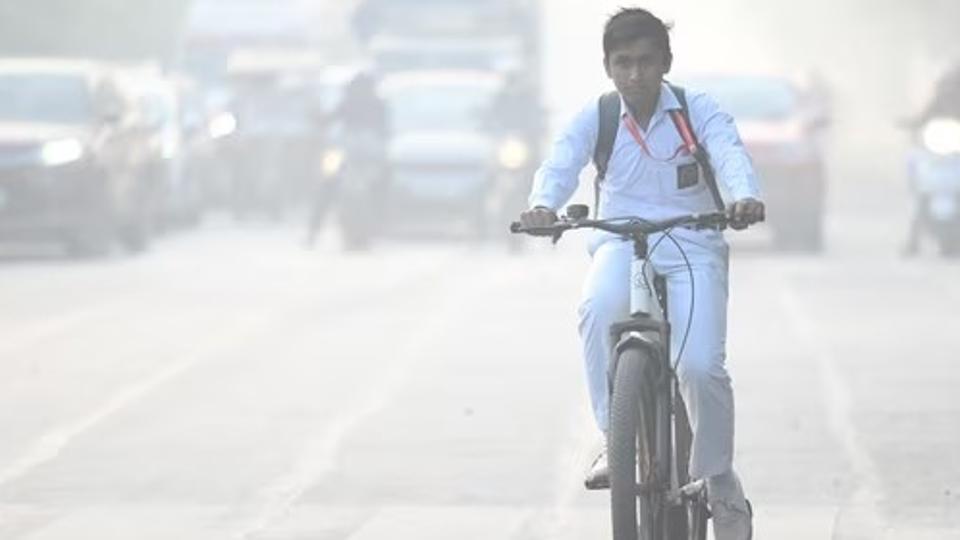
“A day passed after the notification and the link for online classes weren’t shared on the group. When I asked the teacher, he said classes will start once they get instructions from higher-ups and shared a few simple assignments for students,” Soni said. The next morning, with the smog still hanging heavy outside, she sent both children to school.
Her experience is not unusual. As the Delhi government’s November 11 circular directing schools to switch to hybrid mode took effect, the decision has left students, parents and teachers across the city shuttling between caution, confusion and compulsion.
“All Heads of School… are directed to conduct classes… in both physical and online mode (wherever online mode is feasible) with immediate effect until further orders,” the Directorate of Education circular said. But “wherever feasible” has proven a moving target.
Parents torn between health concerns and practical limits
Several parents told HT that the worsening air quality has pushed them towards preferring online classes, especially for younger children. But for many others, the logistics — digital devices, data, and the ability to supervise online learning — outweigh the health risk.
Manisha, whose daughter studies in Class 2 at a government school in Anand Vihar, said she did not receive any intimation from the school. “I heard in the news that schools will run online and offline sessions. But I did not receive any message regarding this from my daughter’s school,” she said, adding that she dropped her child to school on November 13 and 14 as usual.
_1763353973392.jpg "hybrid mode school (2)")
Private school parents too are weighing competing anxieties. “The kind of grooming that happens in school is not possible at home and some children in my daughter’s class have started having cervical issues and huge hump on the back due to online classes,” said Seema Shukla, whose daughter studies in Class V in Bal Bharti School, Dwarka. “So, I am sending her to school with an N95 mask.”
Divided attendance, stretched teachers
With parents pulling in two directions, both government-run and private schools say they are struggling to run two parallel systems.
“The teachers have to focus on the majority of students in the class as well as pay attention to those studying from home. They are overburdened and are confused whether to focus on the class or the camera,” said Jyoti Arora, principal of Mount Abu Public School, Rohini.
She estimated that nearly 90% of her students continue to attend in-person classes. “November is the month when we have all major events like the annual day, and then we help students prepare for exams in December. The entire calendar is disrupted now.”
She said the only long-term solution would be air purifiers in every classroom. “One purifier costs around ₹17,000– ₹20,000. It’s an extra cost, but it seems to have become a necessity like a fan. So I have decided to buy them.”
Government schools say attendance remains high, except for children with respiratory issues, and they are cutting down online teaching to essentials.
“Normally, we have classes for around 4–5 hours. But for those staying at home we are offering only two classes for around 1.5 hours in important subjects like math and science,” said Awadhesh Jha, principal of CM Shri Shri School, Rohini Sector-8.
Digital divide makes matters worse
Teachers say the hybrid model makes sharp the inequalities they have struggled with since the pandemic. Devices are limited, connectivity unreliable, and many teachers themselves lack the tools to deliver quality online instruction.
“Our teachers don’t have laptops or tablets and that’s a basic requirement for online classes,” said a teacher at an MCD school in Mandoli. “Some parents have three children studying in the same school and they lack resources to support online education. Even if they have devices, they are not very technologically advanced to properly help and monitor online classes. Hence, due to all these issues, our natural preference is towards offline classes.”
She added that most teachers use their own phones for online classes. “We don’t have a WiFi-enabled campus and the dongle we have is sometimes recharged and sometimes not, so teachers rely on their mobile data.”
The hybrid model, introduced as a health safeguard, has landed unevenly across Delhi’s school ecosystem, welcomed by some parents fearing pollution, resisted by those unable to support online classes, and burdensome for teachers managing two modes at once.

Stay updated with all top Cities including, Bengaluru, Delhi, Mumbai and more across India. Stay informed on the latest happenings in World News along with Delhi Election 2025 and Delhi Election Result 2025 Live, New Delhi Election Result Live, Kalkaji Election Result Live at Hindustan Times.


