E-Paper



In new Grap, eye on better waste management to cut garbage fires
“If waste is being segregated, it is not going to landfills or open dumps, then it will not be burnt, and a long-term plan is in place,” said Anumita Roychowdhury, executive director, research and advocacy at the Centre for Science and Environment (CSE).

 Prefer HTon Google


New Delhi: To minimise pollution from the burning of solid waste and frequent landfill fires, the revamped Graded Response Action Plan (Grap), notified by the Commission for Air Quality Management (CAQM) on Wednesday to reduce air pollution in the National Capital Region, has listed ways to tackle problems inherent to the current solid waste management system in Delhi, mainly the lack of waste segregation.
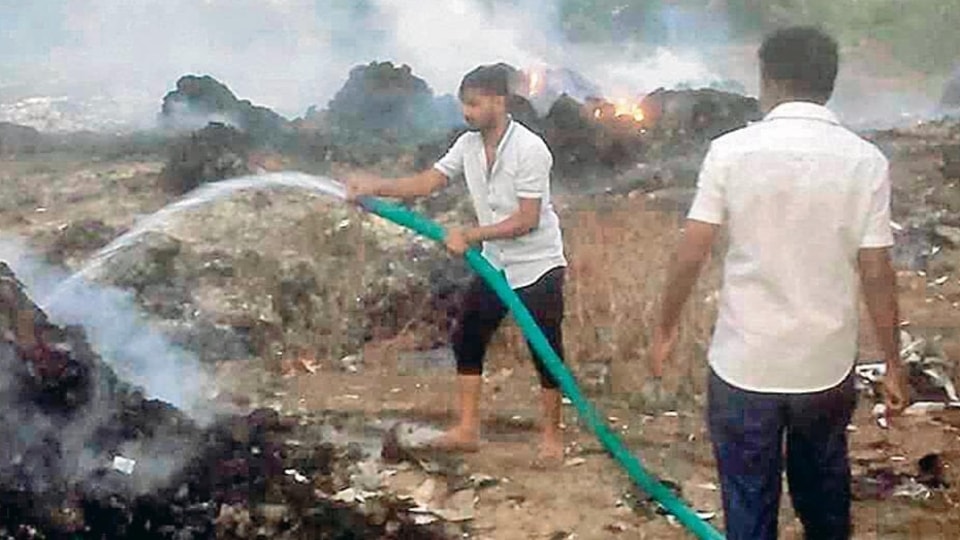
The commission said the infrastructure for waste collection, material recovery and safe disposal is not adequate due to which waste is burnt for easy disposal.
The policy has outlined nine strategies to address this, including adoption of a system in which wet waste is collected daily, while days are fixed for collection of dry or non-recyclable waste, besides incentivising waste segregation at source through property tax rebates, and an overhaul of concessionaire agreement with waste collectors so payments are based on “treated quantity of waste”, instead of “tipping quantity”.
A comprehensive study on Delhi’s air pollution by IIT Kanpur (2016) found that waste burning contributes to nearly 10% of PM10 and PM2.5 (fine particulate matter) in ambient air.
The city generates more than 11,144 tonnes of municipal waste daily and multiple studies estimate that 2-3% of this is burnt openly, adding to particulate matter, sulphur and nitrogen oxide levels.
Anumita Roychowdhury, executive director, research and advocacy at the Centre for Science and Environment (CSE), who is also one of the nine-expert members who framed the new comprehensive policy, said to reduce waste burning instances, including landfill fires, focus must be on the reduction of the source and not penal action.
“We have not looked at fines, which are reactive in nature, but instead, a road map has been built to start segregation at source and to eliminate landfill sites completely. If waste is being segregated and it is not going to landfills or open dumps, then it will not be burnt and for that, a long-term five-year plan is in place now which focuses on eliminating landfills and introducing segregation at source,” she said.
The fine data from three municipal corporations shows that while the penal rates are high, the corporations have a woefully low recovery rate — over the last four years, it has remained less than 20%.
The new policy also directs the Municipal Corporation of Delhi (MCD) to incentivise source segregation through property tax rebates and mapping of bulk waste generators to enforce in situ (in place) management.
An official from the MCD sanitation department said while many of the recommendations such as decentralised processing and setting up of material recovery facilities are already being worked upon, separate collection of dry/wet waste can be carried out only after an area reaches a critical level of segregation.
“If very few people are segregating waste in an area then we cannot simply refuse to collect garbage as it will lead to another crisis. It has to be a phased process,” the official said.
A property tax incentive on segregation will be implemented from July 16, under the Sahbhagita (partnership) scheme, and resident bodies will be provided 5% property tax incentive on 100% segregation and composting of waste, the official added.