
 E-Paper



Islamic, British colonisation disrupted Indian knowledge: Vice-president
He was speaking at the inaugural session of a three-day conference on Indian Knowledge System at Jawaharlal Nehru University


Vice-president Jagdeep Dhankhar on Thursday called for a collective effort to reclaim and nurture the “Indian Knowledge System” (IKS), which he said had endured two major disruptions — the Islamic invasions and British colonisation.
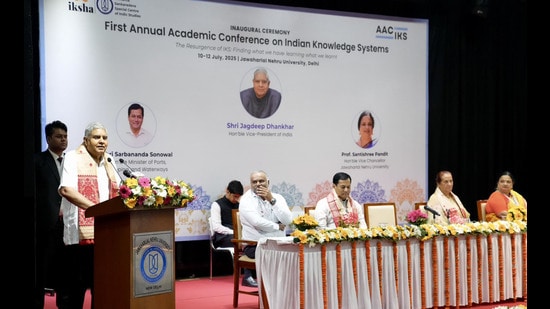
Speaking at the inaugural session of a three-day conference on IKS at Jawaharlal Nehru University (JNU), Dhankhar described India not merely as a political entity but as a civilisational continuum rooted in centuries of enquiry, debate, and learning.
“Islamic invasion of India caused the first interlude in the glorious journey of the Bharatiya Vidya Parampara (Indian Knowledge System). Instead of embracing and assimilation, there was contempt and destruction,” Dhankhar said.
On a lighter note, Dhankhar also quipped about his tenure: “I will retire at the right time, August 2027, subject to divine intervention.”
Referring to the Turko-Afghan military general Bakhtiyar Khilji, Dhankhar said, “Barbarism prevailed over civilization.”
The second interruption, he noted, came with British colonial rule, which reduced India’s knowledge institutions to training grounds for “brown babus”, replacing thinkers with clerks serving the East India Company.
The conference, themed “The Resurgence of IKS”, is being held from July 10 to 12, with discussions on integrating traditional Indian knowledge in philosophy, science, and the arts into modern educational and policy frameworks.
“This conference,” Dhankhar said, “is a serious academic effort to correct a historic wrong.”
Also present at the event were Union minister of ports, shipping and waterways, Sarbananda Sonowal, and JNU vice chancellor Santishree Dhulipudi Pandit.
“IKS is not symbolic but real,” Dhankhar said, urging for the digitisation of classical Indian texts to enhance accessibility. “We must bridge the divide between tradition and modernity. IKS continues to radiate from global hotspots. We must reclaim that heritage and ensure it blossoms.”
Sonowal, highlighting India’s global cultural rise, pointed to growing international recognition for systems like yoga, Ayurveda, and Vedic philosophy. “The last 11 years have seen a historic resurgence in IKS. From International Yoga Day to AYUSH, India’s ancient wisdom has become a tool of diplomacy,” he said.
JNU VC Pandit stressed the role of academia in narrative building: “Political power requires narrative power. It is the duty of higher education institutions to produce that narrative.” She added that the conference aimed to produce path-breaking academic work that could guide a decolonised and holistic framework of learning.
Stay updated with all top Cities including, Bengaluru, Delhi, Mumbai and more across India. Stay informed on the latest happenings in World News along with Delhi Election 2025 and Delhi Election Result 2025 Live, New Delhi Election Result Live, Kalkaji Election Result Live at Hindustan Times.


