
 E-Paper



Key link to Yamuna is missing for Okhla STP
A government official said efforts to improve water quality and the river’s e-flow are ongoing as part of a central govt-monitored plan to rejuvenate the Yamuna

 Prefer HTon Google


The Yamuna’s most polluted stretch in Delhi continues to struggle with effluent load and environmental flow (e-flow) despite the Okhla sewage treatment plant (STP) being operational, as the crucial link connecting the plant’s treated water to the Yamuna — via Abul Fazal drain — is yet to be completed, resulting in discharge of treated water in the Agra canal, officials said.
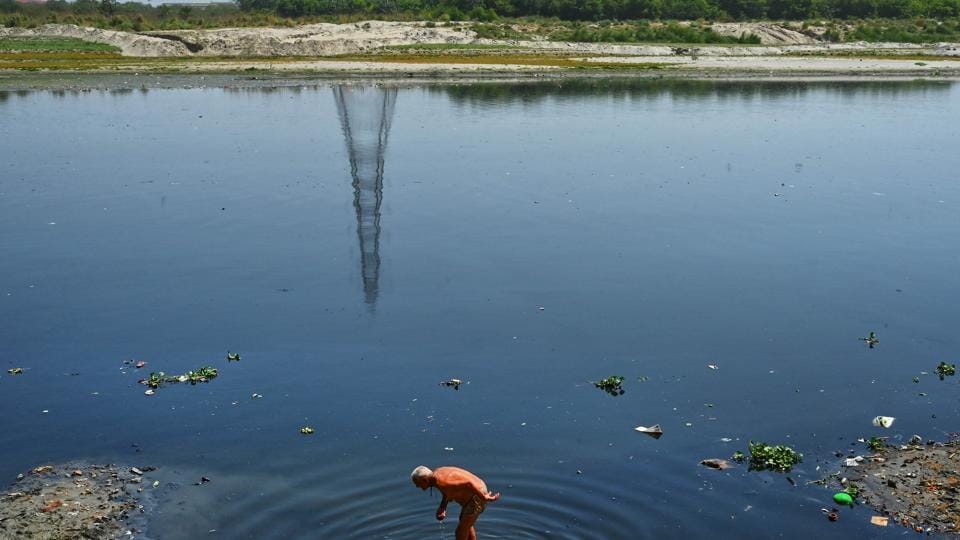
However, a government official said that efforts to improve water quality and the river’s e-flow are ongoing as part of the Central government-monitored plan to rejuvenate the Yamuna.
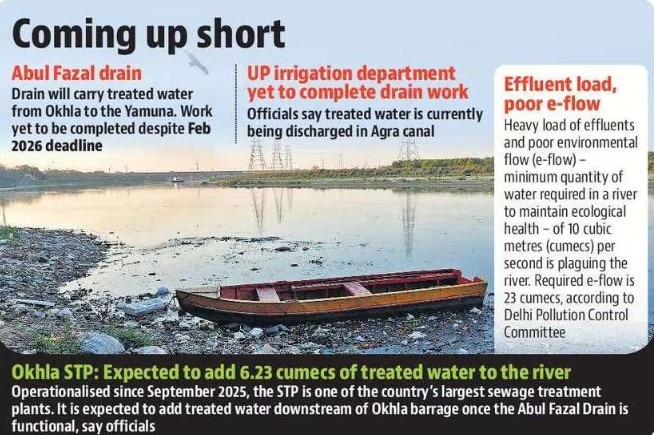
“Multiple projects are being considered to improve the e-flow. This includes the release of 563 million liters per day (MLD) from the Okhla plant downstream of the Okhla barrage. The revised deadline for connecting the STP to the Yamuna was February 2026, but the UP irrigation department has yet to complete the work,” the official added.
E-flow refers to the minimum quantity of water required in a river to maintain its ecological health, as it helps dilute pollution levels.
Experts and pollution monitoring agencies, such as the Delhi Pollution Control Committee (DPCC) and the environment department, have pegged Yamuna’s e-flow requirement at 23 cubic metres per second (cumecs). However, the current average e-flow hovers around 10 cumecs.
A 2023 parliamentary panel also directed immediate action to improve e-flow to prevent the river’s visible pollution symptoms, such as frothing and foul odours, particularly in areas like Kalindi Kunj and Okhla.
The Okhla STP, operationalised since September 2025, is one of the country’s largest sewage treatment plants. It is expected to add 6.23 cumecs of treated water to the river downstream of Okhla barrage once the pipeline connecting the plant’s treated water to the Yamuna is funcitonal, officials said. Other proposed projects include the Coronation Pillar STP and the Yamuna Vihar STP, aimed at discharging treated water into the Yamuna near the Wazirabad barrage, alongside diverting Ganga water into the river through the Eastern Yamuna Canal system.
A second official said that a proper conveyance system needs to be set up with a large water-carrying capacity. “When we connected the Okhla STP to the drain, the pipeline’s inadequate capacity caused water to back up into the STP. Therefore, we had to disconnect these links to prevent further backflow. We have continually urged the UP Irrigation Department to expedite the necessary conduit work,” the official said.
UP executive engineer DK Singh did not respond to requests for comment.
Notably, the Okhla STP has helped treat sewage, diverting untreated flow from southeast Delhi to the river. However, the treated water has yet to be injected into the river.
According to the DPCC’s April report on the Yamuna, the faecal coliform level — an indicator of sewage in the river — peaked at 310,000 MPN/100ml, exceeding the safe limit of 2,500 MPN/100ml. The highest biochemical oxygen demand (BOD) and faecal coliform counts were both recorded at Asgarpur — downstream of the Okhla barrage — where the river exits Delhi. This indicates that sewage and pollutants accumulate in Delhi’s stretch of the river.
The Okhla STP, a joint venture between the National Mission for Clean Ganga (NMCG) and the Delhi Jal Board, began in 2017. NMCG approved the project for e-flow improvement on September 13, 2024, and the UP irrigation department approved the work in March 2025, for which ₹8.6 crore was sanctioned.


Stay updated with all top Cities including, Bengaluru, Delhi, Mumbai and more across India. Stay informed on the latest happenings in World News along with Delhi Election 2025 and Delhi Election Result 2025 Live, New Delhi Election Result Live, Kalkaji Election Result Live at Hindustan Times.


