E-Paper



MCD begins adorning Delhi’s heritage sites with blue plaques
The oval plaques are made of acrylic resin mixture and they have a white circumference and golden lettering over a blue background

 Prefer HTon Google


The Municipal Corporation of Delhi (MCD) has begun installing blue oval plaques on several heritage buildings under a project to mark the historical nature of these buildings and sites — a historical marker similar to the London’s iconic blue plaques. A senior MCD official said that the work has been completed at 35 sites and 55 such plaques will be installed in the first phase of the project.
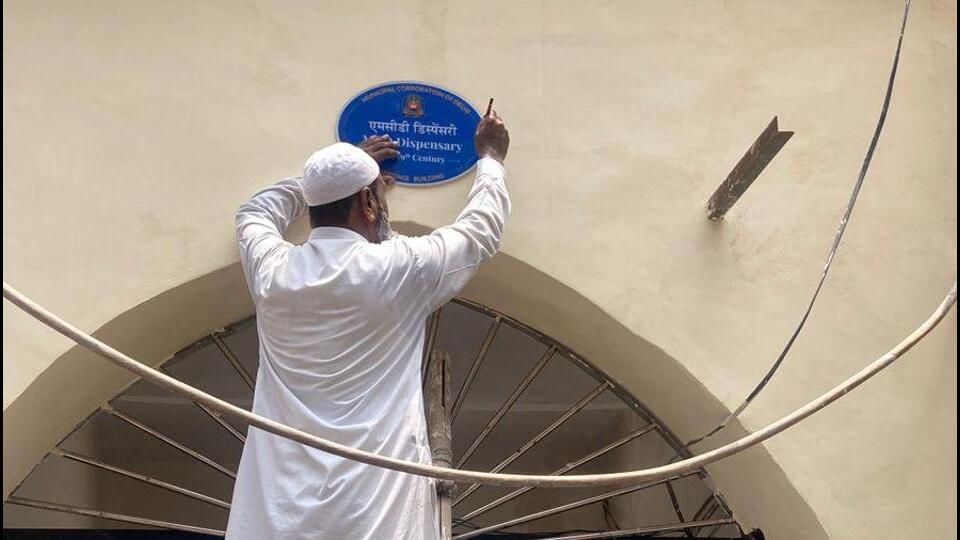
“The project is being carried out in collaboration with the Aga Khan Foundation. The installation work has been completed at 35 sites. Plaques are being installed to mark the historical landmark and to commemorate the monument and its period of origin. These will also inform people about the glorious heritage of the city,” said a civic official associated with the project.
HT had reported on June 7 that MCD’s heritage cell will undertake this project.
The oval plaques have been added at the Town Hall in Chandni Chowk, Fatehpuri Mosque, Hardayal Library, Kasturba Janana Hospital, Sunehri Mosque, and Namak Haram ki Haveli, among other places. “The 55 locations in the first phase are concentrated in areas such as Chandni Chowk, Daryaganj, Kashmere Gate, Defence Colony and Nizammudin. They date from the Tughlaq period, Lodhi period, the Mughal period and up to the early 20th century,” the official added.
The oval plaques are made of acrylic resin mixture and they have a white circumference and golden lettering over a blue background. Each plaque reads “Municipal Corporation of Delhi – Heritage Building” in golden letters, along with the civic body’s logo, the name of the site and its year of origin.
The MCD official said that the buildings being marked with plaques in Nizamuddin area include monuments in the Dargah complex, gateways, Jamaat Khana mosques, and the houses of Mirza Jahangir and Ghalib. The sites near Chandni Chowk include the Town Hall, the State Bank of India building, the Gateway of Katra Neel, the MCD office at Kucha Bagh, and the Grindlays building.
The two monuments on the list in Defence Colony include the gateway and Gumti of Shaikh Ali. All locations are Grade 1 and 2 heritage buildings. According to the classification of the Union ministry of urban affairs, Heritage Grade 1 comprises buildings and precincts of national or historic importance, embodying excellence in architectural style, design, technology and material usage, and Heritage Grade 2 comprises buildings and precincts of regional or local importance possessing special architectural features.
MCD, before its trifurcation in 2012, made attempts to install stone signs near heritage complexes, and roped in the Indian National Trust for Art and Cultural Heritage (Intach). But the project withered away and was eventually disbanded. The municipality’s heritage cell is, concurrently, also cataloguing the city’s heritage buildings on its website, with photographs, descriptions, map locations and nearby Metro stations to make the sites more accessible.
London blue plaques
London’s blue plaque programme was started in 1866 to link “the people of the past with the people of the present”, according to English Heritage, the agency in charge of the legendary medallions that adorn more than 1,000 spots in the UK’s capital.
Some of the most famous plaques in London include the home on Barron’s Court where MK Gandhi lived while a law student, the residences of authors Charles Dickens and Agatha Christie, the building on Brixton Road where Charlie Chaplin lived between 1908 and 1910, and the Feltham house where rock legend Freddie Mercury started making music.
Following in London’s footsteps, similar commemorative plaques have been installed in cities across the world, including Paris, Rome, Oslo, and Dublin.