
 E-Paper



MCD committee calls for fines on feeding stray dogs in non-designated areas
The proposals were submitted by committee member Yogesh Verma.

 Prefer HTon Google


The Municipal Corporation of Delhi’s sub-committee on dogs has drafted a set of sweeping recommendations – including penalties for feeding strays in non-designated spots, the creation of a “high-risk dog holding area” in every zone, and doubling the capacity of all Animal Birth Control (ABC) shelters – in a proposal meant to bring the civic body in line with the Supreme Court’s November 7 order, officials aware of the matter said on Monday.
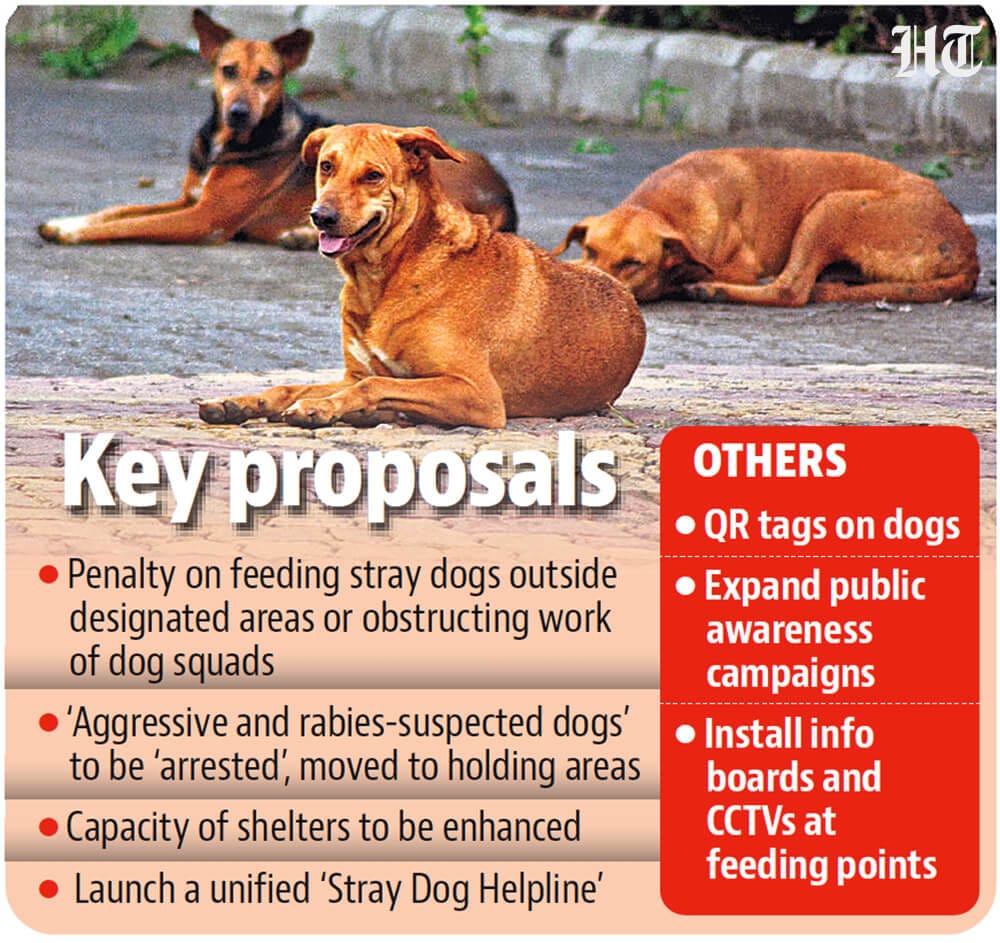
According to the proposal document, seen by HT, immediate fines should be imposed on anyone who feeds stray dogs in non-designated areas, violates MCD guidelines, or obstructs the work of the veterinary department and dog squads. It recommends empowering on-ground veterinary officers and sanitary inspectors to issue penalties on the spot.
The proposals were submitted by committee member Yogesh Verma, who said the document will be placed before the MCD standing committee for approval at its next meeting.
A key component of the draft is the creation of holding areas for “aggressive and rabies-suspected dogs.”
When a complaint is received, such dogs should be “arrested” within 24 hours and not released back into the same locality, the proposal states. Verma said the move is intended to prevent repeat attacks. “If a dog has bitten someone, we cannot risk releasing them and having them bite people again. Doctors will monitor the dogs and procedures will evolve as these centres begin functioning, but aggressive dogs will be permanently kept in shelters,” he said.
To support the expected rise in intake, the proposal calls for doubling the capacity of existing shelters, appointing additional doctors and staff, and carrying out weekly inspections. Land adjacent to shelters will be used for expansion, Verma said.
The document further proposes a ban on feeding near “schools, hospitals, main markets, heavy traffic areas, and bus stands,” with violations punishable by fines. It does not specify how “main markets” or “heavy traffic areas” will be defined. The installation of information boards and CCTV cameras at designated feeding points has also been suggested.
While detailed cost estimates are still being drafted, Verma expressed confidence that the proposal will clear the standing committee. “We are confident it will be approved, as there is nothing negative in the proposal,” he said.
The draft also outlines the creation of a unified “Stray Dog Helpline,” to be integrated with the existing MCD helpline. It suggests that representatives from resident welfare associations, market associations and schools be included in the group that monitors complaints. ABC programmes should be run in every ward with specific six-month targets, supported by two additional dog-catching vans per zone, the document states.
Other measures include QR-tagging dogs, fining people who litter food on roads, expanding public awareness campaigns, and publishing daily reports from the animal husbandry department as well as records of recognised NGOs. The proposal also suggests forming a ward-level stray dog monitoring committee comprising a corporation officer, the ward councillor, a veterinarian, and representatives from an RWA and an NGO.
Animal welfare activists criticised the proposals, calling them impractical and harmful. Geeta Seshamani, vice president of Friendicoes, said the plan would result in widespread displacement and confinement of stray dogs with no infrastructure to support them. “The dogs will be mercilessly relocated and incarcerated in absolutely inadequate facilities with no budgets or infrastructure in place for food, staff or medical care. It’s a knee-jerk reaction, completely lacking in compassion and also common sense, with no understanding of dog behaviour or any practical idea of how to implement these grand plans for ‘shelters’,” she said.
Seshamani noted that the MCD has not paid organisations conducting ABC work since March 2025 and said the corporation has failed to maintain its existing 20 centres. “Now suddenly overnight we are to believe they will create super structures requiring huge budgets? No. I believe the dogs will simply be taken outside Delhi and left anywhere,” she said.
An MCD veterinary department official, requesting anonymity, echoed concerns over funding, saying proposals to clear payments to ABC centres have been pending before the standing committee for months.

Stay updated with all top Cities including, Bengaluru, Delhi, Mumbai and more across India. Stay informed on the latest happenings in World News along with Delhi Election 2025 and Delhi Election Result 2025 Live, New Delhi Election Result Live, Kalkaji Election Result Live at Hindustan Times.


