E-Paper



Mercury falls to season’s low of 8.9°C as winter chill envelops Delhi
This dip in mercury also pushed Delhi’s air quality back in to the “very poor” category on Sunday where it stayed on Monday. The Capital recorded an Air Quality Index (AQI) reading of 310 according to Central Pollution Control Board’s national bulletin at 4pm—a slight decrease from Sunday’s reading of 314.

 Prefer HTon Google


Delhi’s mercury dipped below the 9-degree mark on Monday, with the Capital recording a minimum temperature of 8.9 degrees Celsius (°C)—three degrees below normal and the lowest so far this season. According to the weatherman, the mercury is expected to stay below the 10-degree mark until Sunday as cold northwesterly winds continue to impact the region.
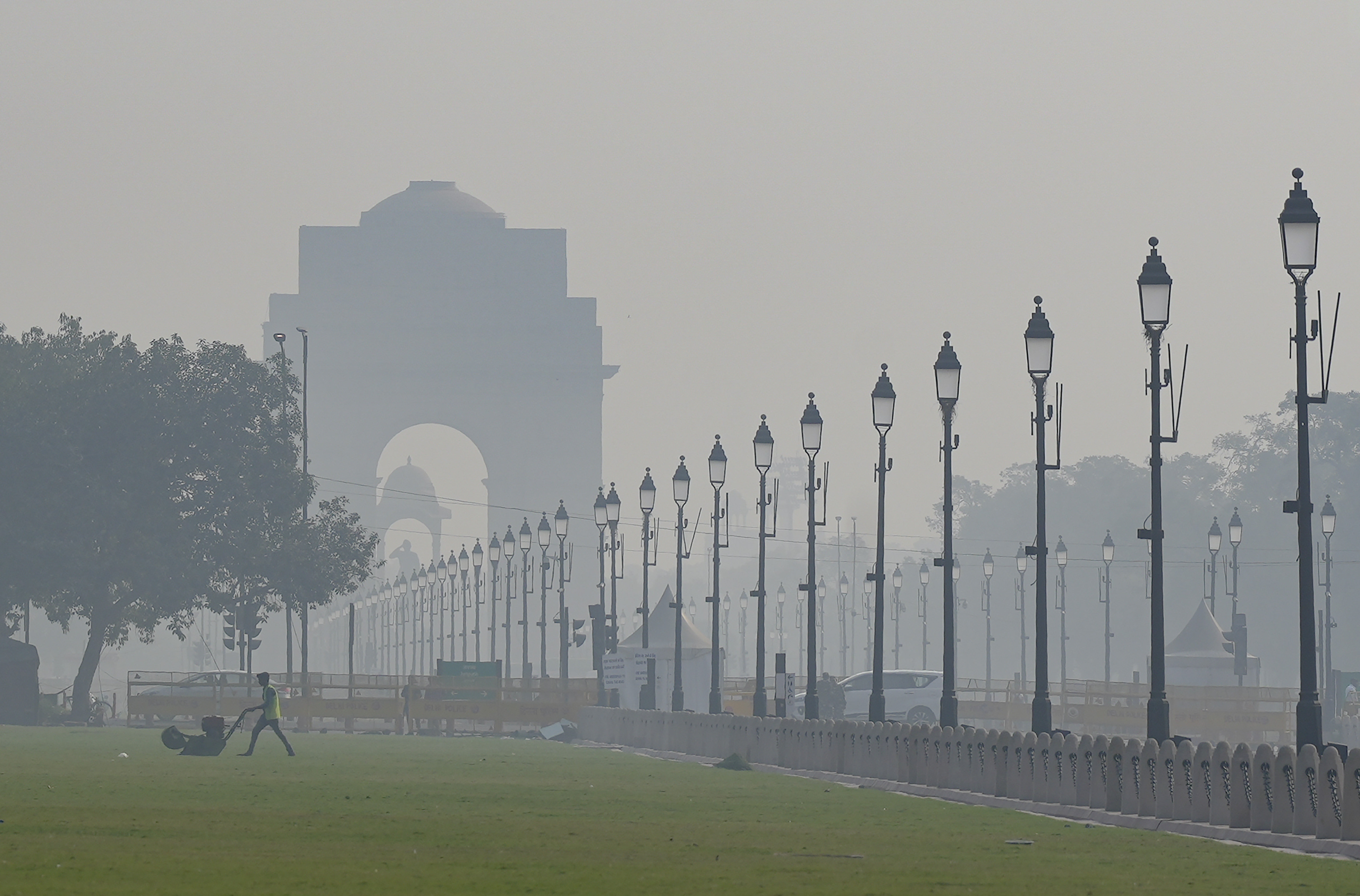
This dip in mercury also pushed Delhi’s air quality back in to the “very poor” category on Sunday where it stayed on Monday. The Capital recorded an Air Quality Index (AQI) reading of 310 according to Central Pollution Control Board’s national bulletin at 4pm—a slight decrease from Sunday’s reading of 314.
An AQI reading between zero and 50 is considered “good”, 51 and 100 “satisfactory”, 101 and 200 “moderate”, 201 and 300 “poor”, 301 and 400 “very poor”, and 401 and 500 “severe”.
Delhi also recorded a maximum temperature of 27.3°C, which is one degree below normal for this time of the year. This is forecast to drop to 26°C by Wednesday.
Delhi’s minimum temperature first fell below the 10-degree mark this season on Friday, with the mercury recording 9.6°C. It dropped to 9°C on Saturday, and has stayed under 10°C for four days now. Met officials said that until cold northwesterly winds stop blowing towards Delhi, there will be no rise in minimum temperature. “The longer these winds blow, nights will continue to be cold and there will be a further drop in temperature towards the end of the month,” said a Met official.
Forecasts by the India Meteorological Department (IMD) show the minimum temperature will be close to the 9-degree mark on Tuesday and Wednesday, and will hover around 8°C on Thursday and Friday.
Last November, Delhi’s lowest minimum temperature was 9.2°C, which was recorded on November 24. In 2020, it fell to as low as 6.3°C (November 23). In 2019, the lowest minimum temperature in November was 11.4°C (November 20), while it was 10.5°C in November 2018 (November 8).
Low temperatures, particularly at night time, lead to a drop in the “mixing height” — an invisible layer of the atmosphere within which particulate matter gets trapped. Cold temperature also leads to a drop in wind speed, leading to a deterioration in air quality. Forecasts by the Early Warning System (EWS) for Delhi, used by the Commission for Air Quality Management (CAQM) in NCR to take pre-emptive action against air pollution, however, show Delhi’s AQI is likely to improve to the “poor” category Tuesday onwards.
“Delhi’s AQI was in the ‘very poor’ category on Sunday, with a reading of 314. The overall air quality in Delhi is likely to remain in lower end of ‘very poor’ category on Monday, but is likely to be in the ‘poor’ category from Tuesday until Thursday. The outlook for the subsequent six days shows the air quality is likely to remain largely between ‘poor’ and ‘very poor’ categories,” said EWS.
According to the System of Air Quality and Weather and Forecasting And Research (Safar), another government body, the improvement is likely due to wind speeds of 12-16kmph during the day, along with a mixing height of 1-1.5km in the day, which will allow pollutants to disperse easily.
The impact of farm fires and their contribution to Delhi’s air is also reducing, Safar said, with farm fires contributing 6% to the Delhi PM2.5 load on Monday. In comparison, the contribution of farm fires was 10% on Sunday and 14% on Saturday. Punjab, Haryana and Uttar Pradesh recorded a combined fire count of just 300 on Monday, with 243 fires in Punjab, 11 in Haryana and 46 in Uttar Pradesh. In comparison, the count was 568 on Sunday, with 368 fires in Punjab, 32 in Haryana and 168 in Uttar Pradesh.
Meanwhile, Punjab has seen an increase of 5% in the area over which paddy stubble was burnt this Kharif season as on November 18, as compared to the corresponding period in the previous season, according to the weekly data compiled by the state’s remote sensing centre.
The Ludhiana-based centre reported that this year, paddy straw was burnt over 1.48 million hectares on November 18, against 1.41 million hectares on the same day last year.
However, the the number of farm fire incidents in the current paddy harvest season has come down by 30% when compared to the last season. As on November 21, Punjab has reported a total of 49,526 incidents of stubble fires, compared to the 71,024 fires reported in the same period last year.