E-Paper



Monsoon brings potholes back to major road stretches across Delhi
Several portions of a road near Shani Bazar Bandh Road in Sangam Vihar caved in early in July, triggering a series of accidents

 Prefer HTon Google


This year’s monsoon and its unpredictable rains have underscored the brittle state of Delhi’s roads, with cracks and potholes on key streets hobbling traffic and exposing commuters to accidents.
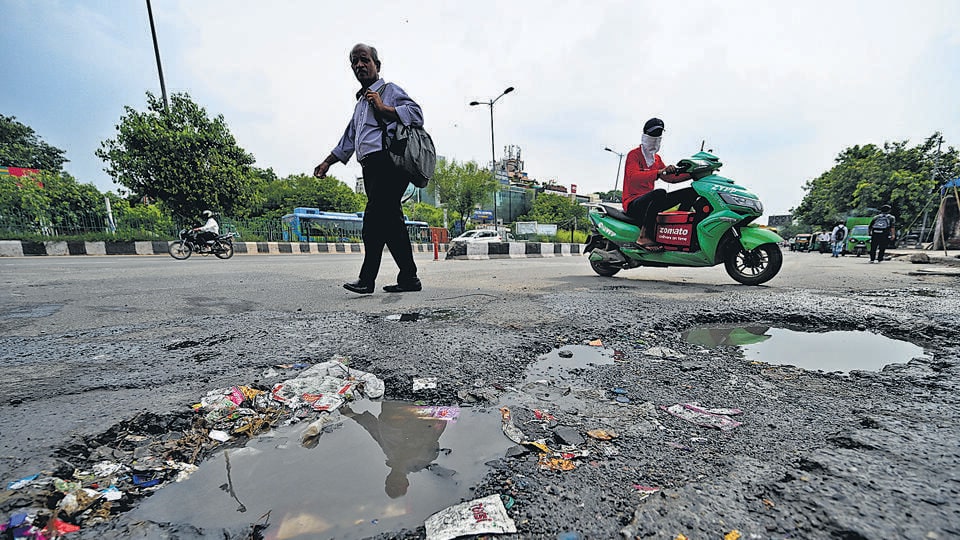
Apart from cave-ins at several spots, the showers have left several major roads, including Ring Road, Outer Ring Road, ITO area, Vikas Marg, Mathura Road and Mahatma Gandhi Marg, riddled with potholes.
Internal roads, meanwhile, fare far worse across the city.
Several portions of a road near Shani Bazar Bandh Road in Sangam Vihar caved in early in July, triggering a series of accidents, leaving even tractors and water tankers stuck. On June 26, a section of the Mehrauli-Badarpur Road near Saket Metro station caved in and a cluster bus got stuck in the damaged section, leading to huge snarls.
Despite this, residents in south Delhi say the Municipal Corporation of Delhi (MCD) has not carried out repairs on these stretches.
“Almost all internal roads and intersections are battered. The arterial roads are in the same condition. For instance, the stretch from B Block in CR Park towards Outer Ring Road, where the Savitri flyover begins, is in a mess. There are several such points, but MCD is not doing any repair work,” said Chetan Sharma, general secretary of Confederation of RWAs and chairman of GK-2 complex RWAs.
Several other areas in the district such as Vasant Kunj, Greater Kailash, Defence Colony, Malviya Nagar and CR Park have similar concerns. A simple patchwork, residents say, can help make rides smoother but the concerned agencies have not undertaken any repair work there either.
The Public Works Department (PWD) and MCD — two of Delhi’s road-owning agencies — did not respond to HT’s requests for comment. However, officials admitted that more complaints have been received this year, and that they are waiting for the monsoon to subside to begin repairs. “The complaints team works on resolving any such repair-related issues immediately... However, the result of patchwork repair is weak if it rains immediately afterwards. So, we are waiting for the rain to subside,” said a PWD official.
Other residents, meanwhile, said that clogged drains exacerbated the waterlogging problems in areas such as Kalkaji.
“The biggest problem is that the drains have not been cleaned at all this year. Because of this, many roads in Kalkaji were waterlogged and then the bitumen developed cracks. The agencies need to work seriously on cleaning drains regularly throughout the year,” said Inder Kohli, a resident of Kalkaji, and chief coordinator, Nehru Place Market Association.
In parts of southeast Delhi such as Maharani Bagh and Friends Colony, the exercise to free footpaths of concrete during the monsoon has spelled trouble for residents.
“Following court orders, PWD is on a spree to deconcretise the pavements. But the agency leaves this debris on the side of the roads. This leaves the pavement at a lower level than the roads, which leads to waterlogging and potholes,” said Shiv Mehra, president of the Maharani Bagh RWA.
Meanwhile, as every year, ITO in central Delhi was one of the city’s worst waterlogging hot spots. This also led to cracks along several sections of Mathura Road near Pragati Maidan and further towards Purana Quila. The Walled City areas have been facing similar problems, with at least two large cave-ins reported near Chandni Chowk this year.
Roads in the rest of the city are just as bad. Residents complain of large, potholed patches in Dwarka, Rohini, Narela, Najafgarh, Nangloi and along Rohtak Road.
In southeast Delhi’s Qutub Vihar, the main road near Goyla Dairy constructed by PWD about a month ago caved in at several places. Such incidents were also seen at Ashoka Road, Sangam Vihar, Mandi House, service lanes of Aurobindo Marg, and parts of Rohini, among others.
Apart from Delhi’s inadequate monsoon preparedness, experts also pointed to bad road-laying techniques, damaged water or sewer lines beneath roads and a depleted groundwater table, which makes the soil beneath the roads hollow, making the stretch vulnerable.
“The rains this year have been unprecedented and potholes are expected. However, agencies must have readymade pothole repair machines that work on cold mix technology that settles almost immediately. These can be immediately deployed after rains, especially in Delhi where there is hardly any continuous rain for days together,” said S Velmurugan, chief scientist and head of traffic engineering and safety division of Central Road Research Institute.