
 E-Paper



Nabbed 6 months after crime, how Soumya Vishwanathan’s killers were nailed
Suspects arrested in the murder of a woman in 2009 confessed to murdering journalist Vishwanathan in Delhi in 2008.

 Prefer HTon Google


On September 30, 2008, at around 3.30am, the Vasant Vihar police station received a call about a car accident on Nelson Mandela Marg in south Delhi. When a team reached the spot, all evidence pointed towards an accident — that the victim, television journalist Soumya Vishwanathan, 25, rammed her Maruti Zen car into a divider while returning home to Vasant Kunj from her office at Jhandewalan and died in the crash.
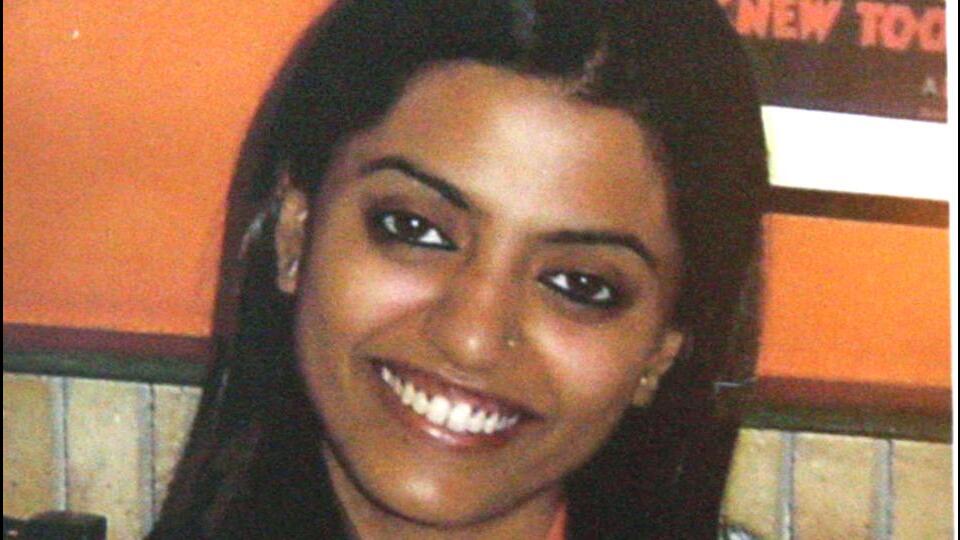
READ | 15 years on, four convicted for killing 26-yr-old journalist Soumya Vishwanathan
However, Vishwanathan’s postmortem report suggested otherwise.“When the autopsy was conducted later that day, a bullet was found in her right temple and the accident became a murder,” said Bhisham Singh, the then assistant commissioner of police of Mehrauli sub-division and the investigating officer of the case. The accused fled the scene, said Singh, who is currently the superintendent of the crime branch in Mizoram.
Over the next six months, the police rounded up dozens of suspects but failed to make a breakthrough. Then, on March 18, 2009, another woman, Jigisha Ghosh, 27, was strangled to death by the same men — a crime that was eventually their undoing. It was during questioning in this second case that one of the accused confessed to a past murder, revving what had till then seemed like a dead-end.
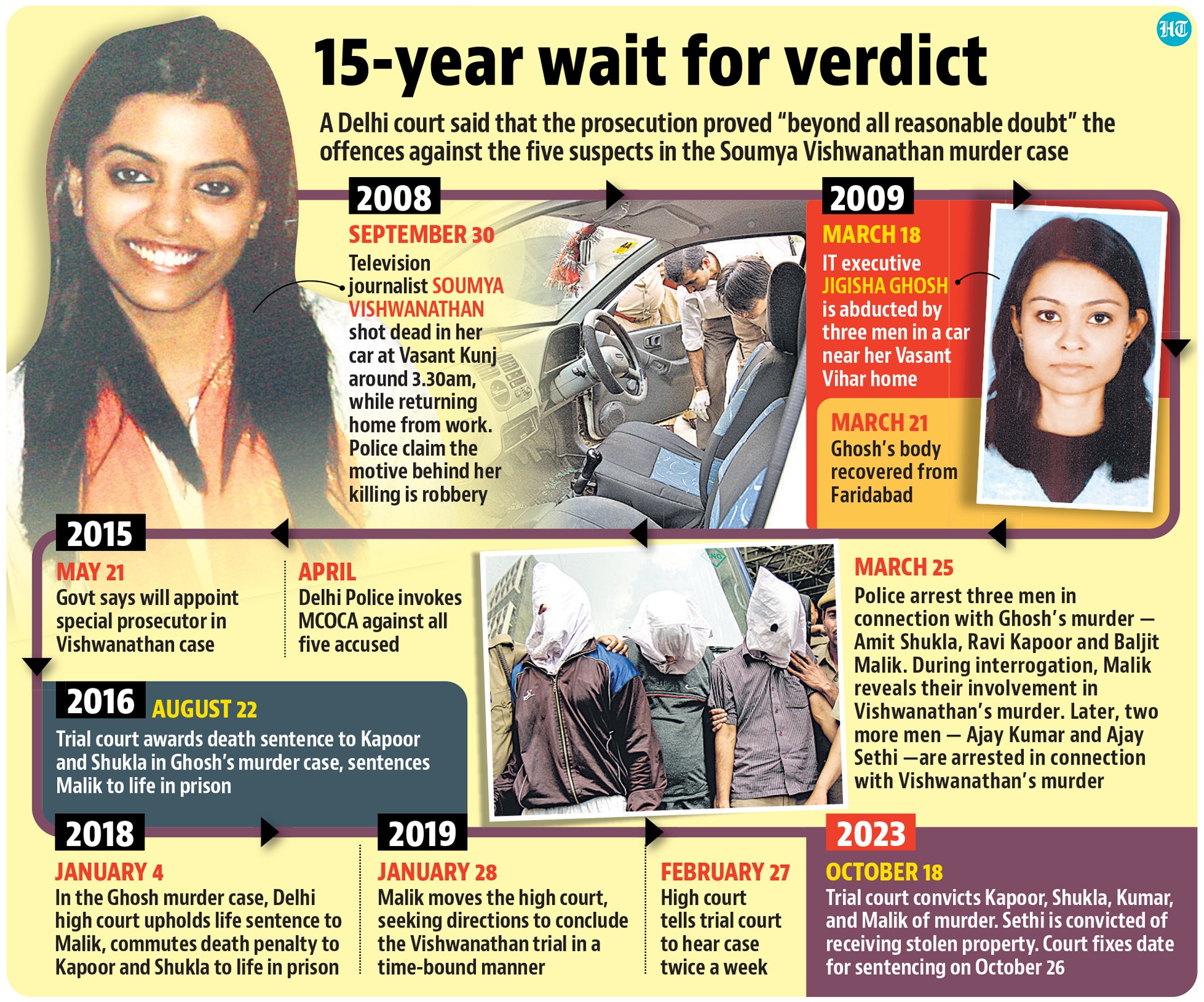
Eventually, a series of evidence, including a forensic laboratory (FSL) report matching the recovered gun, a confessional statement under the Maharashtra Control of Organised Crime Act (MCOCA) and the phone locations of the accused, helped convict the four men — Ravi Kapoor, Amit Shukla, Ajay Kumar and Baljeet Malik — for murder, and a fifth accused Ajay Sethi under Indian Penal Code (IPC) section 411 (dishonestly receiving stolen property).
Seeking the approval to invoke Section 3 of MCOCA against Ravi Kapoor and his associates, then assistant commissioner of police (Mehrauli) Meher Singh wrote to the joint commissioner of police (southern range) saying Kapoor and the co-accused were running a crime syndicate and “were a clear and present danger to society through their organised crime activities”. HT has seen a copy of the letter.
Sethi was arrested on March 28, 2009, and the others were arrested on March 25, 2009.
On the night that they murdered Vishwanathan, the four men waited near PVR Priya in Vasant Vihar inside a stolen car for a target they could rob. After making a failed attempt to halt Vishwanathan’s car, they began following her, said Singh. He said that Vishwanathan had been listening to music and perhaps did not notice the accused. “They repeatedly honked in a bid to make her halt. They shot her either to frighten her or force her to stop. Ravi Kapoor fired at her car,” added Singh.
HGS Dhaliwal, the then deputy commissioner of police (south Delhi) and the current special commissioner of special cell said there was ample evidence in Ghosh’s case against the killers—like a stolen debit card and a host of items they purchased with it, apart from the CCTV footage at Sarojini Nagar market. “But unlike Ghosh, Vishwanathan was not robbed,” said Dhaliwal.
According to Singh, police were able to recover the gun which was used to kill Vishwanathan. “Ravi Kapoor, who used that gun to kill her, had continued wielding it as he believed he would never get caught. The FSL report confirmed that the bullet recovered from Vishwanathan’s head had been shot from the same gun,” said Singh.
The police then recorded Kapoor’s confessional statement in front of a magistrate under MCOCA, and that served as strong evidence, the officer said. “The crime scene we had recreated soon after Vishwanathan’s murder matched the details in the confessional statements of the killers,” Singh added.
The case was further helped by the antecedents of some of the killers, as well as an escape attempt from Safdarjung Hospital by one accused—Ravi Kapoor—and an extortion attempt from jail by another—Ajay Kumar— police added.
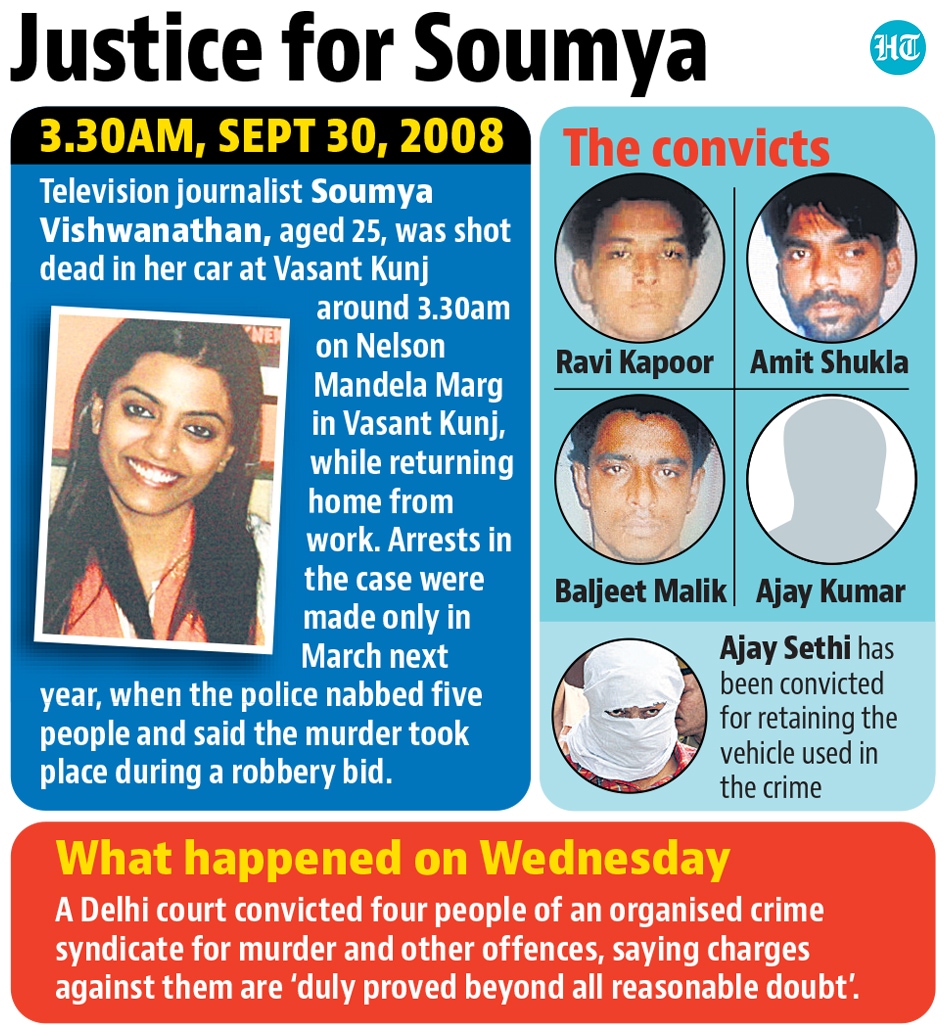
Six months after Vishwanathan’s murder, the men killed Ghosh. The office cab dropped Ghosh — an operations manager with Hewitt Associates in Noida and a resident of Vasant Kunj — at her colony gate around 4.30am. Kapoor and Singh called out to her on the pretext of finding out an address, pulled her inside the car and drove towards Mahipalpur. They forced her to divulge her ATM pin and withdrew money, killed her and dumped her body in Faridabad.
On their investigation trail into their daughter’s disappearance, Ghosh’s parents found that large sums of money had been spent from her account. The killers had shopped in Sarojini Nagar market, from where they purchased expensive watches and shoes using her card. The CCTV footage from one such shop led the police to the killers. Police said they confessed to having killed Vishwanathan while being interrogated for Ghosh’s murder.
“One footage from a watch shop showed one of the suspects wearing a distinct tattoo on his right hand,” said Dhaliwal.
READ | ‘Don’t want death penalty for them’: Soumya Vishwanathan’s mother on 4 killers
In July 2016, the accused were convicted by a lower court for Ghosh’s murder, but the death sentence awarded to two of them — Kapoor and Shukla — was commuted to a life sentence by the Delhi high court in 2018. The court upheld the life imprisonment of the third convict, Malik.
Vishwanathan’s case took 15 years to come to a conclusion. Dhaliwal attributed the delay to factors ranging from the number of witnesses (over 125) to a change in judges and prosecutors and the Covid-19 pandemic.


