E-Paper



New year, same story: Chill, fog, ‘very poor’ air continue in Delhi
IMD has issued an orange alert for Friday, forecasting dense to very dense fog in parts of the city.

 Prefer HTon Google


Little changed on the first day of the new year for Delhi as fog, cold and pollution maintained their grip on the city for another day. A combination of shallow fog and low clouds kept mercury low and the skies overcast on Thursday.
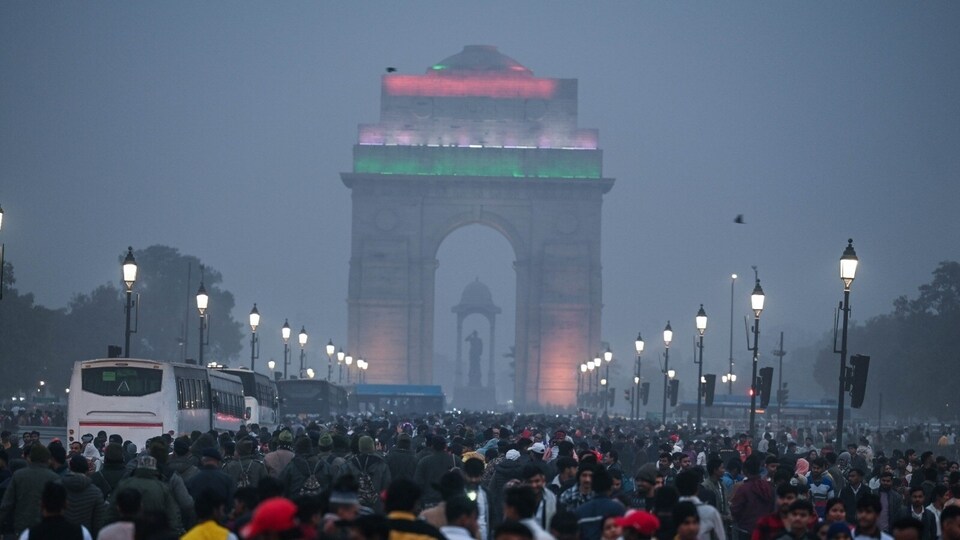
Similar conditions are expected to continue. The India Meteorological Department (IMD) has issued an orange alert for Friday, forecasting dense to very dense fog in parts of the city, while a yellow alert is in place for moderate to dense fog on Saturday.
Also read: Around 40 dead, 115 injured in fire at a bar in Switzerland's ski resort town Crans-Montana
On Thursday, while the city did not officially record a “cold day,” the maximum of 17.3°C, recorded at Safdarjung, which is representative of Delhi’s weather, was two degrees below normal and there was no sunshine in the day.
The minimum was 10.6°C, four degrees above normal.
“No cold day conditions were logged in Delhi, in comparison to Wednesday when ‘cold day’ to ‘severe cold day’ conditions were logged,” an IMD official said.
The IMD classifies it as a “cold day” when the minimum temperature is below 10°C and the departure of maximum temperature from normal is 4.5°C or more. It is a “severe cold day” when the maximum is 6.5°C or more below normal.
On Wednesday, Delhi saw its coldest December day since 2019 with the maximum temperature recorded at 14.2°C. On Thursday, the lowest maximum was recorded at 14.8°C (2.2°C below normal) at Ayanagar station .
Also read: Hindu businessman attacked with sharp weapons, set on fire in Bangladesh: Report
Meteorological experts said Thursday’s chill was also down to a combination of fog and clouds. “We had cloudiness at the upper levels, which led to a drizzle. We also had shallow fog,” said Mahesh Palawat, vice president at Skymet.
On Thursday, the minimum visibility recorded at both Palam and Safdarjung stood at 500 metres, even as isolated parts of Uttar Pradesh recorded zero visibility. Some trains were delayed under Northern Railways, while flights were also impacted at the Delhi airport. Data from the flight tracking website Flightradar24 showed over 500 flights were delayed.
While isolated parts of the city also recorded a drizzle, it had no impact on the air quality index (AQI). The 24-hour average air quality index (AQI) stood at 380 (very poor) at 4 pm, making it the seventh straight day of ‘very poor’ to ‘severe’ air. It was marginally worse than a reading of 373 (very poor) at 4 pm on Wednesday.
Meanwhile, icy-cold northwesterly winds are expected to pick up speed during the day, keeping the maximum temperature between 16-18°C, it said, but that cold day conditions were unlikely.
Forecast: Sharp dip in temp
Meteorological experts forecast a sharp dip in minimum temperature after January 4 onward, with no western disturbance till January 15.
“Cold northwesterly winds will start blowing from Friday onwards, but with no western disturbance ahead, we will now see consistent icy-cold winds across the plains. The minimum will start dipping and by the second week of January, could drop below 5°C,” said amateur weatherman Navdeep Dahiya.
Also read: 'My health is perfect': Trump blames bruised hand on aspirin, opens up on recent 'MRI'
He added a significant dip in maximum temperature may also happen in northern India in the second week of the month — possibly hovering around 10°C in parts of Punjab, Haryana and northwest Rajasthan. “This should be due to a combination of icy-cold winds and then fog,” he added.
The Air Quality Early Warning System for Delhi (EWS) has forecast the AQI to stay ‘very poor’ in the coming days.
“Delhi’s air quality is likely to be in the ‘very poor’ category from January 2 till January 4, 2026. The outlook for subsequent six days – from January 5 onwards shows the air quality is likely to be in the ‘very poor’ category,” said the EWS in its daily bulletin on Thursday.
Sirsa lauds AQI improvement
Meanwhile, environment minister Manjinder Singh Sirsa lauded the improvement in air quality in 2025 when compared to 2024, attributing it to science-based action.
Citing Central Pollution Control Board (CPCB) data, Sirsa said Delhi’s annual PM2.5 concentration stood at 96 micrograms per cubic metre (µg/m³) and the PM10 concentration was 197 µg/m³. In comparison, the PM 2.5 average was 104µg/m³ in 2024 and the PM10 average was 212µg/m³ in 2024.
“In 2025, there were 200 days with an AQI under 200 — a 15% improvement from recent years, driven by source-level interventions. In the last 24 hours, over 12,000 vehicular challans have also been issued for violations, with over 12 lakh challans issued since October 1. Delhi’s mandate translates to clean air priority — 2025 proves science-based action delivers,” he said.