
 E-Paper



In Delhi, online classes have returned, but so has students’ struggle to log in
Delhi's shift to online schooling for younger students highlights a digital divide, impacting low-income families' access to education amid connectivity issues.

 Prefer HTon Google


Last week, Prem Singh, a social worker, was forced to abandon an official trip and rush back home from Bihar after the Delhi government announced that schools for children up to Class 5 will run fully online.
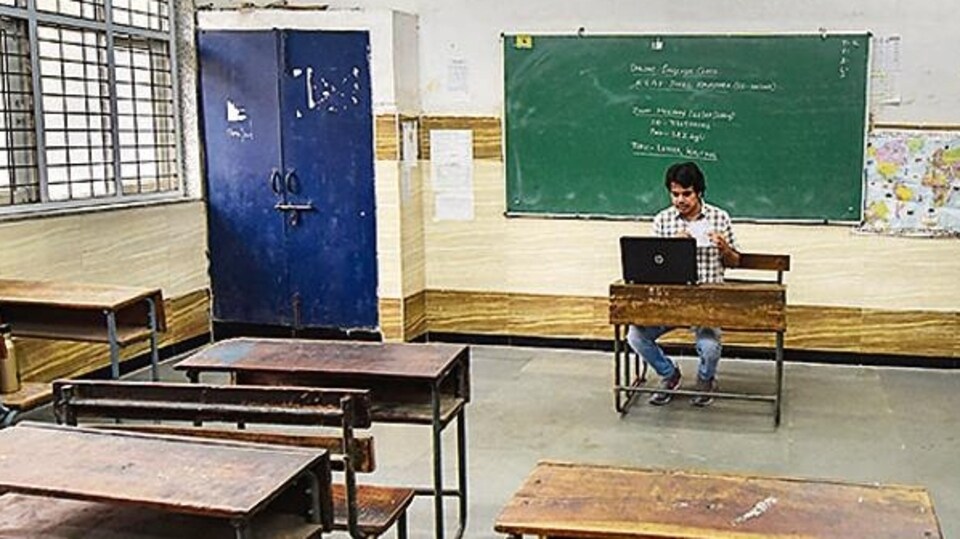
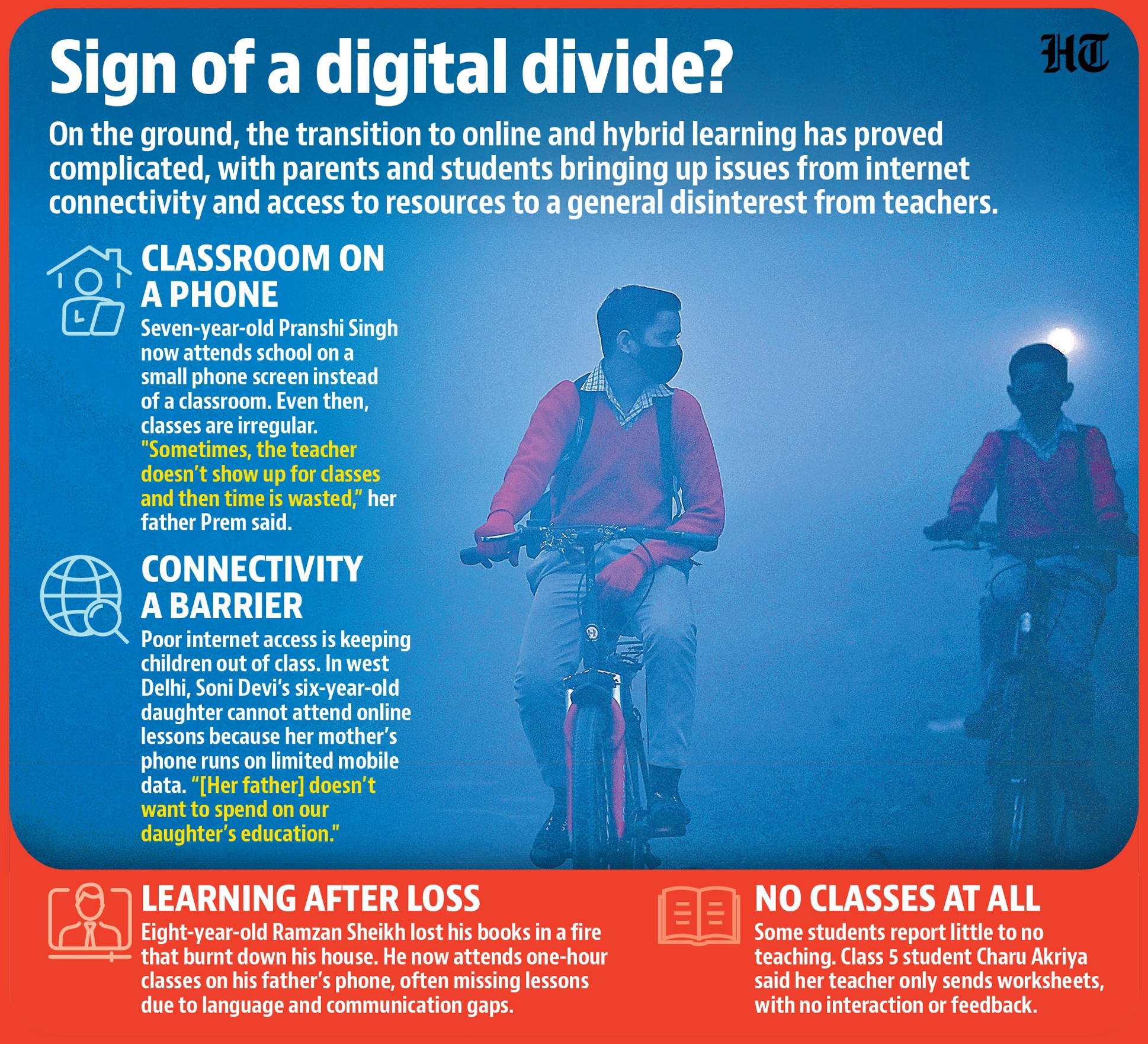
The reason: His is the only phone number registered with the government senior secondary school where his daughter studies in Class 3. Now, the father and daughter have a new routine – every morning, they walk 500 metres to a relative’s house in west Delhi’s Basai Darapur which has an internet connection.
“She studies in a Delhi government school close to our house. We don’t have Wi-Fi,” Singh said.
From sitting in a classroom with her fellow students, seven-year-old Pranshi’s school-day has now transformed into attending lessons over a six-by-six-inch screen via a link sent by the school.
Also Read | Dense fog blankets Delhi, Ghaziabad, Noida; visibility almost nil in some areas
Even after all this, it has not been a smooth transition for them. “Sometimes, the teacher doesn’t show up for classes and then time is wasted,” Singh said. Then, all the effort he makes in ensuring his daughter is able to get her education, he added, feels futile.
When asked what she misses the most about school, Pranshi said, “I can’t meet my friends Ayushi and Pratima.”
On December 13, as the pollution situation in the Capital deteriorated, the directorate of education (DoE) ordered all government, government-aided, and unaided recognised private schools to shift to hybrid teaching for all classes except 11 and 12, and entirely online for students up to Class 5.
Also Read | Delhi govt to crack down on offices violating 50% WFH mandate under GRAP 4
But, on the ground, the transition has proved far more complicated. Parents and students have in the past two weeks or so brought issues from internet connectivity and access to resources to a general disinterest from teachers.
In west Delhi’s Sudhamapuri, 25-year-old Soni Devi is in a fix. Her six-year-old daughter, a class one student who at a Sarvodaya Kanya Vidyalaya, has not been able to attend classes because of poor internet connectivity.
Devi’s phone – on which her daughter Bani could attend the classes – only has a 4G connection, which she said is not enough.
“[Her father] doesn’t want to spend on our daughter’s education. I forced him to put her in school. When I tell him, I need to upgrade my plan to 5G for my daughter’s school, he refuses,” she said. Her husband, Rajeev Kumar, works at a steel factory in Moti Nagar and earns ₹12,000 a month.
The situation is even harder for eight-year-old Ramzan Sheikh, who attends a Municipal Corporation of Delhi (MCD) school in Rohini’s Sector 5. His house, with all his belongings, burnt down in a fire at the Rithala slum on November 7.
“I lost all my books in the fire,” he said. Sheikh got some books and pens from his teachers when he returned to school a couple of weeks later. But he still needs more.
“The school only gave me a few old books and I still don’t have books for English and Maths so I can’t study on my own as well,” he added.
For now, he attends classes on the phone that belong to his father, a trash collector. The lessons last an hour, usually from 9am to 10am.
But he still ends up missing them sometimes. “The messages are usually in Hindi and my parents speak Bengali, so they don’t understand and sometimes I miss classes because of that,” Sheikh added.
Some students said the shift to online school has meant a complete lack of classes.
According to Charu Akriya, a class 5 student at an MCD school in Karol Bagh, the teacher has not interacted with students at all since the very beginning.
“We have been having online classes for more than a week now, but do not have any calls or interactions with our teacher. He sends us a photo of some worksheets in the morning, asks us to solve them, and send them back to him. He does not give us any feedback,” the 10-year-old said, adding, “I liked it when I was going to school because I was able to understand better in class.”
Her mother Sunita, 30, works part time as a pollster for different companies and her father, Karan Khatri, 35, works as a helper in a plywood factory at a salary of ₹10,000 a month.
Her parents are among the many others who are now worried that their children are missing out during a foundation period of schooling.
“We only have my phone in our household, and I have to take it with me to work, meaning my son has been missing his classes. It is anyway difficult for him to pay attention to studies at home, and this is further impacting his studies,” said 30-year-old Archana Dev. Her son, 8, is a class 3 student at an MCD school in Keshavpuram.
By comparison, for others — particularly those in private schools — online classes have been an easy adjustment after the COVID-19 pandemic. For 12-year-old Aarna Shukla, who studies at Dwarka’s Bal Bharti School, there is not much difference from physical lessons.
“We use the ‘raise hand’ symbol in the online classes whenever we have to ask questions and the teacher answers everyone one-by-one. My classes are from 9 am to 2 pm, including a 20-minute lunch break,” she said, adding that the teachers ensure students are engaged by conducting activities such as yoga, dance, and singing throughout the day.
The shift to online classes and hybrid teaching amid pollution-related curbs appear to lay bare a deep digital divide, increasingly tying daily education to access to devices, data and stable internet connections. First coming to fore during the start of the Covid-19 pandemic when all schools in the nation moved to online-only classes, the system is particularly harsh on children from low-income households who face a multitude of challenges in acquiring education risk falling further behind during crucial foundational years.
“The issue which has led to the classes going completely online is a temporary and seasonal concern. The digital divide that exists within the government set-up at both ends— the teachers and the students — will need a long term solution like ensuring sufficient access to digital tools,” said Sayantan Mandal, associate professor at Jawaharlal Nehru University’s Zakir Hussain Centre for Educational Studies.
MCD did not respond to queries from HT on if the body if it is tracking the effectiveness of online classes and if it intends to provide devices or network connections to children from economically weaker backgrounds.
When asked about it, education minister Ashish Sood said, “We are ensuring the classes run smoothly in the online mode. Other than that, we have not received any complaints regarding these issue with the internet connectivity in the school.”



Stay updated with all top Cities including, Bengaluru, Delhi, Mumbai and more across India. Stay informed on the latest happenings in World News along with Delhi Election 2025 and Delhi Election Result 2025 Live, New Delhi Election Result Live, Kalkaji Election Result Live at Hindustan Times.


