
 E-Paper



Pollution eases a bit in Delhi, but relief only temporary
Effigy burning and stubble burning may worsen Delhi's air quality

 Prefer HTon Google


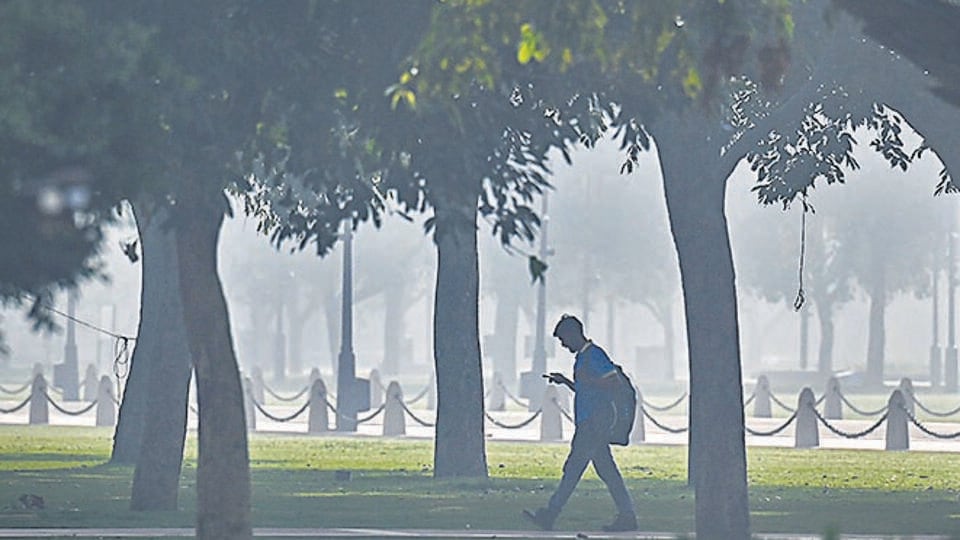
Delhi’s air quality improved on Tuesday due to strong winds but remained in the “poor” category for the second consecutive day, according to the Central Pollution Control Board (CPCB) after dipping to “very poor” on Sunday for the first time this season.
The Early Warning System (EWS), which issues a 10-day forecast on behalf of the ministry of earth sciences, said the air quality will likely deteriorate by Wednesday, with effigy burning during Dusshera festivities adding to local emissions at a time when temperatures are gradually dipping.
ALSO READ: Delhi Metro to run extra trips to cut vehicular pollution
Delhi’s 24-hour average air quality index (AQI) was recorded at 220, according to CPCB’s national bulletin released at 4pm — an improvement from Monday’s reading of 263 — due to faster winds and clear skies.
“Despite the wind direction being northwesterly during the day, wind speeds were averaging 10-12km/hour and touching 20km/hour at times, which facilitated dispersion of pollutants,” said Kuldeep Srivastava, scientist at IMD. He added that winds drop below 5km/hour at night largely due to low temperatures, which might lead to a spike in pollution after the effigy burning.
“This same trend will continue over the next few days as well, so if there are any local emissions, they may get trapped and not get dispersed easily. However, we expect wind speeds to increase once again on Wednesday afternoon,” he said.
Another factor that may contribute to a possible deterioration in air quality on Wednesday is the impact of stubble burning across the northern plains.
Data from the Indian Agricultural Research Institute (IARI) showed that Punjab recorded 360 farm fires on Tuesday, its highest single-day count this season. The previous highest was 174 on October 20 from the state. Haryana, meanwhile, recorded 70 farm fires. Its highest single-day fire count of 127 fires was on October 15.
The Decision Support System (DSS), under the ministry of earth sciences, which estimates the source of each contribution to Delhi’s PM2.5, did not share the percentage contribution of stubble burning on Tuesday. However, an estimate for Tuesday issued on Sunday pegged the contribution to be around 32%.

The early warning system predicted that the Delhi AQI will likely oscillate between “poor” and “very poor” till the end of the month as meteorological conditions continue to play a key role.
“Delhi’s air quality is likely to be in the ‘very poor’ category on Wednesday. It will then improve again and will likely be in the ‘poor’ category on Thursday and Friday. The outlook for the subsequent six days shows air quality is likely to be between ‘poor’ and ‘very poor’,” EWS said in its daily bulletin on Tuesday.
The Central Pollution Control Board (CPCB) classifies an AQI between 0-50 as “good”, between 51 and 100 as “satisfactory”, between 101 and 200 as “moderate”, between 201 and 300 as “poor”, between 301 and 400 as “very poor”, and over 400 as “severe”.
Delhi recorded a maximum temperature of 32.1 degrees Celsius (°C), which is around normal for this time of the year. The minimum was 16.1°C, a degree below normal. Srivastava said that mercury was unlikely to dip significantly in the coming days. “Both the maximum and minimum will roughly remain in this range till the end of the month,” he added.


