
 E-Paper



Prepared to implement Delhi govt’s winter action plan, say agencies
While the three municipal corporations said they will take additional measures to control road dust, the Delhi Traffic Police said it will take measures to cut traffic jams. They said all steps will be taken to implement Delhi’s 10-point winter action plan that was announced by Delhi chief minister Arvind Kejriwal


The three municipal corporations and the Delhi Traffic Police on Monday said they were committed to take all necessary steps to ensure that the 10-point anti-pollution Winter Action Plan unveiled by the Delhi government is fully implemented.
Delhi chief minister Arvind Kejriwal on Monday released the city’s winter action plan, which will be a guiding document to manage the pollution levels in the Capital this winter. Kejriwal set a 10-point agenda, which details tasks to be performed by various agencies, to control pollution at source.
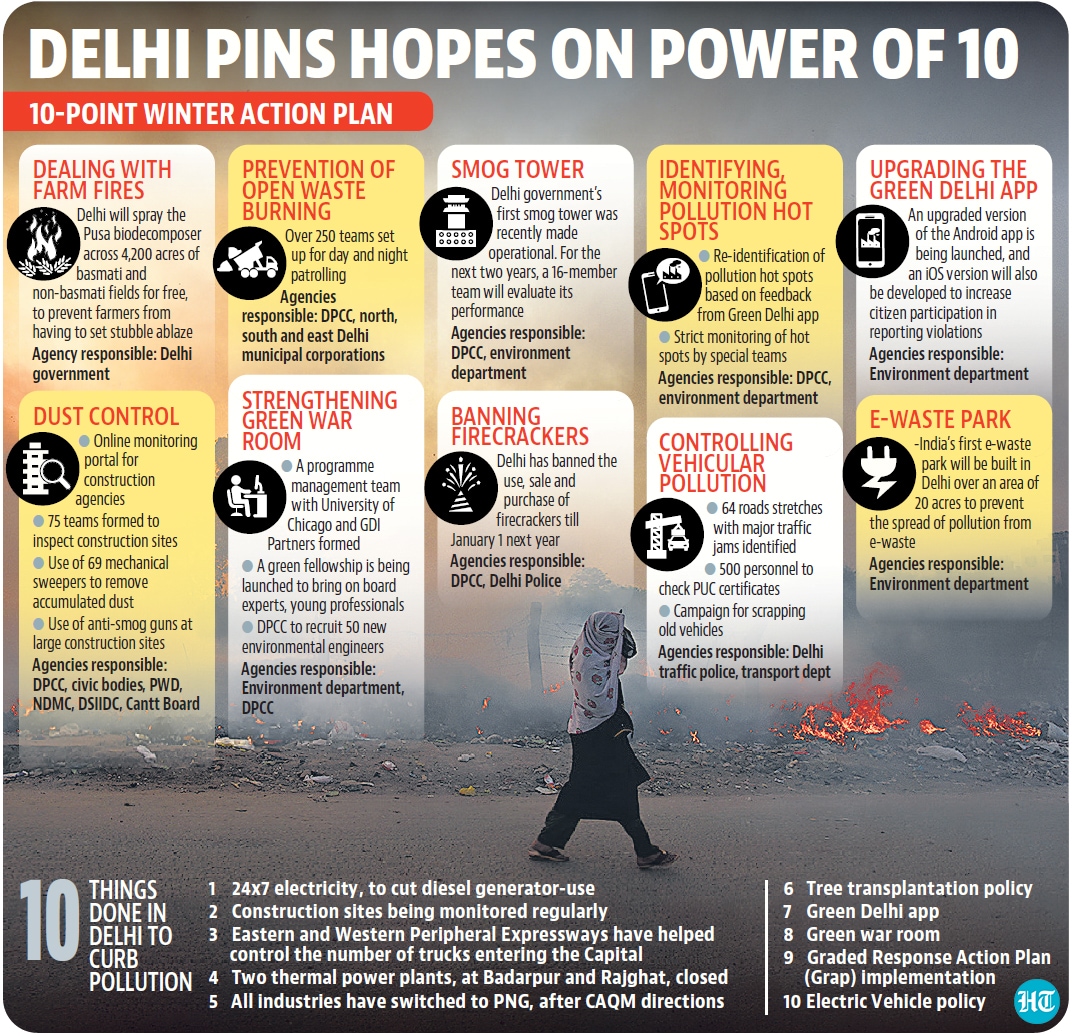
Delhi government officials said that while it is a state-level action plan, and the Delhi state pollution control board along with other agencies will continue to act simultaneously on the emergency measures laid down under the SC-mandated Graded Response Action Plan (Grap).
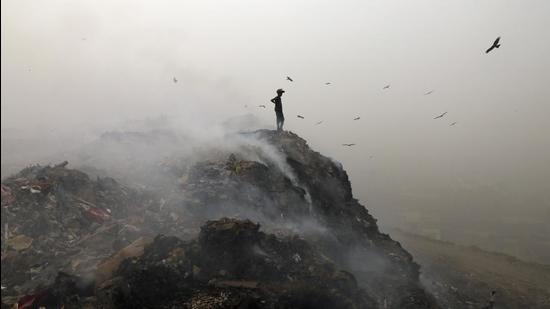
Every winter, Delhi experiences a huge spike in air pollution due to a combination of several local, external and meteorological factors such as crop stubble burning in the northern states of Punjab, Haryana, Uttar Pradesh, burning of garbage, road dust and low temperatures and poor wind speed trapping pollutants in the air closer to the ground.
In fact, in the run-up to the formulation of the action plan, the Delhi government had asked all agencies, including the PWD, the civic bodies, the traffic police and the Delhi Pollution Control Committee (DPCC) to come up with their own plans to ensure that air pollution could be prevented from slipping into emergency levels.
On Monday, several senior functionaries in the three municipal corporations of Delhi stated that most of the pollution countermeasures mentioned in the Delhi government’s winter action plan are already covered under the Supreme Court-mandated Grap, and the municipal bodies will replicate the measures taken last year with a few modifications.
Shyam Sunder Aggarwal, the East Delhi Municipal Corporation (EDMC) mayor, said a “three-pronged strategy” will be undertaken in the form of using water sprinkler tankers, pressing 10 mechanical road sweepers in service for controlling dust on roads and deploying enforcement teams for checking waste burning in trans-Yamuna areas.
“Most of the measures in the action plan were already being undertaken last year under Grap. Even if some additional steps have been directed which are for public welfare, we are committed to execute them,” a senior EDMC official said.
Road dust is one of the major contributors to the particulate pollution (PM2.5 and PM10) in Delhi -- the primary pollutants in Delhi’s air.
Avinash Chanchal, Climate Campaigner, Greenpeace India, appreciated the efforts by the Delhi government and added that air pollution crisis should not be seen as just seasonal and the action plan must provide long-term solutions, PTI reported.
“It’s good to see the Delhi government preparing for the winter’s air pollution crisis but it should also adopt a holistic and long-term solution to improve the air quality. The plan needs to address the consistent major contributors like emissions from vehicular, power, industry, waste and other sectors which exist throughout the year,” he said.
A senior civic official said changes in operation of mechanical road sweeping machines, which have been ordered under the state action plan for the season, will be undertaken as per the audit carried out by The Energy and Resources Institute (TERI). Among other changes, the audit recommended that each mechanical sweeper should cover 80-100 kms by working in double shifts. The three corporations and New Delhi Municipal Council together operate 59 road sweepers. The north DMC has also decided to set up a separate dust control and management cell headed by the engineer-in-chief.
Besides these 59 mechanical sweepers, additional 10 such machines will also be operated by the Public Works Department (PWD) on all arterial roads.
Municipal officials said that the civic bodies will together deploy 102 teams for 24x7 monitoring of waste burning cases. Fines for waste burning related violations are one of the ten actions mentioned in the government’s winter action plan.
“In the past, we have noticed that the levels of recovery of these NGT-mandated waste burning fines have been low. We will be working with sub-divisional magistrates to issue FIRs in major cases of non-payment of challans. The teams will also be working on a 24-hour basis instead of just carrying out night patrolling,” a senior north DMC official said.
He added that the project to set up e-waste parks, where electronic waste will be safely dismantled and recycled, is already being monitored by lieutenant governor Anil Baijal.
Inderjeet Sehrawat, the leader of the house in South Delhi Municipal Corporation, said the steps being taken for controlling pollution during winter will be replicated from last year. “We will try to improve the efficiency of the measures stated in Grap,” he added. The south body operates the largest fleet of 24 mechanical road sweepers among the local bodies.
The Delhi traffic police said they are already working towards decongesting the list of 64 stretches that they have submitted to the government. Traffic jams amplify pollution due to vehicular exhaust in particular areas.
“These 64 stretches are among the 120 roads which witness consistent traffic snarls in the city, and need to be decongested. We have in the past worked with governments and other agencies, and we will be taking steps to manage the traffic in these areas,” a senior traffic official said.


Stay updated with all top Cities including, Bengaluru, Delhi, Mumbai and more across India. Stay informed on the latest happenings in World News along with Delhi Election 2025 and Delhi Election Result 2025 Live, New Delhi Election Result Live, Kalkaji Election Result Live at Hindustan Times.


