
 E-Paper



Frescos of 17th century Delhi monument revamped
Restoration work is underway at the tomb of Muhammad Quli Khan in Delhi's Mehrauli Archaeological Park ahead of the G20 Summit in September. The tomb, which dates back to the early 17th century, features intricate frescoes that have lost their lustre over the years. Fresco artists from Bhopal and Gwalior are using a unique painting technique to restore the artwork to its original state. The restoration work is expected to be completed in a week, and a protective layer will be applied to prevent future damage.

 Prefer HTon Google


Nestled within the Mehrauli Archaeological Park in south Delhi, nearly 100 metres from the south entrance of Qutub Minar, is the tomb of Muhammad Quli Khan from the early 17th century — a site which has been brimming with activity over the past month.
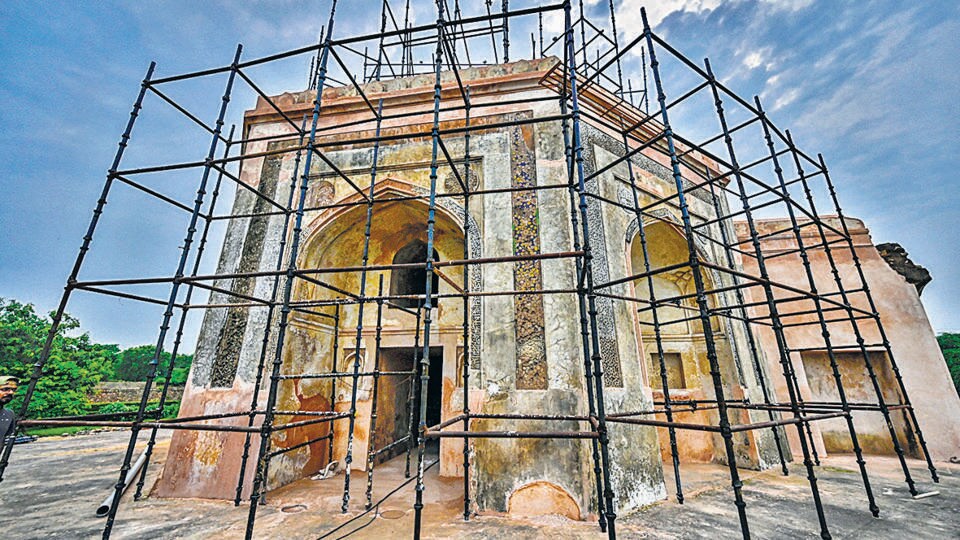
The historical structure is set to transform with the first restoration works in 13 years, meant as an improvement ahead of the G20 Summit in September.
While plaster and strengthening work started months ago, fresco artists have begun restoring the intricate artwork on the tomb’s interiors. At work are specialists from Bhopal and Gwalior, who employ a unique painting technique by which pigments are painted on the surface when the lime plaster is wet.
Frescoes, in an inimitable blue with hints of brown, decorate the niches and alcoves on the inside of the tomb, while the exteriors are adorned by floral ornamentation with calligraphic inscriptions. Over the past decade, the artwork outlining the tomb lost lustre and sustained damage.
“Conservation work at Quli Khan’s tomb will transform the monument and make it stand out. The tomb has beautiful ornamentation which makes it quite unique. Specialised fresco artists are working on the tomb to preserve the original ornamentation,” said Sanjay Garg, deputy director, department of archaeology.
Garg added that the last repair was carried out in the complex ahead of the 2010 Commonwealth Games. “The tomb is adorned with intricate carvings. In order to highlight the art, we will be illuminating the tomb to make the fresco stand out,” said Garg.
The octagonal tomb dating back to 1600s has housed different people since it was first constructed.
It was originally the tomb of Muhammad Quli Khan, the brother of Adham Khan — the general and foster brother of Mughal emperor Akbar. Adham Khan was the son of Maham Anga, Akbar’s wet nurse.
Later, between 1835 and 1853, the tomb was remodelled and used by Thomas Metcalfe as his weekend retreat, “Dilkusha” (heart’s delight). Metcalfe was a powerful East India Company civil servant in India and a British resident at the court of Mughal emperor Bahadur Shah Zafar. Metcalfe was also the last known resident of the site.
Metcalfe altered the enclosure in which the tomb stood into a garden with terraces, water courses, and pavilions, traces of which continue to exist.
According to the Indian National Trust for Art and Cultural Heritage’s built heritage listing in Delhi and the Archaeological Survey of India’s listing, the complex was extended in the northwest, and rooms and fireplaces were built by Metcalfe.
Currently, a team of six fresco artists is working on the tomb. Neha Syed, one of the fresco artists, said that the tomb demonstrated art influence from the Samarkand region and a confluence of diverse design patterns in niches and windows. The team undertook a multi-layered process to prepare the cobalt blue colour being used to paint the frescoes.
“For Quli Khan’s tomb, we used a natural blue stone to create the pigment. The tomb demonstrates Samarkand art and shows a distinctive use of blue. We have used natural colours since the goal of conservation is to preserve the tomb in the manner it originally was,” said Syed, from Bhopal, who has previously worked on multiple heritage structures across Madhya Pradesh including the Gwalior Fort. To prepare the pigment, the team sourced natural blue stone from Jaipur. The stone was ground and processed to prepare the pigment which was used directly on wet lime plaster to paint.
“The fresco was damaged and covered in layers of dust. There were cracks in various parts. Across the tomb, there was a fungus infestation. We cleaned the fresco twice to unveil the original colours that had faded. This was followed by chemical peeling and fresh painting,” added Syed.
The painting process is expected to take another week after which a final protective layer will be given to the artwork to prevent future damage. “Once we complete the work and layer it with a protective agent, the designs should remain good at least for the next 30-40 years,” she said.
Syed and her team will also fix broken ornamentation and Quranic inscriptions on the exteriors of the tomb. The exteriors of the tomb also demonstrated Iranian tile artwork which will be re-done in consonance with the original template, said Syed.
“On the outside, the ornamentation and colours along with inscriptions have faded and disappeared. Coloured tiles have been created in Iranian art technique. We will replicate the original design and prepare the original colours used on the facade. Quranic inscriptions lining the exteriors were also broken and we will engage calligraphers to fix them,” added Syed.
Meanwhile, historians said that while the tomb was conserved in the past, it deteriorated and faced vandalism. “The tomb is historically significant. After the death of Metcalfe, his family continued to use the residence. During the revolt of 1857, the residence was looted since it was British property. Conservation is welcome but maintenance is equally important. The tomb has been repeatedly vandalised,” said author and historian Swapna Liddle.


