
 E-Paper



Seven northern cities record poorer AQI than Capital, CPCB data shows
This is not a one-day phenomenon, as air pollution levels in these locations have been worrisome for the last one week

 Prefer HTon Google


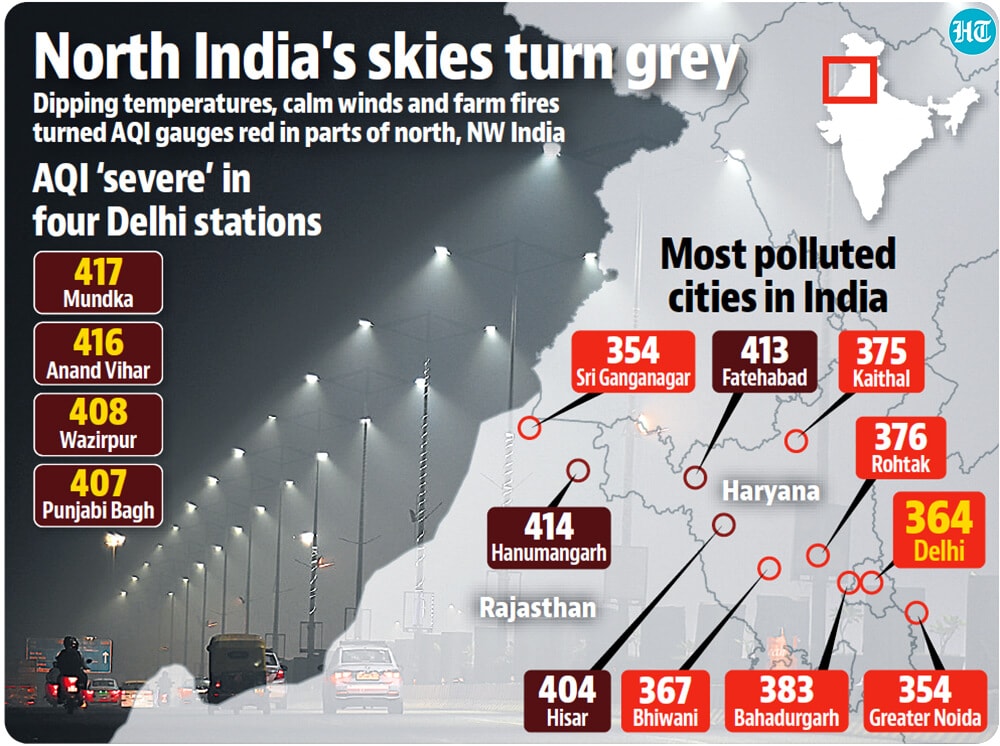
Hanumangarh in Rajasthan and Fatehabad in Haryana were among seven locations that recorded higher air pollution levels than Delhi on Wednesday, indicating that air pollution is not just a problem of National Capital Region (NCR) but of most of the northern plains, as per the Central Pollution Control Board (CPCB) data.
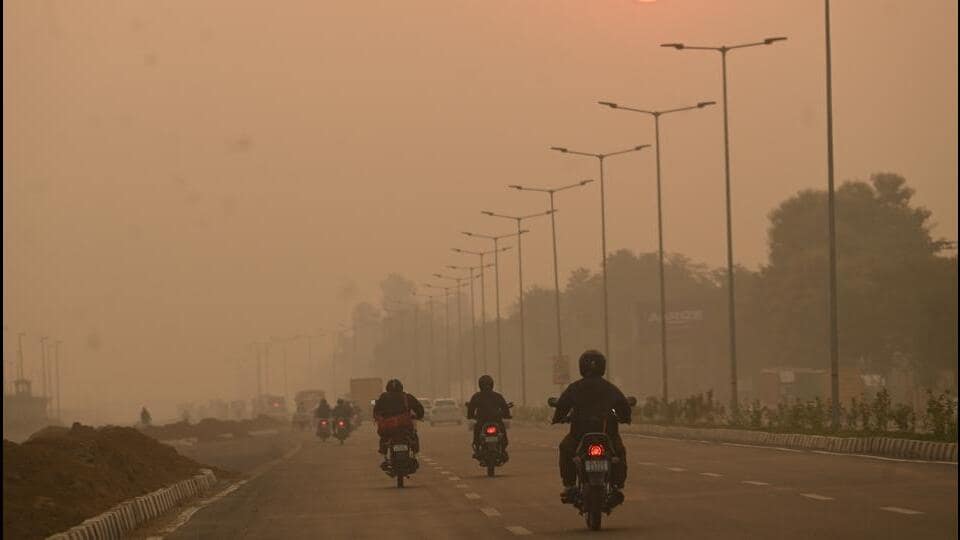
Hanumangarh in north-western Rajasthan recorded air quality index (AQI) of 414 becoming the most polluted town in the country, followed by Fatehabad and Hisar in Haryana, with AQI of 410 and 403, respectively. The air quality in these three towns, as per the CPCB data, was in the ‘severe’ category on Wednesday.
Meanwhile, Delhi’s air quality was in the “poor” category, as the AQI recorded was 364. Other places in the region with worse air quality were Bahadurgarh (383), Kaithal (376), and Rohtak (374) in Haryana, and Muzaffarnagar (370) in Uttar Pradesh.
Analysis of CPCB’s AQI data for Wednesday shows that almost half of the locations monitored in western Rajasthan, Haryana, Punjab, and Delhi had either “poor”, “very poor” or “severe” air quality.
This is not a one-day phenomenon, as air pollution levels in these locations have been worrisome for the last one week, with towns struggling to stay off the list of cities with the worst air in the country.
“Air pollution is no longer just an NCR problem,” said Anumita Roy Choudhary, executive director of Centre for Science and Environment (CSE).
She added that during the non-winter months, these towns have lower particulate matter (PM) as compared to Delhi. “But during winters, there is a spike in pollution levels in smaller towns of northern plains due to localised biomass burning, emissions, and lots of dust,” she said.
As per CSE data, in 2022, Agra and Vrindavan had 20% lesser PM pollution than Delhi in the non-winter months but in the winter months, pollution levels in the two towns were 5% more than Delhi.
Experts said that air pollution in smaller towns in the Indo-Gangetic plains is as bad -- if not worse -- as NCR, due to multiple factors recently, such as a spike in vehicular emissions and higher construction activity.
The CSE analysis shows that atmospheric changes during winter such as inversion, calm conditions, change in wind direction, and seasonal drop in ambient temperature across north India entrap pollution. The air quality further gets pushed to the ‘severe’ category due to the smoke from farm fires and Diwali firecrackers. Air quality, however, improves in cities of Punjab and north Haryana post stubble fire season, as per CSE.
Read Here: As AQI climbs, Delhi govt admits next fortnight will be crucial
The CPCB data shows that bad air quality is spread more across the Indo-Gangetic plains than central and southern India. The eastern parts of the plains, however, have it easier than NCR -- with Patna and Rajgir in Bihar recording AQI of 214 and 211, respectively.
It was more than 300 in Patna till last week due to localised stubble burning,” said a Bihar pollution control board official aware of the issue. After the spike in air pollution, Bihar chief secretary Amir Subhani had directed officials to dissuade farmers from stubble burning, and if found indulging in it, they will lose their direct benefit transfer (DBT) registration.
(With inputs from Patna, Lucknow and Chandigarh)


