E-Paper



Shiv Murti-Nelson Mandela tunnel faces green concerns
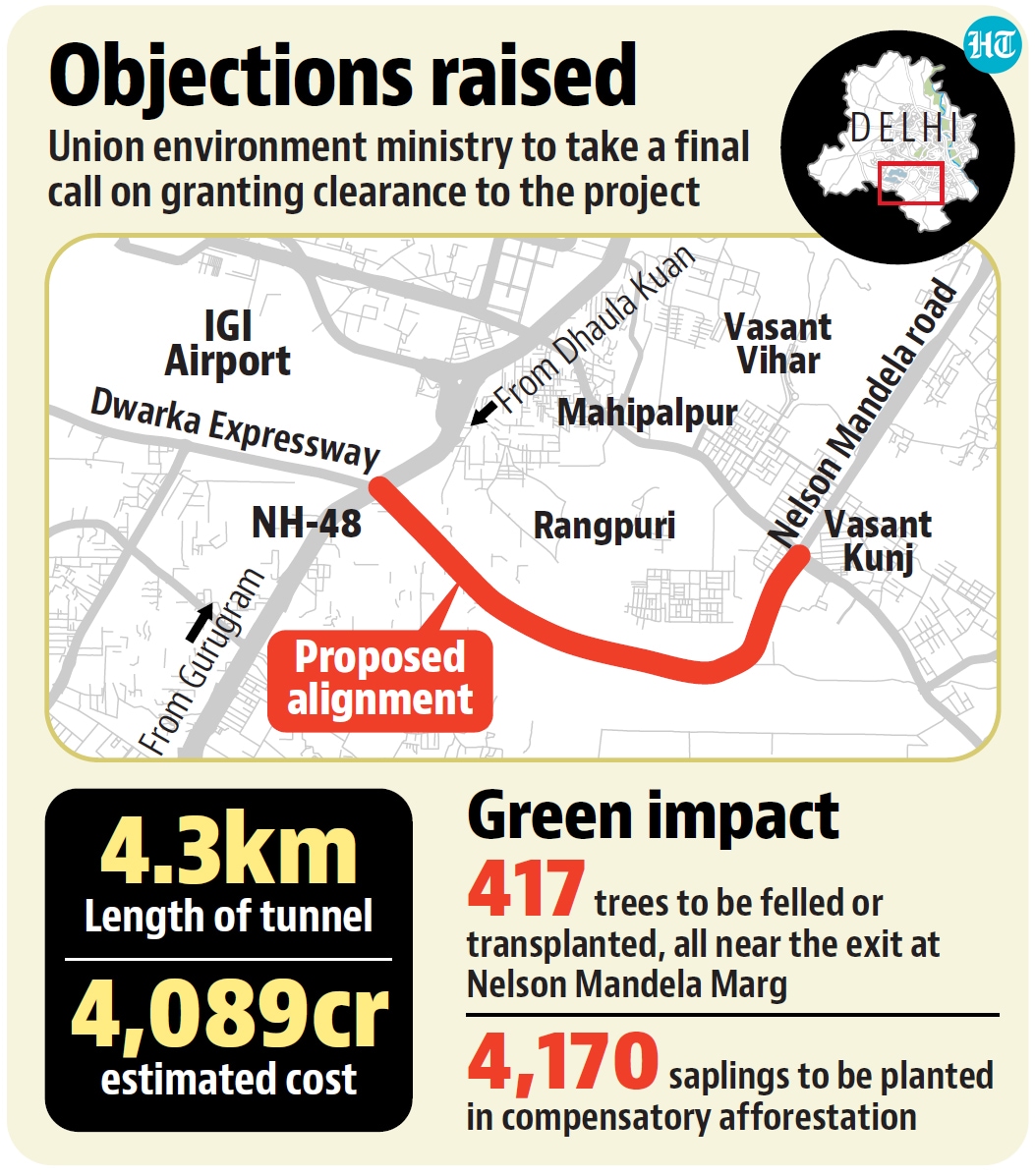
The project, to be constructed by the National Highways Authority of India, involves creation of a 4.9km underground tunnel and felling of around 417 trees.

 Prefer HTon Google


The Delhi Pollution Control Committee (DPCC) has stated that residents of south Delhi have raised concerns that a proposed tunnel between Shiv Murti interchange on NH-48 and Nelson Mandela Marg in Vasant Kunj could have an adverse impact on the forest and environment, and possible damage to houses in the area.
DPCC shared the concerns with the Union environment ministry in a report that the pollution body uploaded on its website this week, which was based on two public hearings conducted in September. The ministry will now take a final call on granting an environmental clearance to the project, the construction for which is planned to commence in July 2025.
The project, set to be constructed by the National Highways Authority of India (NHAI), involves the creation of a 4.9km underground tunnel and the felling of around 417 trees.
DPCC in its report said all objections and queries raised by local residents and activists were put together, with responses accordingly sought from the project proponent.
Niskarsh, a resident of Mahipalpur’s Gali number five, said he was worried about possible damage to his home, as the proposed tunnel passes directly underneath. However, DPCC in its report stated that a tunnel boring machine (TBM) will be used for the project, which is not likely to impact the surface or the houses in the area in any way.
“Proper monitoring and safety design checks shall be done to avoid any damage to existing structures,” DPCC’s report, quoting the project proponent said.
Jitendra Kumar Yadav, another resident of Mahipalpur, questioned how the environment will be protected from possible damage. “The environment management plan (EMP) will be implemented during the construction phase to mitigate environmental impact,” the report said, addressing a third query on air pollution caused by ready mix plants by stating all preventive measures will be taken by NHAI.
In September, DPCC in a project report stated that the tunnel will decongest Mahipalpur and its surrounding areas.
“The main objective of the project is that NH-48 carries very heavy traffic to Chattarpur and Vasant Kunj from Gurugram and creates a heavy congestion at Mahipalpur due to very narrow city road. Traffic is also seen to and from Delhi airport and Mahipalpur and Rangpuri markets,” the report had said, adding that the tunnel will pass through 5.825 hectares of area, which comes under the southern Ridge, and another 1.68 hectares was part of a deemed forest, for which permission has been applied under the Forest Conservation Act (FCA), 1980.
In November 2022, the Delhi’s Ridge Management Board (RMB) cleared the project, and further recommended it to the Central Empowered Committee (CEC), which cleared it in June 2023, and the Supreme Court gave the final approval in October last year.
For any project being built in a forest area, clearances are also needed under the FCA, which are granted by the Union environment ministry.