E-Paper



Throwing caution to the wind on Diwali in Delhi
Thousands ignored the ban on firecrackers, filling the night air with a dense haze of toxic smoke that pushed pollution to hazardous levels

 Prefer HTon Google


Thousands of residents flouted the city’s firecracker ban during Diwali celebrations on Thursday night, blanketing India’s capital in toxic smoke that sent air pollution soaring to hazardous levels, especially in residential areas, where the sound of explosions echoed until early Friday.
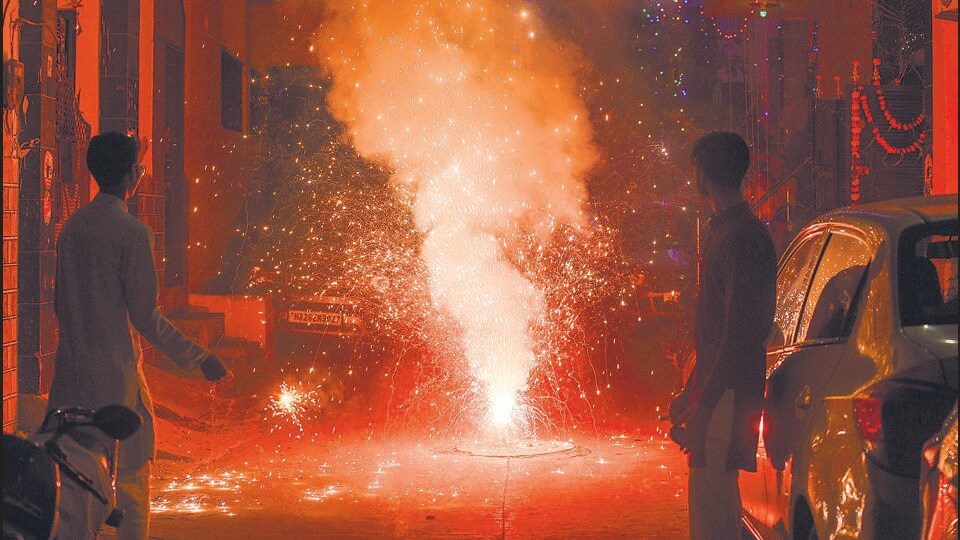
Data accessed by HT helps understand the scale of this reckless revelry, which was most stark at residential locations such as Vivek Vihar in East Delhi, where PM2.5 levels surged to an astounding 1,853 µg/m³ at midnight -- over 120 times WHO’s safe limit of 15 µg/m³ and 31 times India’s more lenient standard of 60 µg/m³.
Vivek Vihar is surrounded by several residential enclaves in East Delhi and its peak PM2.5 concentration was followed by that of Nehru Nagar in South Delhi abutting Lajpat Nagar, and in the general vicinity of multiple residential colonies. Here, the peak PM2.5 value was 1,527µg/m³.
HT accessed readings from 40 weather stations deployed across the Capital, which are maintained by a number of agencies – the Delhi Pollution Control Committee (DPCC), the Central Pollution Control Board (CPCB) and the India Meteorological Department (IMD).
The hourly data reveals a telling pattern: while residential areas showed massive jumps from their evening baselines, industrial areas maintained relatively moderate levels throughout the night. In east Delhi’s Patparganj, PM2.5 levels soared to instant peaks of 1,504 µg/m³, with hourly averages showing a dramatic jump from 156 µg/m³ at 6pm to over 450 µg/m³ post-midnight.
The monitoring station at Okhla Phase-2 reached 1,362 µg/m³, marking a severe deterioration from its early evening readings of about 200 µg/m³. At the Dr Karni Singh Shooting Range, levels touched 1,240 µg/m³.
In stark contrast, industrial areas, typically Delhi’s pollution hot spots, showed significantly lower spikes during the Diwali celebration hours. Narela, an industrial hub, peaked at just 251 µg/m³, while Jahangirpuri reached 385 µg/m³. Mundka’s hourly averages stayed below 400 µg/m³ through the night, a fraction of what residential areas experienced. This disparity stems from the concentration of Diwali celebrations in residential areas, while industrial zones, with fewer residents, saw limited firecracker activity.
The situation was particularly challenging for residents in the heavily affected areas.
BS Vohra, the joint front president of east Delhi RWAs, who lives in Krishna Nagar near Vivek Vihar, reported that firecrackers were being burst flagrantly until around 3am. “Firecrackers were going on non-stop till midnight and only then, the intensity reduced marginally. We personally had our fans switched off and had to keep our exhaust fans on so the smoke that had entered our house could escape,” said Vohra, noting that itchy red eyes were a clear indication of the high pollution levels in the area.
Monica Aggarwal, 54, a resident of Mayur Vihar Phase-3, near Patparganj, shared similarly harrowing account. “We could not step outside as there was visible smoke and breathing was difficult. We have an air quality monitoring device too, which showed the PM 2.5 concentration was over 200µg/m3, even with all our doors and windows closed,” she said, adding she was not surprised PM 2.5 outside had crossed 1,000.
Aggarwal said firecrackers were also being burst freely in the run-up to Diwali.
Ashok Bhasin, president of north Delhi RWA federation, said that if the government was serious about controlling pollution it should have imposed a ban on production itself. “There was no ban and more crackers were burst this year compared to even last year that went on till 2am. The ban was only for publicity as crackers were available for sale in every single market in the last week and crackers were burst in every lane,” he said.
The hourly progression shows residential areas consistently deteriorating through the evening, with most recording their worst pollution between 11pm and 2am. Even typically cleaner residential areas like RK Puram saw hourly averages jump from around 100 µg/m³ at 6pm to over 500 µg/m³ by midnight. Central Delhi locations like ITO witnessed some of the most dramatic increases, with hourly averages rising from 88 µg/m³ in the early evening to nearly 1,000 µg/m³ at its peak – a staggering increase of over 1,000%.
Data from Delhi Pollution Control Committee’s 23 ambient air quality monitoring stations showed a majority of these recorded their peak pollution levels around midnight, with the PM2.5 concentration dipping afterwards as wind speeds picked up. Out of the 23 stations, five recorded PM2.5 concentration crossing 1,000 µg/m³, though this was an improvement from last year when 11 stations had crossed this threshold.
To be sure, last year’s Diwali was celebrated a little later in the year, with colder temperatures and lack of breeze making pollution last longer. This year, weather officials said the region was largely fortunate since the weather is unusually warm and breezy – factors that helped clear up some of the smoke.
The contrast between residential and industrial areas is particularly evident in the recovery patterns: while industrial areas maintained relatively stable levels throughout the night, residential areas showed dramatic spikes followed by gradual improvement only after 3am, when celebration-related emissions began to decrease.
By 9am on Friday, most residential areas still showed levels 2-3 times higher than their pre-Diwali readings, while industrial areas had largely returned to their baseline levels.
Experts noted that stronger-than-expected winds and mild nighttime temperatures kept this year’s pollution peaks lower than in previous years, helping to disperse smoke faster than usual. “We have seen strong wind speed help Delhi this year. In some parts, if the wind speed was fairly strong in the evening, the peak levels would have been much lower. At locations like Najafgarh and Narela, where the levels consistently remained lower, it is likely people did not burst many crackers,” said Sunil Dahiya, founder and lead analyst at the environmental think tank Envirocatalysts.