
 E-Paper



Want to see Delhi University in list of world’s 200 best universities: Vice-chancellor Yogesh Singh
Yogesh Singh took charge of Delhi University (DU) in October last year, amid a massive overhaul of its undergraduate admission system.

 Prefer HTon Google


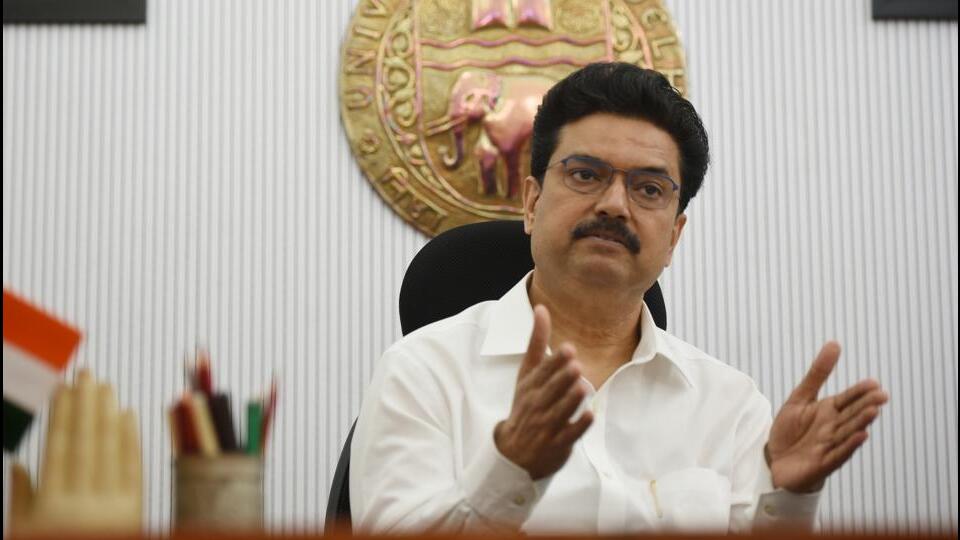
Yogesh Singh took charge of Delhi University (DU) in October last year, amid a massive overhaul of its undergraduate admission system. Ahead of the implementation of the Central Universities Entrance Test (CUET) that replaces the cutoff-based admission procedure this year, he spoke to HT’s Sadia Akhtar. While addressing key concerns pertaining to CUET and the four-year undergraduate system, Singh said the common entrance was a step in the right direction. Edited excerpts:
DU will be implementing CUET from this year. Do you think it’s the best way to solve the problems in the admission system? Some say this will lead to additional stress on students. What impact is the university expecting on admissions this year?
CUET is a right step in the right direction. Till now, we were admitting students through merit based on Class 12 scores. Had there been a single board, the situation would have been different and we would not have required an entrance test. India is a very large country that has a central board, a few international boards, and so many state boards. Every board has its own uniqueness, strengths and weaknesses. Some boards are lenient, others are strict. We admit students based on their performance in their respective board exams, but give equal weightage to all of them. This means students who are coming from lenient boards have an edge over other students and those who are coming from strict boards, they don’t have that advantage. This is a very unfair system for our students because your performance is also dependent on the performance of your board. One of the best solutions in our view is the common entrance test, where every student will be assessed on the same parameters. This will provide an equal opportunity to all students.
A section of stakeholders feel that the current Class 12 batch has seen too many changes, starting from term-wise board exams amid the pandemic. They feel the decision to implement CUET is rushed. Your views?
This decision (CUET) has not been taken on the basis of data from just a year or two. We analysed data from many years and found that many students suffered unnecessarily due to the nature of their board. Although I am not criticising any board, when we admit students in our university, it should be done on the basis of the same parameters. If a student fails to perform well in the boards, the chances of admission are blocked. With CUET, students can appear next year as well, so there is another opportunity. We think it’s likely that the central government will conduct CUET twice a year from 2023, so the best performance can be taken into consideration for admission. I will be very happy if this is done. The marks scored in Class 12 will be replaced by the marks scored in CUET. Other processes will remain the same.
Will CUET reduce the pressure of high cut-offs?
The pressure of high cut-offs will be replaced by the pressure of the entrance test. There will merely be a transfer of pressure. However, this pressure will be more prudent since it gives students more chances. If we are able to give two chances in a year, that will be the best thing.
The undergraduate curriculum framework passed by DU will require 176 credits for a four-year degree. According to the draft UGC framework, students will require 160 to 176 credits for a four-year degree with honours/research. How will MEES and multi-disciplinarity work in such a system where students coming from non-DU universities might have lesser credits?
We are offering 176 credits. If someone wants to join DU after first year, they have to earn 176 credits only because that is our criteria for a DU degree. Right now, the UGC draft says 160 credits, but we have also requested the UGC to give flexibility to universities. I hope we get that flexibility because universities have their own compulsions. A one-size-fits-all formula might not work for everyone.
Drawing on experiences of NEET, there is a concern among people that CUET will be disadvantageous for students from rural backgrounds or marginalised groups. Your comments?
If we set a question paper that is very difficult for a Class 12 student, the student will not have any other option but to opt for coaching. In CUET, questions will be based on NCERT books with reasonable difficulty level. If a student is good in Class 12, they will be able to perform in the entrance test as well. There will be a correlation between the Class 12 and entrance performance. If we are unable to establish this correlation between the Class 12 and entrance performance, we need to take a look at the entrance paper. This concern is related to the question paper and not coaching. The difficulty level of NEET and JEE is very high. Students have no option but to go for coaching. I hope the agency that will conduct the test will take care of this.
What do you have to say about apprehensions that boards will become redundant or diluted?
Someone who performs well in school should perform well in the entrance also. Otherwise, we will have to rethink the process of selection. We need to keep in mind that schools are not meant to get marks. Schools are for education. They are in place to ensure a good learning environment, and marks are an offshoot of this learning. Students will no longer have any pressure of marks. They can focus on learning skills, creativity and originality. Our education system is based on marks and grades. We need to rethink this approach to education. Marks are not everything. We have unnecessarily given a lot of premium to marks. School is an instrument of learning and change and its value will never be diminished. Students from small towns will have some advantage under CUET. Otherwise, such students have suffered a lot in the previous system.
Another criticism of CUET is that a MCQ-based test is not the best way to assess students’ writing and comprehension abilities, particularly in the arts and humanities.
These apprehensions were there when the MCQ based format was introduced for engineering exams. Some 30-40 years ago, many universities would take descriptive tests in engineering as well. I am not saying that the MCQ-based testing mechanism is the best. However, at the moment, we do not have a better system. When we talk about a descriptive paper, subjectivity is involved and due to subjectivity, there will be variation. In order to avoid subjectivity and variation, the MCQ based format is one of the ways. All of these tests, however, are elimination tests or filtration tests. We need to devise an instrument that can decide if a candidate has the aptitude for a particular course or not. This is a real challenge for the country.
How is the university placed when it comes to creation of course content under the new framework? Has the process been completed for the first year? When FYUP was implemented earlier, the course content had drawn a lot of flak.
Departments are working on the course content. It is not ready. We have asked them to focus on first year and create the course content by April. Afterwards, they can start working on the second year. The framework will be completed first after which the detailing will be carried out.
Ad hoc teachers, under the DUTA banner, on Thursday protested and asked to be absorbed. Absorption and teacher recruitment has been a long-pending demand. Are any steps being taken to end this stalemate?
The vice chancellor cannot do anything. Absorption is not possible as per law. We had the Rama Devi judgement. Any subjective scrutiny and selection will not be allowed in the eyes of law. It’a difficult situation and I don’t have any solution. Teachers should appear in the recruitment process when it is carried out. They will get a fair chance.
There are also concerns that with the reduction in credits under the new framework, there will be reduction in workload as well.
The university is not for teachers, it is for students. We have to keep the interests of students in mind. We have to decide courses in a way that are good for our students, which will add value to their lives. Universities serve that purpose only, and to fulfil that purpose we need a vice chancellor, administration and teachers. Our focus should be to improve the quality of life of our teachers. When we say that workload of teachers should not be affected, it means that the workload of students should not be reduced. The issue is workload of students and not teachers because if there are no students, there is no need of teachers either. If a student is busy for 40 hours in a week, then how are we expecting our students to indulge in creative work. Such a model is not followed anywhere else. We need to make our students skillful. The welfare of teachers is directly proportional to the welfare of students.
There are concerns that the reduction in number of credits will lead to dilution of course content for honours degree. NEP also offers one year masters and MPhil has been done away with. Many teachers are of the view are if students are allowed to pursue PhD straight after 4 years of undergraduate course, it will lead to the devaluation of the PhD degree itself.
The four-year honours course is not at all a dilution of the degree. It is a different way of teaching and learning. It is unconventional and not the traditional way but things have to change. We should train our students based on the students’ interest and not our interest. We are bringing a major-minor concept. Students might be able to do a major in psychology with a minor in journalism. They will have both options available in life. We want to cultivate a culture of research at the UG level. We need to give students the option and not everyone will end up going for a PhD. Others can go for a masters and then PhD. Both options are available to them.
Do you think the MEES [Multiple Entry/Exit System] provision might encourage drop-outs, especially among women students. Please comment.
MEES is a very good step towards women empowerment. After first year, we will teacher certain general electives and skills. For whatever reasons, if a woman student has to exit after one year, she will have at least some document on the basis of which she can secure a job. Right now, if she were to quit, she would simply be identified as a college dropout. Many students end up getting married and quitting without any degree. They will at least have a certificate , degree or diploma which allow them to get a job. You can also rejoin and join another university in the future for further completion of the degree. Women face a lot of mobility in their lives. This provision will be enablers of women empowerment. This will benefit women
DU will be entering its centenary year this May. What is your vision for the university?
My vision is very simple. We want to place DU in the league of the world’s 200 best universities. Right now, when the global rankings come, there is a hue and cry. Some people criticise the international parameters set up by the best. However, an Indian university should feature in the top 200, and DU has the capacity and capability to do this. Last year, we were 600. This year, we are 800. We are climbing down which is unfortunate. We are working on those parameters and we hope to enter the top 200 in the next 10 years.
In the past few years, the strife between Delhi government-funded colleges and the government had escalated. How has your experience been working with the government?
I worked with the government of Delhi in my capacity as director of NSIT [Netaji Subhas Institute of Technology] as well as the V-C of DTU [Delhi Technological University]. I could do anything and everything that I wanted. They supported me and gave the funds. The situation of 12 Delhi government funded colleges is quite different since their posts are not approved. We are working in that direction. I am hopeful that things will be resolved within a year. Colleges have received the grants and salaries but the issue is that for creation of additional teaching posts, approval of finding agency is required. Some of the colleges could not take that. This is an issue but it should be sorted.


