
 E-Paper



‘We were assaulted as if we’re criminals,’ say protesters of CJP march
Several protesters who participated in Monday’s march towards Parliament remained bruised and injured on Tuesday, with one still critical and on respiratory support, a day after violent clashes between demonstrators and police across central Delhi left estimated hundreds injured

 Prefer HTon Google


Several protesters who participated in Monday’s march towards Parliament remained bruised and injured on Tuesday, with one still critical and on respiratory support, a day after violent clashes between demonstrators and police across central Delhi left estimated hundreds injured.
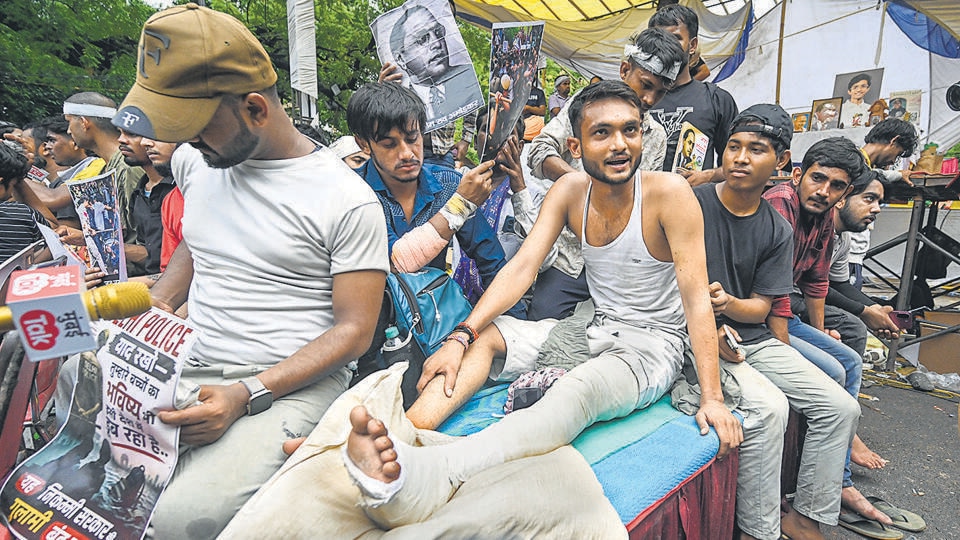
On Monday, tens of thousands of protesters had marched towards Parliament demanding the resignation of Union education minister Dharmendra Pradhan over repeated examination paper leaks. As crowds advanced, toppling barricades erected across Lutyens’ Delhi, Delhi Police and paramilitary personnel attempted to stop the march using tear gas, lathicharge and pellet-firing.
While the Delhi Police alleged that the planned-but-unauthorised march was handled “professionally,” visuals showed security personnel in full riot gear thrashing young unarmed protesters. Protesters – students, young professionals, farmers, social media influencers among others – described what they called an “indiscriminate” and “unwarranted” lathicharge on unarmed demonstrators.
Among the most critically injured is 22-year-old Sakshi, an Uttam Nagar resident, who remains in the intensive care unit (ICU) at Ram Manohar Lohia (RML) Hospital on ventilator support. A family member said she suffered severe injuries after a stampede-like situation that followed tear gas shelling near Jantar Mantar and Tolstoy Marg.
“She has injuries on her face and neck and had difficulty breathing. She had gone with her cousin, who also suffered injuries. We have seen videos online showing how badly she was hurt,” the relative said.
Sakshi, originally from Bihar, lives with her uncle and aunt in west Delhi while pursuing a computer science course. Her family said she had gone to the protest with her cousin sister, who also received injuries in her leg.
At Lady Hardinge Medical College, 25-year-old Shekh Irshad Mansuri, a private firm employee from Gurugram, awaited surgery after fragments from a tear gas shell became lodged in his eye and neck.
“I had only joined the gathering after seeing people raising slogans near Connaught Place. Then a security personnel came and started hitting us. Suddenly someone fired a tear gas shell, which I felt exploding next to my face. It felt like my face was on fire and I would choke to death,” he said. “The police treated us like terrorists. Two-three policemen walked by but they didn’t help. They picked up lathis and hit my friends. Thankfully, other protesters rushed me to the hospital.”
A medical officer at the hospital said he will undergo surgery as gas shell fragments are still lodged in his eye and neck and have to be removed.
Several others recounted similar experiences.
Shivam Navani, 18, a student from Rajasthan, described the confrontation that unfolded around the barricades near Parliament. “We had just reached... when the police charged at us. I was hit when I was trying to protect a couple of girls who were being beaten up. They did not wait or see anything and just kept hitting. All we were trying to do was peacefully march.”
Tanvi, a 21-year-old Delhi University master’s student, suffered a hairline fracture in her hand and multiple bruises. She said the entire CP area felt like a “maze” with barricades everywhere and a heavy police presence that made movement difficult. “Several of us rushed into the LIC in an attempt to escape the chaos, but police entered there too and asked us to leave. I still have hand-shaped marks on my chest,” she alleged. “I still have hand-shaped marks on my chest. The fact that all of this was done by male police officers made the experience even more traumatic.”
Among NEET aspirants who joined the march, Anshu Mishra from Nangloi said he was beaten after falling to the ground during the lathicharge, while his friend Keshav Jha required seven stitches to his head after trying to shield him. “A cop first hit me on my back and neck, when I fell down, other officers joined in… I was rushed to RML by other protestors,” he said. “We expected to be stopped, not beaten like this,” Mishra said.
“We knew that the police will try to stop us to go for the March, but we did not think that they would brutally assault us,” said Jha.
Among those who travelled specifically for the protest was Anil Singh, a 45-year-old farmer from Madhya Pradesh. “This is the peak paddy sowing season, but I came here thinking about my children’s future. I have to ensure my daughter and son do not study only to remain unemployed. Instead, we were assaulted like criminals. The government owes answers to us and to all those lying injured in hospitals,” Singh said.
Suhana Khan, 23, a Delhi student, claimed both uniformed personnel and men in plainclothes wielding batons assaulted protesters before detaining around 30 women together. “We were hit atrociously as if we were criminals.”
Content creator Ramit Verma, known online as PeeingHuman, said he sustained head, jaw and groin injuries after allegedly being struck repeatedly while filming the protest. “I was following a group of protesters and recording videos for content when personnel started hitting protesters. I turned around and tried to leave, but then I felt a heavy blow to my head,” he said. “After some time, another group of policemen arrived, and without any provocation, attacked me.”
Saavy Gupta, who recently completed her LLB from Delhi University, alleged she was repeatedly struck on her legs even after collapsing. “A few cops first hit me on my legs, and I wasn’t able to move. I sat down on the road and started crying. I wanted to leave, but I couldn’t stand again. I had a breakdown. Two or three people helped me get back on my feet; otherwise, I believe cops would have continued hitting me,” said Gupta.
A BBA graduate from a DU college Vishal Pandey, suffered a fractured leg after a barricade fell on him during the chaos.
Vijay Daniel, a protester who came from Hyderabad to join the march, said the violence erupted moments before it was to begin. “We were just getting into the bus to leave for the march. I was with Gitanjali ma’am when the officials barged into the vehicle and started pushing and hitting us,” he said, referring to educator Gitanjali Angmo, who has been at the forefront of the protest since the removal of her husband, activist Sonam Wangchuk, from Jantar Mantar. He alleged that protesters were trapped as police advanced from multiple directions.
Wangchuk’s hunger strike and forcible removal last week galvanised the protest movement.
“We had to run back towards the protest site. I hid under the stage with a doctor who was helping injured people, but they pulled us out and hit me on the neck. It felt like Jallianwala Bagh because we were surrounded from both sides,” he said.
David Lal Tongchangya, 29, a student from Mizoram, questioned the police allegation that protesters threw stones. “They say we threw stones. How is that possible when there are no stones here and everyone is frisked before entering?” he said.
Also on Tuesday, Union health minister JP Nadda visited RML Hospital and Lady Hardinge to interact with the injured protesters. During his visit, he held a meeting with doctors to review the medical care being provided.
Police said 118 personnel, including senior officers, were injured in the clashes. While the exact number of injured protesters remains unclear, hospital officials said they treated well over 100 people. Police on Monday put the figure at around 60.


Stay updated with all top Cities including, Bengaluru, Delhi, Mumbai and more across India. Stay informed on the latest happenings in World News along with Delhi Election 2025 and Delhi Election Result 2025 Live, New Delhi Election Result Live, Kalkaji Election Result Live at Hindustan Times.


