
 E-Paper



Delhi riots: Hospital corridors echo with grief, stories of loss
Some eyes are still moist with grief for newly lost family members, others whose tears have dried up waiting for the bodies of their loved ones.

 Prefer HTon Google


Seventeen-year-old Salman broke down when doctors at the Guru Teg Bahadur Hospital told him on Friday that he had lost his father, his only surviving family member, to “severe head injuries”. The riots in north-east Delhi had claimed another life. The toll was now 42, with many still battling for life.
Ayub Khan had left Salman sleeping to collect scrap from Shiv Vihar around 4am on Friday, when a mob surrounded him, asked him his name, and then started hitting him with iron rods and sticks. When a crowd of local residents noticed these men, they ran away.
“My father was conscious then and told the locals our address. When I saw him, his head and spine were injured and his clothes were soaked in blood,” said Salman, who was still asleep on the footpath when Ayub reached him.
He rushed his father to a private hospital but did not have the money to admit him. “They asked me for Rs 3,000 for his stitches and to admit him. I did not have the money. We reached GTB around 10am and even then he was speaking to me, telling me that he won’t survive. Maybe if I had the money my father would be alive,” he said.
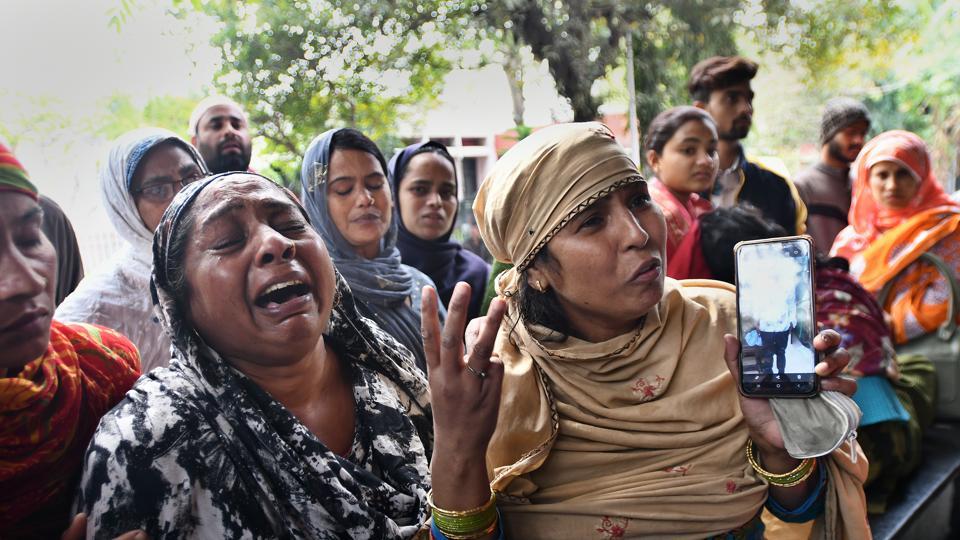
The passage outside GTB hospital’s mortuary is filled with similar tales of horror and despair. Some eyes are still moist with grief for newly lost family members, others whose tears have dried up waiting for the bodies of their loved ones.
A Delhi Police head constable, who did not wish to be named, said that he has been trying to find the family of a man who was charred to death, and all that remains of his body is a part of his leg.
“I had submitted the leg to the hospital for a DNA test. All we know is that it belongs to a man. There might be a family, which is still hoping that their father, brother, or husband is missing, but alive,” he said.
Twenty-year old Dalbir Singh Negi, fondly called Dilbar by his family and employers, came to Delhi six months ago to get “work experience” before applying to the Indian Army. On Monday, when a mob surrounded the bakery where he worked in Shiv Vihar, he was sleeping. He stepped out to see where the noise was coming from, when a mob surrounded him, beat him and hacked his hands and legs. The pieces of his body were then set on fire.
“He wanted to join the Army and had only come here to get a hang of the city life,” Jagat Singh Negi, Dalbir’s uncle said.
Mithilesh Tiwari, 32-year-old Alok Tiwari’s brother, also had to identify his body through clothes and other hints. Alok’s face was so badly bludgeoned that it was hard to identify him.
“At 9pm on Tuesday, Alok went out of the house to buy some essential goods when he was caught by an angry mob and battered to death. He suffered most of injuries on his head and face. We will take the body to his home in Hardoi in Uttar Pradesh,” an inconsolable Tiwari said.
Noor Mohammad, a social worker who lives in Seemapuri, said that though full-blown riots have been controlled, instances of violence continued in areas such as Shiv Vihar and Karawal Nagar till Friday. Late Thursday night, two men identified as Nizamuddin and Riyazuddin, were admitted to hospital after they were thrashed by rioters.
“We are taking turns to stay up all night to ensure that no unruly elements enter our colonies to insight fresh violence. The kind of injuries that have killed people is just horrific. I have seen cases where people have been cut into pieces and charred to death,” said Mohammad.
Out of the total 42 deaths, 28 people were brought dead to the hospital, six bodies recovered from drains. Ten people died at the hospital during treatment.
Among the grieving family members was 30-year-old Farah, whose husband Mohammad Dilshad has not returned home from work since Monday. She was waiting outside the mortuary for two days with her five children; the youngest is just two-months-old.
“I have hope but if he were alive, he would have at least tried to contact us,” said Farah, a resident of Garima Garden. “If the worst happens, I don’t know how I will support my children.”


