
 E-Paper



From selfie sticks to thermal scanner headgear: Delhi Police try to keep Covid-19 away
The police force has been playing a critical part in enforcing the national lockdown norms, manning entries in containment zones, helping transport people and general patients and also maintaining law and order.


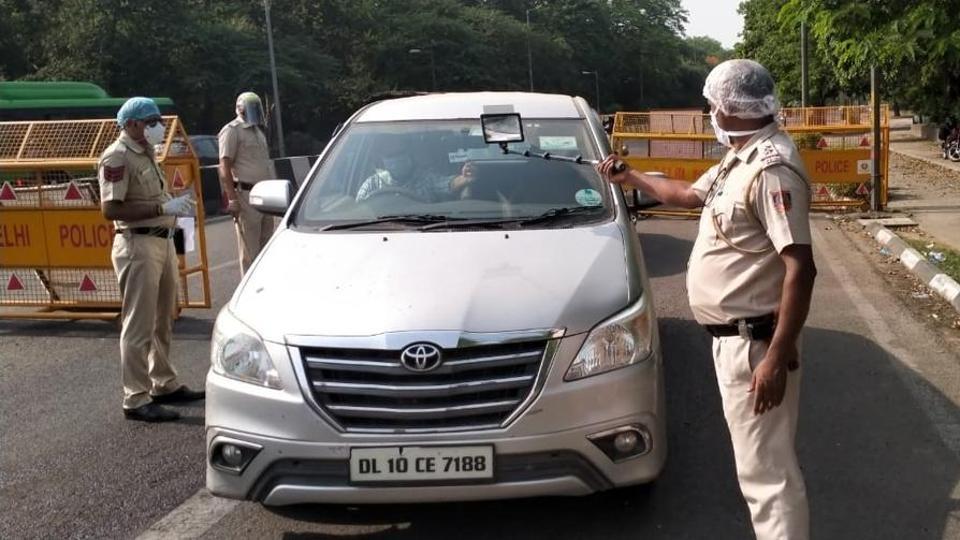
A magnifying glass attached to a selfie stick that can help read documents from a safe distance to a headgear that can scan the temperatures of multiple people from 10 metres way, Delhi Police are using innovative ways to keep its personnel from contracting Covid-19, the viral disease that has killed one policeman and infected at least 110 others in the Capital.
The police are also using hands-free water taps, foot-operated soap dispensers and automatic temperature scanners -- some of which are being sourced from private firms while some others being put together by the police personnel themselves.
The police force has been playing a critical part in enforcing the national lockdown norms, manning entries in containment zones, helping transport people and general patients and also maintaining law and order, which leaves them vulnerable to contracting coronavirus infection.
Last month, the Chandni Mahal police station had to be sealed after eight police personnel deployed there had tested positive. Later, nine personnel from the Sultanpuri police station in outer Delhi too had tested positive. The virus has spared officers of no rank: On Tuesday, an IPS officer and his two staffers had tested positive.
Senior police officers said while some of these devices are already being employed by the personnel deployed on the ground, trials continue on some others. The idea is to minimise contact while performing our duties and staying safe, the officer said.
SELFIE STICK
The first of these improvisions is a selfie stick that has been turned into a “document-checking equipment”. “We fixed a magnifying glass at the end of the stick so that the policemen at pickets can read documents presented by motorists without having to approach the person or touch the documents. We attached an LED light to make it handy even at nights,” said Atul Kumar Thakur, deputy commissioner of police (South).
The improvisation was made by Rahul Gupta, a probationary Indian Police Service officer and an alumni of IIT Delhi. After top police officers inspected the operation of the device, about 50 such equipments were readied and distributed to other police districts, the South DCP said.
SCANNER HEADGEAR
In West Delhi, the police partnered with a private firm to prepare a headgear, similar to a helmet, on which a thermal scanner has been fitted which, the police officers claim, can measure the temperatures of multiple people at a time.
“This device can scan the temperatures from as far as 10 metres, negating the need for the police to approach the public. We have conducted a trial run at a picket in Rajouri Garden. If successful, it can be deployed at supermarkets, mandis and hospitals,” said Deepak Purohit, DCP (West).
Sagar Naugriya, the founder of Indian Robotics Solutions, which has developed the headgear, said it could scan the temperatures of multiple people at once. “If 10 people are captured in the frame of the headgear, it can scan the temperature of each person. It takes about four seconds to test each person’s temperature. The live images can be shared or sent to a centralised control centre,” said Naugriya.
EXPERTS NOT IMPRESSED
Jugal Kishore, director and professor of community medicine at Safdarajang Hospital, said the accuracy of the data provided by the headgear should be put to stringent tests before pressing it in service. He said the headgear will also factor in the temperature of the local environment and the readings has to be precise. “Similar devices used at hospitals haven’t been really effective,” Kishore said.
Prashant Pillai, co-founder of the robotic firm, agreed with the doctor. He said that considering this factor, the mean temperature of a group of people being scanned will be taken first. “If there is deviation of say more than one degree Fahrenheit in any person in that group, apart from those who already have higher temperatures than the body temperature, they’ll be referred for a secondary examination.
“The temperature that our device captures is the elevated body temperature, which is the temperature of the skin. Whereas, doctors test the body temperature. So, a secondary test will be required for those with a high variation from the mean temperature,” said Pillai.
The South district police too are working on an unmanned, static thermal scanner to be installed at police stations. “It will record and store the temperatures of every personnel and visitor arriving at the police stations. It should be ready and in service in a day or two,” DCP Thakur said.
TOUCH-FREE SOAP, WATER
The police in Sangam Vihar sub-division have devised a simple system by which anyone visiting the police station can use their feet to press a spring below a water tank to turn on the tap, and then a similar spring on another side to dispense liquid soap.
“This device works on the hydraulic principle to release water and soap without having to use hands,” said Sudhans Dhama, assistant commissioner of police (Sangam Vihar). Dhama, who devised this system, is an electronic engineering graduate from BITS-Pilani.
In many police stations, the police have also installed standalone hands-free soap dispensers that can be operated by foot .
Doctor Kishore found these “non-touch techniques” more useful. “Such techniques must be developed more and used more widely,” he said.
Across districts, the police are already extensively using drones to keep a watch on neighbourhoods from a safe distance. Some have gone a step ahead to improvise these drones. The Central and South police districts, for example, carry out live announcements using the drone, to the extent of singling out individuals based on the colour of their dresses..

Stay updated with all top Cities including, Bengaluru, Delhi, Mumbai and more across India. Stay informed on the latest happenings in World News along with Delhi Election 2025 and Delhi Election Result 2025 Live, New Delhi Election Result Live, Kalkaji Election Result Live at Hindustan Times.


