
Sign in

MCG sees surge in ad revenue amid crackdown on illegal hoardings

MCG officials revealed that in addition to legal advertisement revenues, penalties imposed on illegal vendors have also contributed to the revenue hike

Updated on: Oct 8, 2024, 07:26:07 IST
Share
Share via
  • facebook
  • twitter
  • linkedin
Copy link
  • copy link

The Municipal Corporation of Gurugram (MCG) has reported a sharp increase in advertisement revenue this year, driven by a rigorous crackdown on illegal hoardings and unlicensed vendors, which thereby boosted the number of ‘outdoor media’ permission fees collected by them, officials said. Around 600 illegal hoardings have been removed in the crackdown so far, they added.
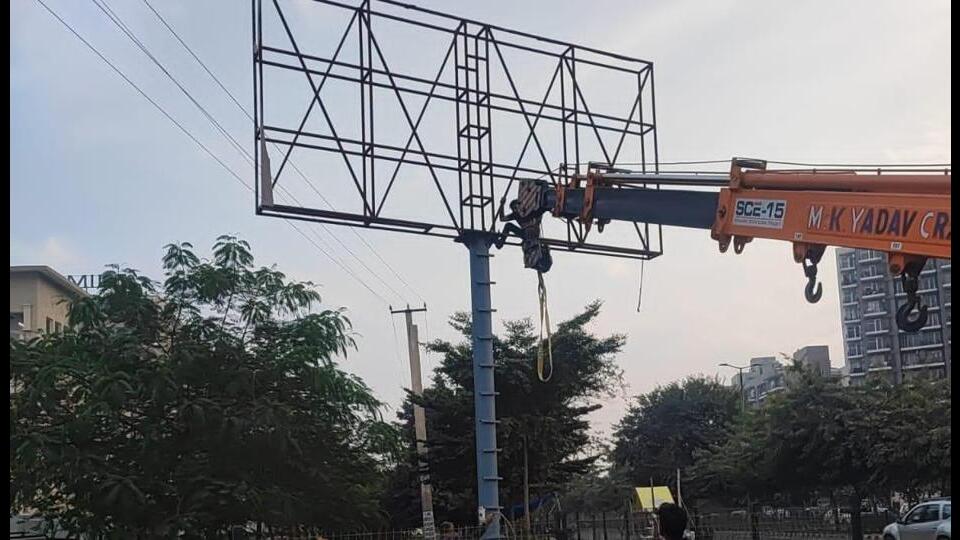
Hoardings being removed alongside Southern Peripheral Road and Dwarka Expressway on Monday (HT Photo)

By September 2024, MCG had already collected ₹61.75 crore in advertisement revenue, surpassing last year’s total of ₹47.40 crore, officials said. Of this, ₹8.81 crore was generated in September alone, they added. MCG officials attribute the rise to stricter enforcement of advertisement regulations and penalties on unauthorised advertisers.

MCG officials revealed that in addition to legal advertisement revenues, penalties imposed on illegal vendors have also contributed to the revenue hike. So far, ₹2.44 crore has been recovered in fines from illegal advertisements up to September 2024, compared to a modest ₹15.95 lakh in 2023.

MCG Commissioner Narhari Singh Bangar attributed the increase in advertisement revenue to the corporation’s proactive measures and removal of illegal advertising structures across the city. “In the last two months alone, we have removed illegal wall wraps around 50 buildings along the highways and dismantled 200 illegal unipoles that displayed unauthorised advertisements. Our enforcement teams have identified the locations of illegal hoardings across the city, primarily on Sohna Road, Golf Course Extension Road, Southern Peripheral Road, and National Highway-48,” said Bangar.

According to the byelaws, any unipole or advertisement within the jurisdiction of MCG must have prior approval, and advertisers are required to pay a prescribed fee by applying online for permission. The MCG has made it clear that unauthorised advertisements are a punishable offence. “Landowners and advertising agencies need to obtain the necessary permissions before installing any unipole or billboard,” Bangar said.

In addition to legal revenue, MCG’s enforcement has also led to a surge in fines on illegal advertisers, officials said. Till September 2024, ₹2.44 crore was recovered from penalties, a steep increase from the ₹15.95 lakh collected in 2023. According to officials, the corporation has intensified its vigilance, registering over 30 cases and removing more than 300 illegal unipoles between January and September. Moving forward, MCG plans to impose penalties on both advertisers and landowners who permit illegal advertisements on their properties under the Haryana Municipal Advertisement Byelaws, 2022, they added.

Despite the crackdown, MCG faces ongoing challenges in maintaining control over illegal hoardings. Sanjeev Kumar Gupta, MCG executive engineer, highlighted the problem of swift reinstallation of unauthorised advertisements. “Often, within hours of removing them, advertisers put up new ads. To counter this, we have deployed teams to patrol the city at random times, including at night, to prevent and monitor these activities,” Gupta explained.

  • Leena Dhankhar
    ABOUT THE AUTHOR
    Leena Dhankhar

    Leena Dhankhar is Senior Editor and Bureau Chief, Gurugram, at Hindustan Times, where she has spent over 17 years chronicling the transformation of one of India's fastest-growing urban regions. From starting her career as a crime reporter to leading the Gurugram bureau, her journalism has been defined by investigative reporting, in-depth storytelling and an unwavering focus on public interest. Over nearly two decades, she has reported extensively across crime, politics, civic governance, elections, real estate, environment, courts, sports, education and entertainment, covering Gurugram, Faridabad, Nuh and Palwal. Her reporting has exposed several major scams and systemic failures, including insurance frauds, waste management irregularities, illegal arms manufacturing units in Nuh, illegal mining in the Aravallis, organised crime networks and governance lapses affecting millions of residents. Known for her investigative work and exclusive stories, Leena has reported on high-impact national issues, including the Nicaragua charter flight carrying Indian migrants that was turned back amid allegations of human trafficking, exposing the growing network of illegal immigration rackets. Her work has also focused on gang wars, prison administration, juvenile crime, women and child protection systems, the functioning of the Juvenile Justice Board and Child Welfare Committee, and environmental challenges such as pollution, waterlogging and deteriorating civic infrastructure. Beyond hard news, Leena has extensively documented Haryana's rich heritage, forests and wildlife, bringing attention to the state's historical landmarks, biodiversity, conservation efforts and ecological challenges through immersive reportage and feature writing. Her journalism has consistently gone beyond breaking news. She has documented Gurugram's rapid urbanisation through long-form narratives and enterprise reporting on issues ranging from pothole-ridden roads, flooding and waste management to the changing social fabric of India's Millennium City. She also writes widely read feature columns, including The Outsider, Changemaker, and Concern for Gurugram, profiling people, places and ideas shaping the city's identity. Leena is the author of Gurugram School Murder, published by Juggernaut Books, a deeply reported account of one of India's most high-profile school murder investigations. She is currently working on her second book, an investigative work exploring some of India's most significant scams and fraud investigations. Beyond print journalism, she has expanded her storytelling through public speaking and digital media. She is a TEDx speaker and has produced podcasts exploring Gurugram's transformation, civic challenges and untold stories. Her work reflects a commitment to narrative journalism that combines rigorous reporting with compelling storytelling. A law graduate with an MBA in Human Resources, Leena brings a multidisciplinary perspective to her reporting, particularly on governance, public policy and legal affairs. She has travelled extensively across India to pursue investigative assignments, often reporting from remote locations and conflict-prone areas in search of stories that matter.Read More