
 E-Paper



Pollution action plan to be enacted in entirety as air quality hovers around ‘severe’ levels
In its sixth meeting on Grap implementation on Monday, the CPCB took the decision taking into consideration the India Meteorological Department’s forecast of northwesterly winds for the next five days, which may lead to a higher contribution of stubble burning to the pollution. The air quality is expected to fluctuate between the ‘severe’ and the higher end of the ‘very poor’ category over the next few days


The city on Monday continued to be engulfed under a blanket of polluted air, recording an air quality index (AQI) of 369 (‘very poor’), even as the Central Pollution Control Board (CPCB) ordered the implementation of the Graded Response Action Plan (Grap) in its entirety, including measures listed under the ‘severe’ air quality.
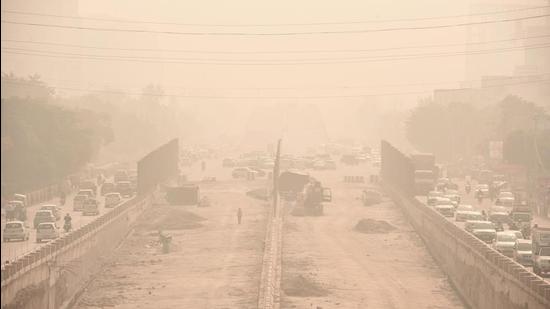
In its sixth meeting on Grap implementation on Monday, the CPCB took the decision taking into consideration the India Meteorological Department’s forecast of northwesterly winds for the next five days, which may lead to a higher contribution of stubble burning to the pollution. The air quality is expected to fluctuate between the ‘severe’ and the higher end of the ‘very poor’ category over the next few days.
In Gurugram, the air quality was in the ‘severe’ category of CPCB’s classification for three days after Diwali. The air quality improved slightly on Monday and reached the ‘very poor’ zone, with PM 2.5 as the prominent pollutant.
The minutes of the CPCB meeting stated, “It was observed that due to sudden and unforeseeable change in meteorological factors, substantially high emissions on account of bursting of firecrackers and other local sources, and high contribution of stubble burning, the air quality of Delhi declined to ‘severe’ category but is in ‘very poor’ category now (on Monday).”
The CPCB ordered 60 agencies in the National Capital Region (NCR), including the Haryana State Pollution Control Board (HSPCB), Municipal Corporation of Gurugram (MCG), Municipal Corporation Faridabad (MCF), deputy commissioner of Gurugram traffic police, chief executive officer Gurugram Metropolitan Development Authority (GMDA), to implement “actions under severe category, in addition to steps listed under very poor and poor to moderate AQI categories” with immediate effect.
S Narayanan, member secretary of Haryana State Pollution Control Board (HSPCB) said that an order for implementing measures under the ‘severe’ category of Grap will be issued and all orders of the CPCB would be followed.
Kuldeep Singh, the regional officer of HSPCB for Gurugram north, said, “In the past three days, since air quality reached ‘severe’ category, we enhanced sprinkling of water and mechanised cleaning of hotspots across Gurugram to control further deterioration of air quality. We have been continuously coordinating with all agencies like district administration, urban local bodies, Haryana Shahari Vikas Pradhikaran and even private agencies, like industrial associations and builders, to implement these activities. All ground staff have also been informed to share pictures along with time and location as soon as they carry out sprinkling of water on roads.”
The actions under ‘severe’ Grap mention increasing the frequency of mechanised cleaning of roads and sprinkling water on roads, identifying road stretches with high dust generation, ensuring that all brick kilns remain closed, as per directions of the National Green Tribunal (NGT), closure of hot mix plants and stone crushers, maximising the generation of power from existing natural gas-based plants to reduce the operation of coal-based power plants and intensifying public transport services, with the introduction of differential rates to encourage off-peak travel.
On Monday, Gurugram also recorded a minimum temperature of 13.9 degrees Celsius (°C), the lowest of the current winter season, while the maximum temperature was 27°C, which was three degrees below normal. Officials said that the normal minimum temperature is 12.6°C.
“This is the first time this season that the minimum temperature has gone below 15°C, which means that we are approaching winter. Over the next three to four days, the minimum temperature will keep reducing gradually by 0.3-0.4°C daily. Due to this, air quality can get impacted. South Haryana might see cloudy skies due to formation of cyclonic circulation over the Bay of Bengal, but it will not rain,” said Manmohan Singh, director of Meteorological Centre Chandigarh.
Stay updated with all the Breaking News and Latest News from Mumbai. Click here for comprehensive coverage of top Cities including Bengaluru, Delhi, Hyderabad, and more across India along with Stay informed on the latest happenings in World News.


