
Sign in

Residents protest MCG’s plan to shift waste disposal site near Dwarka e-way

Last week, MCG announced that it will begin processing waste at Daulatabad to ease the load at the Bandhwari landfill

Updated on: Jul 5, 2024, 06:46:15 IST
Share
Share via
  • facebook
  • twitter
  • linkedin
  • whatsapp
Copy link
  • copy link

A decision by the Municipal Corporation of Gurugram (MCG) to process fresh waste at a site in Daultabad near the Dwarka Expressway has triggered a row, with residents of nearby condominiums protesting against the move and urging the civic body to explore alternative locations for a waste processing facility.
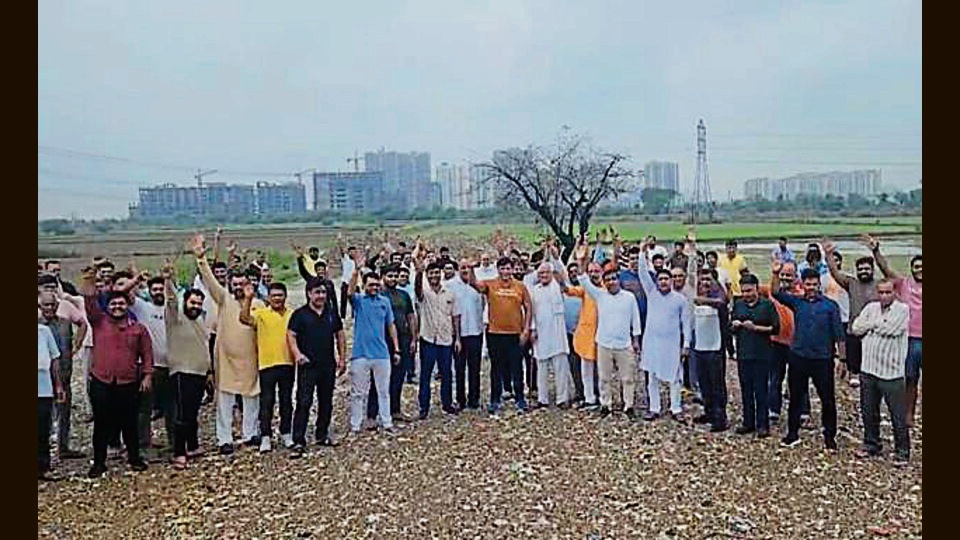
Residents during the protest (HT Photo)

Last week, MCG announced that it will begin processing waste at Daulatabad to ease the load at the Bandhwari landfill, which has long been a source of pollution and health concerns for the locals.

However, on Thursday, residents from at least 30 residential societies along the Dwarka Expressway held a protest against the plan, citing concerns with respect to health, pollution, and groundwater contamination.

“The new waste site will lead to increased pollution, foul odour, and other environmental hazards, degrading the quality of life in the rapidly developing residential hub. We are surprised that MCG has taken a decision to create a garbage dump in the populated zone of Sector 103. This will have a disastrous impact on the environment and on the health of people. I urge the Government to take back this order,” said major general Gajinder Singh of Indiabulls Centrum Park.

Navdeep Singh, a resident of ATS Triumph Sector 104, said that it is grossly irresponsible to establish a centre of pollution surreptitiously. “All societies along the Dwarka Expressway are mandated to be zero-discharge communities, which means that waste from other areas would be unjustly dumped here,” he said.

A group of villagers from Daulatabad said they will not let MCG use the new site for dumping garbage.Sunny Daulatabad, a resident of the village said “We will not allow the MCG to start dumping waste here. This decision poses serious environmental and health risks. We are determined to protect our village.”

Meanwhile, MCG commissioner Narhari Singh Bangar said that finalising on a waste processing facility has become a challenge because whenever they name a proposed site, nearby residents start protesting.

“We are ready to shift the site, but residents should identify the area where it can be shifted to and tell us. We are open to having a discussion on the same,” said Bangar.

MCG joint commissioner Naresh Kumar said their prime focus is to finalise the site by September, as the site is to be handed over to NTPC. “We have tried to set up processing units at many locations, but each time, there was resistance from locals leading to further delays. Currently, we are dumping waste at the Bhandwari landfill but will soon start the new site,” he said.

  • Leena Dhankhar
    ABOUT THE AUTHOR
    Leena Dhankhar

    Leena Dhankhar is Senior Editor and Bureau Chief, Gurugram, at Hindustan Times, where she has spent over 17 years chronicling the transformation of one of India's fastest-growing urban regions. From starting her career as a crime reporter to leading the Gurugram bureau, her journalism has been defined by investigative reporting, in-depth storytelling and an unwavering focus on public interest. Over nearly two decades, she has reported extensively across crime, politics, civic governance, elections, real estate, environment, courts, sports, education and entertainment, covering Gurugram, Faridabad, Nuh and Palwal. Her reporting has exposed several major scams and systemic failures, including insurance frauds, waste management irregularities, illegal arms manufacturing units in Nuh, illegal mining in the Aravallis, organised crime networks and governance lapses affecting millions of residents. Known for her investigative work and exclusive stories, Leena has reported on high-impact national issues, including the Nicaragua charter flight carrying Indian migrants that was turned back amid allegations of human trafficking, exposing the growing network of illegal immigration rackets. Her work has also focused on gang wars, prison administration, juvenile crime, women and child protection systems, the functioning of the Juvenile Justice Board and Child Welfare Committee, and environmental challenges such as pollution, waterlogging and deteriorating civic infrastructure. Beyond hard news, Leena has extensively documented Haryana's rich heritage, forests and wildlife, bringing attention to the state's historical landmarks, biodiversity, conservation efforts and ecological challenges through immersive reportage and feature writing. Her journalism has consistently gone beyond breaking news. She has documented Gurugram's rapid urbanisation through long-form narratives and enterprise reporting on issues ranging from pothole-ridden roads, flooding and waste management to the changing social fabric of India's Millennium City. She also writes widely read feature columns, including The Outsider, Changemaker, and Concern for Gurugram, profiling people, places and ideas shaping the city's identity. Leena is the author of Gurugram School Murder, published by Juggernaut Books, a deeply reported account of one of India's most high-profile school murder investigations. She is currently working on her second book, an investigative work exploring some of India's most significant scams and fraud investigations. Beyond print journalism, she has expanded her storytelling through public speaking and digital media. She is a TEDx speaker and has produced podcasts exploring Gurugram's transformation, civic challenges and untold stories. Her work reflects a commitment to narrative journalism that combines rigorous reporting with compelling storytelling. A law graduate with an MBA in Human Resources, Leena brings a multidisciplinary perspective to her reporting, particularly on governance, public policy and legal affairs. She has travelled extensively across India to pursue investigative assignments, often reporting from remote locations and conflict-prone areas in search of stories that matter.Read More